The Scarlet Pimpernel by Baroness Orczy

I’ve had my copy of The Scarlet Pimpernel for a long time. I can’t remember how long and there is no date in the book – all I know is that it cost 3s 6d and I must have been about 11, 12 or 13 when I first read it. Once I started to read it this time I realised that I remembered very little of the plot, apart from the fact that it’s about the French Revolution and a band of Englishmen, led by the mysterious Scarlet Pimpernel,  rescuing French aristos from the guillotine. No-one knows his identity, the French hate him and are desperate to catch him whilst he is the toast of the British aristocracy – the Prince of Wales describes him to Chauvelin, the agent of the French government, as “the bravest gentlemen in all the world, and we all feel a little proud, Monsieur, when we remember he is an Englishman.”

And I hadn’t forgotten this little verse that that “six foot odd of georgousness as represented by Sir Percy Blakeney, Bart” had composed whilst tying his cravat:

We seek him here,
We seek him there,
Those Frenchies seek him everywhere.
Is he in heaven?
Is he in hell?
That demmed elusive Pimpernel.

Everyone knows that Sir Percy is hopelessly stupid, but he is incredibly rich and as a leader of fashion he is the talk of the town and “his inanities were quoted, his foolish laugh copied by the gilded youth at the Almanack’s or the Mall.” His French wife, Marguerite is by contrast, a clever, witty woman, but she is trapped by Chauvelin into betraying the identity of the Pimpernel. Chauvelin had acquired a letter written by her brother revealing that he was working with the Scarlet Pimpernel – either she finds out who the Pimpernel is or her brother will go to the guillotine.

I wish I could remember whether I guessed the identity of the Scarlet Pimpernel when I first read the book, but I do remember that I loved the romance and the action of this tale based loosely on the French Revolution. I was still spellbound by the romance and drama of it all. I’ve discovered that it start out as a play, starring Fred Terry (the brother of Dame Ellen Terry and great-uncle of Sir John Gielgud) as the Scarlet Pimpernel. There have been many films of the book and the role of the Scarlet Pimpernel has been played by many actors on stage and screen including Leslie Howard, Anthony Andrews, and Richard E Grant. Amazingly I have never seen any of them, so my mental vision of the characters is drawn straight from the book, which is what I prefer.

 I re-read this book as part of the Heart of a Child Challenge. It also qualifies for the What’s In a Name Challenge as a book with a plant in the title, because the Scarlet Pimpernel is not only the nickname of the hero but it is also the symbol with which he signs his messages.


 

The Sunday Salon

Sunday SalonLast August I read The House at Riverton by Kate Morton and thought it was one of the best books I’d read in 2007. So it was with great anticipation that I started to read The Forgotten Garden. It starts off well, with a little girl in London in 1913 on a boat bound for Australia. The lady who took her to the boat has disappeared and the little girl is found alone on the Maryborough wharf, with no name and no family. All she can remember is that the name of the lady is the Authoress and she has a little white suitcase containing a book of fairy stories written by the lady.

The Forgotten Garden

The novel is about three women – Eliza, Nell and Cassandra and follows their lives from 1900 to 2005. Nell is the little girl in the opening chapter and the book reveals the story of her birth. Of course it’s not just as simple as that – there are several mysteries in this long book. It’s quite easy to read once you have got used to jumping from England in 1913 to Australia in 2005, and in and out of the 1930s and 1975 in both countries and back again to 2005 in England and Australia and sorting out the characters of the three women.

I was enjoying it and then I realised that I was reading a re-working of The Secret Garden, as Eliza is taken as a child of twelve to live with her aunt and uncle at Blackhurst Manor in Cornwall, just as Mary is taken to live with her uncle at Misselthwaite Manor on the Yorkshire Moors, both houses in isolated places, both girls finding it difficult to fit into their new surroundings, both with maids who help them settle in, both with walled gardens and secrets to be discovered. Even down to both having sickly cousins who stay in their rooms.

I was so disappointed that I stopped reading the book! But I picked it up again the next day and carried on. I worked out the ‘mystery’ quite easily and found the book rather predictable, which was also disappointing. Nell attempts to find out the truth about her parents and in 1975 travels to England, eventually finding Blackhurst Manor where the Mountrachet family used to live. After her death in 2005, Cassandra her granddaughter discovers she has been left a surprise inheritance, Cliff Cottage and its forgotten garden in Cornwall, now derelict.

It wasn’t just the predictability of the story I found a let down, I also had difficulty picturing the settings and working out the locations of the cottage, its garden, the maze and Blackhurst Manor even though I re-read their descriptions several times.

I read this book whilst on my recent travels along with The Other Side of You by Salley Vickers, which I also found a bit disappointing – more about that some other time maybe. Other reading this week has been more enjoyable with The Fall of Troy by Peter Ackroyd and Wessex Tales by Thomas Hardy. I also finished reading The Prime of Miss Jean Brodie by Muriel Spark. I first read this about 10 years ago and was a bit worried that I would find it a let down on re-reading it, but thankfully I thoroughly enjoyed it. It’s the next book up for discussion on Cornflower’s Blog on 12 July. For once I’ve read the book well in advance.

I’m also re-reading The Scarlet Pimpernel by Baroness Orczy for the Heart of a Child Challenge. A tale of the French Revolution, a time of terror and tension as the dashing Englishman rescues French aristos destined to death by guillotine. I loved this book as a child and so far it’s living up to my expectations.

Reading Summary 1 January – 30 June 2008

It’s hard to believe that it’s now July – half the year has gone by in the blink of an eye – or in the time it has taken to read 44 books. The full list is here. This time last year I had read 52 books, so either I’m not reading as much, or as quickly, or the books are longer/more detailed. Anyway, of these 44 books, 36 are fiction and 8 are non-fiction. Month by month totals are:

  • Jan: 7
  • Feb: 9
  • March: 5
  • April: 7
  • May: 7
  • June: 9

Best reads are:

Clicking on the titles takes you to my thoughts on each book.

Overall, so far, the best book has to be Our Longest Days with Half of a Yellow Sun a close second.

I’ve participated in several reading challenges:

Celebrate the Author. The challenge is to read a book each month by an author who celebrates a birthday in that month. From January to May I succeeded and read books by

  • Virginia Woolf –The Death of the Moth and Other Essays – see here
  • Paul Auster – The Book of Illusions – see here
  • Robert Frost – see here
  • Ian Rankin – A Good Hanging – see here
  • Margaret Forster – Keeping the World Away – see here

June’s author was to have been Orhan Pamuk or Thomas Hardy but I didn’t read anything by either of these authors – maybe I’ll catch up in July. July’s author is either Alexander Dumas or Joanne Harris. I have a feeling it will be Joanne Harris as I have both Chocolat and The Lollipop Shoes, which I have been meaning to read for ages.

The Chunkster Challenge. This challenge is to read at least 4 books of over 450 pages. So far I’ve read three:

  • The Book Thief by Markus Zusak (584 pages) See here.
  • Winter In Madrid, C J Sansom (530 pages) See here.
  • Revelation by C J Sansom (546 pages). See here.

I’m also aiming to read:

  • The Meaning of Night by Michael Cox (598 pages)
  • The Needle in the Blood by Sarah Bower (575 pages)
  • Cloud Atlas by David Mitchell (529 pages) 

Heart of a Child Challenge. The challenge is to read 3 to 6 books by July 14, 2008 that you discovered, loved or adored as a child. So far I’ve read two – Mr Blossom’s Shop by Barbara Euphan Todd, see here and The Secret Garden by Frances Hodgson Burnett, see here. I’ll be reading one of these in the next two weeks to complete the challenge.

  • What Katy Did and What Katy Did Next by Susan Coolidge
  • Heidi by Johanna Spyri and Heidi Grows Up and Heidi’s Children by Charles Tritten
  • The Scarlet Pimpernel by Baroness Orczy
  • The Gloriet Tower by Eileen Meyler 

What’s In a Name Challenge. This challenge ends in December and is to read one book in each of the categories. So far I’ve read three out of the six as follows:

  • A book with a colour in the title: Half a Yellow Sun, Chimamanda Ngozi Adichie – see here
  • A book with an animal in its title: The Tenderness of Wolves, Stef Penney
  • A book with a first name in its title: Daniel Isn’t Talking, Marti Leimbach – see here
  • A book with a place in its title: Winter in Madrid, C J Sansom – see here
  • A book with a weather event in its title: Snow, Orhan Pamuk
  • A book with a plant in its title: Gem Squash Tokoloshe, Rachel Zadok

Soup’s On Challenge. Challenge is to select six cookbooks to read (enough to give an overview of the book) and make at least one of the recipes. See here. So far I’ve read After Work – see here and Toast by Nigel Slater – see here.

Once Upon a Time Challenge. This challenge ended in June. I didn’t manage to complete it and only read John Wyndham’s The Chrysalids – see here.

The Pulitzer Project. This is an open ended project. The goal is to read all 81 books that have won the Pulitzer Prize for Fiction. This year I’ve read The Shipping News by Annie Proulx, the winner in 1994 – see here.

Once Upon a Time Challenge II

This Challenge has now ended.  My aim was to complete ‘œQuest the First” – to read at least 5 books of fantasy, or folklore, or fairy tales, or mythology’¦.

I decided to choose books were already on my to-be-read list and sadly they’re still there, with the one exception of The Chrysalids by John Wyndham, which I read and wrote about – see here. This is a book that I have owned for years, so I’m really pleased I’ve read it. The other books are still waiting and I will read them – sooner or later.


  • Dante’™s Descent into Hell, translated by Dorothy L Sayers. I’ve started this.
  • The Gormenghast Trilogy by Mervyn Peake. I have actually read these books, but it was so long ago that I’ve nearly forgotten the story.
  • Cloud Atlas by David Mitchell. This is one that I’ve started twice and put back on the shelf.
  • Star Wars by George Lucas. Will this be like the TV series/films?
  • Helen of Troy by Margaret George. I must read this soon!

The Book Thief by Markus Zusak

The Book Thief

I was not that keen on reading The Book Thief when I first heard about it. One reason, and this is quite contrary of me, I know, is that people were raving about it and that always makes me wonder whether a book can really live up to its reputation. The other reason was that I had the impression it was about the Holocaust, concentration camps and the Nazi persecution of the Jews and I would find it too heart-rending. Then I gave in and thought I’d better read it to see what all the fuss was about. It had been sitting on the book shelves unopened ever since I bought it until it was chosen as the next book to read in Cornflower‘s on-line book group.

Death is the narrator of the book. Oddly enough, I became fond of this character, Death, as the story progressed. Death is compassionate, commenting on man’s inhumanity to man and he is very overworked. The action takes place in Nazi Germany and there are some very moving, tense and emotional scenes. Overall though, the book is about ordinary German people and their experiences during the war, their reaction to the Fuhrer and their efforts to help their Jewish friends and acquaintances. As I was reading about how they survived during the air raids I was comparing it to how the British also coped as described in Our Longest Days. As you would expect, it was much the same. People in both countries suffered.

The “book thief” is Liesel Meminger who is nine at the start of the book in 1939. On her way to live with foster parents, Rosa and Hans Hubermann, she witnesses the death and burial of her brother and finds “The GraveDiggers Handbook”. This is the first book that became very important to Liesel. Her love of words leads to her acquiring more books with the help of her friend, Rudy. She steals a book from the Nazi book-burning fires and from the local mayor’s library, with the assistance of the mayor’s wife. The danger increases for Liesel and the Hubermanns when they shelter a young Jew, Max Vanderburg, in their basement. Liesel’s relationships with Rudy, Hans and Max are central to the story, as Death almost seems to stalk them. Terrible things happen in this book; the Nazis and the Hitler Youth Movement cast their sinister shadow, the people are starving, Jews are persecuted, people are whipped for helping them, and towns and cities are bombed and devastated.

Although this is a long book I read it very quickly; it is an easy book to read. The language is simple and straight forward. Some of the sentences are very short, almost staccato and fragmentary: “Door open, door shut. Alone again.” “The food.” “The carrots.” “I know. You know.” This jarred on me a bit but I suppose that writing like this does make the book easier to read and I was able to read it in just a few sessions. Still, I thought it was a disturbing, unsettling book and I found myself reading it completely absorbed in the story.

It also made me think of The Diary of Anne Frank, which she wrote whilst in hiding for two years with her family during the Nazi occupation of the Netherlands. Her family was apprehended in 1944 and Anne Frank ultimately died of typhus in the Bergen-Belsen concentration camp. This is a heartbreaking account. If you haven’t read it you really must!

Food, Glorious Food

Nigel Slater’s Toast is the story of his childhood and adolescence told through food; food he liked and food he hated. Reading it was a nostalgic remembrance of my childhood, even though mine was so very different from his, apart from the food. My mother, unlike his, was a good cook, but she did stick to recipes she knew and we had the same meals each week. She cooked English food, so meals such as spaghetti bolognese were not on the menu in our house. The only spaghetti we ate was out of a tin. Nigel’s description of the first and only time his family cooked and tried to eat spaghetti is hilarious – “the slithery lengths of spaghetti” escaped through the holes in the colander and curled “up in the sink like nests of worms”. His Aunt Fanny thought she was being poisoned and the smell of the Parmesan cheese turned their stomachs.

Toast is not at all like his Kitchen Diaries; there are no recipes, although you could make trifle from his description of his father’s sherry trifle, made with bought Swiss Roll, tinned peaches, jelly, custard and cream, the success of which depended upon the noise it made when the first spoonful was lifted out:

The resulting noise, a sort of squelch-fart, was like a message from God. A silent trifle was a bad omen. The louder the trifle parped, the better Christmas would be.

Contrast this trifle with “Nigel’s Delightful Trifle” in his Kitchen Diaries made with sponge cake, eggs, sugar, mascarpone cheese, vanilla extract, cream and blackcurrants. The cream and marscapone are whipped together and spooned on top of the trifle in “deep, billowing folds”, chilled and then topped with more fresh blackcurrants and crystallised violets.

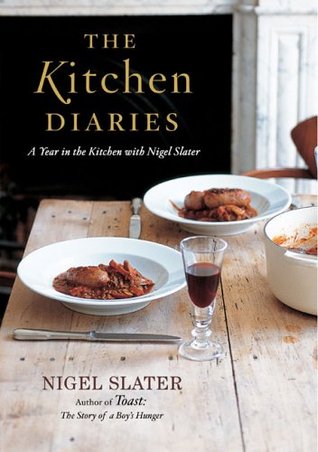
Kitchen Diaries is an account of more or less everything Nigel cooked in the course of a year, presented as an illustrated diary. The photographs are sublime, and they are done in ‘real time’; they are photos of the food he cooked and ate on that day.The book follows the seasons so you can find suggestions about what is worth eating and when – a book to dip into throughout the year and for years to come. There are recipes for Onion Soup Without Tears, Thyme and Feta Lamb, Roast Tomatoes with Anchovy and Basil, Mushroom Pappardella, Stilton, Onion and Potato Pie and many many more.

In Toast Nigel charts his way through childhood with descriptions of toast, cakes, puddings, jam tarts, pancakes, sweets and toffee, tinned ham, lamb chops – you name it and it’s in this book. It’s not just food he liked but also food he detested, in particular milk and eggs. I felt so sorry for him after reading of the way his teacher made him drink his school milk. How it brought back memories of that warm milk we had each day at school – warm because the bottles had been kept standing in the crate in the sun and the cream sat in a thick layer at the top of the bottle! I hated it too.

It’s a very frank book about a young boy’s feelings and a teenager’s sexual experiences, and his relationship with his mother whom he loved, and his father who sometimes scared him. It’s both funny and sad, unsettling and moving; the pathos when his mother no longer makes the mashed potao he loves, but gives him Cadbury’s Smash,

grainy and salty, wet but possessed of a dry, almost powdery feel in the mouth. ‘The mash tastes funny, Mummy.’ Quietly but firmly, in a tone heavy with total and utter exasperation, and with a distant rasp after the first word, she said, ‘Nigel … Just eat it.’ 

I read it quickly, almost devouring it, enjoying the remembrance of food of times past. There is so much in the book that I’m tempted to make a food index to go with it – here’s just a few I could name –

Arctic Roll, Banana Custard, Crumpets, Damson Jam, Eggs (Scrambled), Flapjack, Grilled Grapefruit, Haddock (smoked), Ice Cream, Jelly, Kraft Cheese Slices, Lemon Drops, Marshmallows, Nestle’s (pronounced Nessles) Condensed Milk, Oxtail Soup (tinned), Prawn Cocktail, Quick-Gel, Rabbit, Spinach, Tapioca, Victoria Sandwich, and Walnut Whips (my favourites).

Toast is the winner of six literary awards, including the National Book Awards British Biography of the Year. I love Nigel Slater’s TV series A Taste of My Life and I’ve just discovered he’s written another book – Eating For England: the delignts and eccentricities of the British at Table – I must read that!

An entry in the Soup’s On Challenge.