August Prompt – A Classics Challenge

This year I am taking part in a Classics Challenge hosted by Katherine of November’s Autumn. The goal is to read at least seven classics in 2012 and every month Katherine is posting a prompt to help us discuss the books we are reading. This month we are asked to share some quotes from our current read.
Rather than a questions August’s prompt is to share a memorable
Quote… or a few of them from what you’re currently reading. Try to select ones that are not so well-known but, of course, if you can’t help yourself share it too!

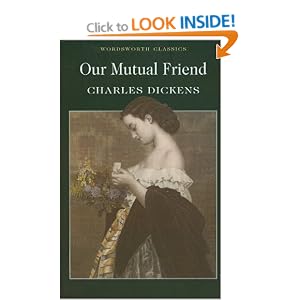
This month I’ve been reading Our Mutual Friend by Charles Dickens. There are many passages I could quote. Here are just a few:

“Has a dead man any use for money? Is it possible for a dead man to have money? What world does a dead man belong to? ‘Tother world. What world does money belong to? This world. Can a corpse own it, want it, spend it, claim it, miss it,? Don’t try to go confounding the rights and wrong of things in that way. But it’s worthy of the sneaking spirit that robs a live man.” (page 6)

“No one who can read, ever looks at a book, even unopened on a shelf, like one who cannot.” (page 18)

“And this is the eternal law. For, Evil often stops short at itself and dies with the doer of it! but Good, never. (page 95)

“I have made up my mind that I must have money, Pa. I feel that I can’t beg it, borrow it, or steal it; and so I have resolved that I must marry it.” (page 302)

“This reminds me, godmother, to ask you a serious question. You are as wise as wise can be (having been brought up by the fairies), and you can tell me this: Is it better to have had a good thing and lost it, or never to have had it?” (page 410)

“And Oh! there are days in this life, worth life and worth death. And Oh, what a bright old song it is, that Oh, ’tis love, ’tis love, ’tis love, that makes the world go round!” (page 636) (From a popular song usually sung to the French tune ‘C’est l’amour’.)

Crime Fiction Alphabet: L is for …

Lord Edgware Dies by Agatha Christie. This was first published in the UK in 1933 and later the same year in the USA as Thirteen for Dinner. It’s the eighth book featuring Hercule Poirot, narrated by Captain Hastings. Agatha Christie had written it in the autumn of 1931 at her house in Ninevah, whilst with her husband, Max Malloran on his expedition in the Middle East sponsored by the British Museum.

Lord Edgware Dies is set far from Ninevah, in London’s West End. Poirot is having supper at the Savoy with Hastings after they had been to the theatre to see the celebrated American impressionist, Carlotta Adams. At the next table is Jane Wilkinson, Lady Edgware, also a celebrated actress, who Carlotta had impersonated during her show. Jane implores Poirot to help her to ‘get rid of her husband’ – to convince him to agree to a divorce. Poirot agrees to go and see Lord Edgware. Much to Poirot’s surprise, Lord Edgware readily agrees to a divorce, but as Poirot and Hastings leave the house, Hastings is surprised to see an astonishing change in Lord Edgware’s face:

That suave smiling face was transformed. The lips were drawn back from the teeth in a snarl, the eyes were alive with fury and an almost insane rage. (page 33 0f my copy)

The next morning Lord Edgware was found dead, stabbed in the back of the neck. Jane was seen at the house the night before, but there are witnesses who can testify that she was at a dinner party with twelve other guests.  Could Jane have been in two places at once and killed him? She had boasted to her friends that if Poirot couldn’t help her that she would

‘have to call a taxi to go round and bump him off myself. (page 17)

Or was it Carlotta Adams impersonating Jane?

It’s not a simple mystery and there is a second murder which complicates matters. Poirot is at his best, relying on his knowledge of psychology, the ‘employment of the little grey cells‘, which gives him such mental pleasure. There are small personal touches such as this where Poirot compares his moustache to that of Hastings in this conversation between the two of them:

‘You have made a hit, Poirot. The fair Lady Edgware can hardly take her eyes off you.’

‘Doubtless she had been informed of my identity’, said Poirot, trying to look modest and failing.

‘I think it is the famous moustaches’, I said. ‘She is carried away by their beauty.’

Poirot caressed them surreptitiously.

‘It is true that they are unique,’ he admitted. ‘Oh, my friend, the ‘tooth-brush’ as you call it, that you wear – it is a horror – an atrocity – a wilful stunting of the bounties of nature. Abandon it, my friend, I pray of you.’ (pages 12-13)

Yet again, another baffling case solved by Hercule Poirot – a very entertaining book.

The Crime Fiction Alphabet 2012 is a meme hosted by Kerrie at Mysteries in Paradise.

Classics Challenge 2012 – July Prompt

This year I am taking part in A Classics Challenge hosted by Katherine of November’s Autumn. The goal is to read at least seven classics in 2012 and every month Katherine is posting a prompt to help us discuss the books we are reading. July’s prompt is about

Lasting Impressions

Choose one of the Classics you’ve read this year or are currently reading.

What is a moment, quote, or character that you feel will stay with you? Years from now, when some of the details have faded, that lasting impression the book has left you with? What is it? –or why did it fail to leave an impression?

I wondered which classic to choose for this post, but I knew the answer as soon as I read the the words ‘lasting impressions’ had to be either Pride and Prejudice or A Tale of Two Cities. Both of these are books I first read when I was a teenager, so I know the lasting impressions they have made on me, both the characters and lots of quotations. How could I ever forget Elizabeth Bennet and Mr Darcy, or Charles Darnay and the wonderful Sydney Carton? And the opening sentences of both are so memorable.

From Pride and Prejudice:

It is a truth universally acknowledged, that a single man in possession of a good fortune, must be in want of a wife.

and from A Tale of Two Cities:

It was the best of times, it was the worst of times, it was the age of wisdom, it was the age of foolishness, it was the epoch of belief, it was the epoch of incredulity, it was the season of Light, it was the season of Darkness, it was the spring of hope, it was the winter of despair, we had everything before us, we had nothing before us, we were all going direct to Heaven, we were all going direct the other way.

Whereas I’ve read  Pride and Prejudice several times I’d only ever read A Tale of Two Cities once before and my memory of it was that it was about the French Revolution and the sacrifice that Sydney Carton made to save Charles Darnay from the Guillotine, with these words, which close the book:

It is a far, far better thing that I do, than I have ever done; it is a far, far better rest that I go to than I have ever known.

Reading the book this time round the character of Sydney Carton is much clearer in my mind, with several vivid images of his slovenly appearance and drunken behaviour. He is in fact a brilliant barrister, but also an alcoholic, lacking self confidence. He is called a ‘jackal‘, who worked for his fellow barrister, Stryver, who then got the credit.

Sydney Carton, idlest and most unpromising of men, was Stryver’s great ally. What the two drank together, between Hilary Term and Michaelmas, might have floated a king’s ship. Stryver never had a case in hand, anywhere, but Carton was there, with his hands in his pockets, staring at the ceiling of the court; they went to the same Circuit, and even there they prolonged their usual orgies late into the night, and Carton was rumoured to be seen at broad day, going home stealthily and unsteadily to his lodgings, like a dissipated cat. At last, it began to get about, among such as were interested in the matter, that although Sydney Carton would never be a lion, he was an amazingly good jackal, and that he rendered suit and service to Stryver in that humble capacity.

To help him overcome his drunkenness he soaked towels in a bowl of cold water and after wringing them out folded them on his head, and whilst working continued drinking wine, brandy and rum with sugar and lemons.

Two or three times, the matter in hand became so knotty, that the jackal found it imperative on him to get up, and steep his towels anew. From these pilgrimages to the jug and basin he returned with such eccentricities of damp headgear as no words can describe; which were made the more ludicrous by his anxious gravity.

He is moody and morose, and when he falls in love with Lucie Manette, he realises he is a wastrel, a ‘drunken, poor creature‘, that she can never return his love and that he can only ever bring her to misery, sorrow and repentance, blight and disgrace her, pulling him down with himself. 

It is Carton’s resemblance to Charles Darnay that enables him to martyr himself in Darnay’s place because of his love for Lucie. It is these two images that will remain with me – that of the dissolute man, who despite his drunkenness, worked though the night with his head wrapped in damp towels, and the man as he approached his death on the Guillotine with:

… the peacefullest man’s face ever beheld there. Many added that he looked sublime and prophetic.

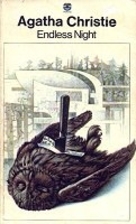
Crime Fiction Alphabet: Letter E

Endless Night (Agatha Christie Collection)…

Endless Night by Agatha Christie was first published in 1967.

She usually spent three to four months writing a book, but she wrote Endless Night in six weeks. It differs from most of her other books in that it is a psychological study. In fact it reminded me very much of Ruth Rendell’s books, writing as Barbara Vine. It has the same suffocating air of menace throughout the book, with more than one twist at the end.

The title comes from William Blake’s Auguries of Innocence:

Every Night and every Morn
Some to Misery are born.
Every Morn and every Night
Some are born to Sweet Delight.
Some are born to Sweet Delight,
Some are born to Endless Night.

It’s hard to write about this book without identifying the murderer.  Don’t read the Wikipedia entry if you don’t want to know,  as that gives it away completely.

The narrator is Michael Rogers, a young man with grand ideas who’d had many jobs and not enough money to buy everything he wanted. He longs for a fine, beautiful house designed by his architect friend, Santonix and after seeing the Sale Notice of ‘The Towers’ and its land, known locally as ‘Gipsy’s Acre’, he dreams that he would live there with the girl that he loved.

His dreams come true when he meets and falls in love with Ellie, an American heiress. They marry when she reaches 21 and she buys the ‘The Towers’ . Santonix designs and builds them a new, modern house and they live there – but not happily ever after because ‘Gipsy’s Acre’  is said to be cursed. Indeed, old Mrs Lee, who tells fortunes and prophesies the future warns Ellie:

‘I’m telling you my pretty. I’m warning you. You can have a happy life – but you must avoid danger. Don’t come to a place where there’s danger or where there’s a curse. Go away where you’re loved and taken care of and looked after.  You’ve got to keep yourself safe. Remember that. Otherwise -otherwise- ‘ she gave a short shiver. I don’t like to see it, I don’t like to see what’s in your hand. (pages 32-3)

It’s Michael  who dominates the book, with his aspirations, his determination to get what he wants, his optimism and also his difficult relationship with his mother, his inability to get along with Ellie’s family and her companion, Greta, who Michael thinks has an undue influence on her.There is little or no detection, and no investigators – no Poirot or Miss Marple – to highlight the clues to the murders, for there are several.

I read Endless Night very quickly and easily, convinced of the characters and the locations. But thinking about it now I can see that it’s deceptively easy to read and I read it too quickly, hardly taking in hints and clues along the way, although I did begin to sense who the murderer was. It’s a study of avarice, of the effect of the pursuit of wealth, of the restless desire to possess. It’s also about evil, love, hate and desire – and ‘endless night’ is a terrible fate.

Classics Challenge: May Prompt – Literary Movement

This month’s topic in the Classics Challenge is about literary movement and where the book you’re reading fits within the movement.

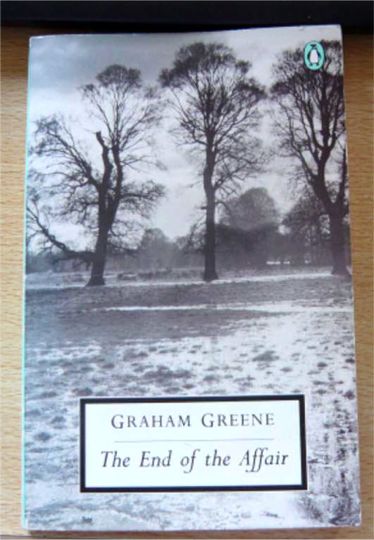
the end of the affair

I’ve recently read Graham Greene’s The End of the Affair, published by Penguin as one of the Twentieth Century Classics. It was originally published in 1951.

It’s very difficult, or at least I think it is, to place this book within a ‘literary movement’. I’m not the only one because William Golding wrote:

Graham Greene was in a class by himself  – He will be read and remembered as the ultimate twentieth-century chronicler of consciousness and anxiety.’ 

So maybe he fits into the ‘stream of conciousness’ movement, because The End of the Affair is full of Maurice Bendrix’s thoughts and feelings, but I don’t think it’s quite that. It moves backwards in time recollecting past events, but it certainly reveals what is going on in Maurice’s mind.

Maurice’s love affair with his friend’s wife, Sarah, had begun in 1944 during the London Blitz. They had met at a party held by Sarah’s husband, Henry. The affair had ended suddenly after his house had been bombed by a V1 and Sarah had not explained why. Two years later Maurice, still obsessed by Sarah employed Parkis, a private detective to find out the truth. So it’s maybe a romantic novel, inspired by Greene’s affair with a married woman ‘C’ (Lady Catherine Walston), but then again, maybe not. The story is narrated by Maurice but includes his reading of Sarah’s diary, which reveals her increasing fascination with religion, specifically with Catholicism. Some describe The End of the Affair as the last of Greene’s Catholic Novels (the others being Brighton Rock, The Power and the Glory and The Heart of the Matter), but Greene didn’t like that label. Nevertheless, The End of the Affair is a study of love and hate, of desire, of jealousy, of pain, of faithfulness, and of the interaction between God and people.

At the beginning Maurice states that: ‘this is a record of hate, far more than of love’. He struggles to believe in God and is full of desperation and anger. He is tormented by his efforts to understand:

But I don’t want Your peace and I don’t want Your love. I wanted something very simple and very easy: I wanted Sarah for a lifetime and You took her away. With Your great schemes You ruin our happiness like a harvester ruins a mouse’s nest: I hate You, God, I hate You as though You existed. (page 191)

It’s a powerful novel that, for me, defies being categorised. Emotional, passionate and intense it’s a  dark and compelling book, with more emphasis on character than on plot. God, whether the characters believe in ‘him’ or not, has a major part. I knew before I read this book that Greene was a convert to Roman Catholicism, but the doubts about belief and the depth of criticism of Christianity both surprised and interested me, more than the question of the affair.

Here’s a selection of passages that I noted as I read:

  • Maurice is in Henry’s study, a room Maurice feels Henry never uses: ‘I doubted whether the set of Gibbon had once been opened, and the set of Scott was only there because it had – probably – belonged to his father, like the bronze copy of the Discus Thrower. And yet he was happier in his unused room simply because it was his: his possession. I thought with bitterness and envy: if one possesses a thing securely, one need never use it.’ (page 13) How true is that I wondered? – to me the unread books on my shelves are less my own than the read books.
  • Maurice is a novelist. Throughout the book he ponders on the nature of writing, characterisation and so on. In this passage he considers his habits of working and he effects outside events have on his ability to write, listing all the obstacles that had never affected him before, concluding that: So long as one is happy one can endure any discipline: it was unhappiness that broke down the habits of work.  (pages 34-5)
  • I wondered how much of this novel is autobiographical – not just the affair, but Maurice’s own character and beliefs seem to be based on Greene’s own life and personality. Maybe that’s an unfair assumption, but I do think it’s true for his passages on writing. Another passage reveals: ‘So much of a novelist’s writing, as I have said, takes place in the unconscious: in those depths the last word is written before the first word appears on paper. We remember the details of our story, we do not invent them.’ (page 35)
  • And on the existence of God/Devil: ‘I have never understood why people who can swallow the enormous improbability of a personal God boggle at a personal Devil. I have known so intimately the way that demon works in my imagination.’ (page 59)

I can’t say that I enjoyed this novel, but it is well written, full of ideas and questions packed within its pages – a tragedy about conflict and doubt.

A Place of Greater Safety by Hilary Mantel: a Book Review

Given a choice of reading one long book or several shorter books, in the past I’ve always gone for the long book, as I like to got lost in a book, but more recently I’ve preferred shorter books. So this is the reason that Hilary Mantel’s A Place of Greater Safety has sat on my bookshelves unread for a few years. It took me over a month to read it and I did pause for a while to read other shorter books in between. And this book is certainly a book that takes you to another time and place.

It is a remarkable book about the French Revolution concentrating on three of the revolutionaries – Georges-Jacques Danton, Camille Desmoulins and Maximilian Robespierre, from their childhoods to their deaths. Along with these three main characters there is a whole host of characters and without the cast list at the beginning of the book I would have struggled to keep track of them. In fact, some of the lesser characters were just names to me and I never saw them clearly, but that didn’t surprise or deter me, given the enormity of the task of chronicling the events of the French Revolution.

But the main characters stand out and there are also vivid portraits of such people as Mirabeau (a renegade aristocrat), Lafayette (a general in the American Revolutionary War and a Commander of the French National Guard), Louis XVI and Marie Antoinette. I was also fascinated to read about Jean-Paul Marat  (he who was murdered in his bath), the Marquis de Sade and Pierre de Laclos (Les Liaisons Dangereuse) – I didn’t know anything about de Sade’s and de Laclos’s involvement in the Revolution.

My European History at school stopped at 1789, so although I remembered listing the causes of the Revolution and the events that led up to it, my knowledge of the main event, as it were, is patchy and incomplete, mainly gathered from books such as A Tale of Two Cities and TV programmes over the years. I found the first part of A Place of Greater Safety covered much of the ground that I was familiar with, but seen through the eyes of the three main characters as they grew up.

Despite Mantel’s insight into the personal lives and characters of the three main protagonists I never really sympathised with any of them – after all they were responsible for the deaths of many people, including their own friends and played a major part in the Reign of Terror. But at times I was drawn into hoping that they would escape their fate – they were all guillotined. They were all lawyers who grew up in the provinces, knew each from their youth and moved to Paris.

Camille Desmoulins is perhaps the star of the book. It was he who instigated the storming of the Bastille. He was by all accounts a charismatic character, despite his stutter. He and Danton lived close to each other, and Danton, a large, loud and ugly man who had the power of captivating his audiences, had a liaison with Lucille, Camille’s wife. Robespierre was a much cooler character and his involvement in the Terror (in which many people lost their heads) was chilling. But even he came over under Mantel’s pen as almost a likeable human being, revealing his weaknesses as well as his power. As long as he could he shielded Danton and Camille as opposition to them grew.

Unlike Wolf Hall, this book isn’t written in the first person, but it moves between the first and third person points of view, giving an almost panoramic view of the characters and their attitudes to the Revolution. It really is written in a most diverse style, moving between locations, characters and even tense. There are also passages written as script-style dialogue, passages from recorded speeches and pamphlets, ‘woven’ into Mantel’s own dialogue. She writes in her Author’s Note that this is not an impartial account and she has tried to see the world as her characters saw it, so where she could she used their own words.

The events of this book are complicated, so the need to dramatize and the need to explain must be set against each other. …

I am very conscious that a novel is a co-operative effort, a joint venture between writer and reader. I purvey my own version of events, but facts change according to your viewpoint. …

I have tried to write a novel that gives the reader scope to change opinions, change sympathies: a book that one can think and live inside. The reader may ask how to tell fact from fiction. A rough guide: anything that seems particularly unlikely is probably true. (pages ix-x)

I think, for me, that Hilary Mantel succeeded with this book. I have struggled reading other books written in the present tense, but either I’m getting more used to it, or Hilary Mantel’s style has won me over. Either way, reading this book and Wolf Hall has been a pleasure – ‘real journeys’ into other times and places.

  • Paperback: 880 pages
  • Publisher: Fourth Estate; (Reissue) edition (4 Mar 2010)
  • Language English
  • ISBN-10: 000725055X
  • ISBN-13: 978-0007250554
  • Source: my own copy
  • My Rating: 4/5

Today I’m eagerly waiting for the follow up to Wolf Hall to be delivered to my letter box: Bring Up the Bodies is published today and I’ve had an email saying it’s on its way to me.