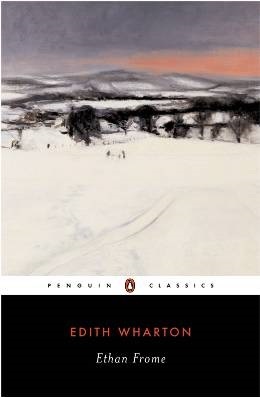
Ethan Frome by Edith Wharton

Ethan FromeWhat a fantastic book. Ethan Frome is a beautifully told tale – a tragedy, signalled right from the beginning of the book, when the unnamed narrator first saw Ethan Frome and was told he had been disfigured and crippled in a ‘smash up’, twenty four years earlier. Life had not been good to him:

Sickness and trouble: that’s what Ethan’s had his plate full up with ever since the very first helping.

I was a bit wary as I began reading Ethan Frome because I’d not long finished reading Doris Lessing’s The Grass is Singing and didn’t want to sink into another bleak and dismal book. I needn’t have worried, even though Ethan Frome is a tragedy there is light to contrast the darkness, and there is love and hope set against repression and misery. It’s another book (like The Grass is Singing) where I hoped the ending would be a happy one, although I knew it couldn’t be. 

It’s a short book (just over 120 pages) and deceptively simple to read, but there is so much packed into it. I enjoyed it very much.  As well as striking and memorable characters the setting is  beautifully described – a ‘mute and melancholy landscape, an incarceration of frozen woe‘, in the isolated village of Starkfield (a fictional New England village). Trapped in an unhappy marriage, Ethan’s life had changed when his father died and he had had to give up his studies to work on the farm. His wife Zeena had always been ill and needing help in the house, which was why her cousin Mattie came to live with them. At first it worked out quite well, but Ethan can’t shrug off a sense of dread, even though he could

… imagine that peace reigned in his house.

There was really even now, no tangible evidence to the contrary; but since the previous night a vague dread had hung on the sky-line. It was formed of Zeena’s obstinate silence, of Mattie’s sudden look of warning, of the memory of just such fleeting imperceptible signs as those which told him, on certain stainless mornings, that before night there would be rain.

His dread was so strong that, man-like, he sought to postpone certainty.

Edith Wharton (1862 – 1937) was an American author. Ethan Frome was first published in 1911 and is in contrast to some of her other books about the New York society of the 1870s to 1920s. It’s a rural tragedy of inevitable suffering and sadness that reminded me of Thomas Hardy’s books.

This book was the Classics Club Spin book for February/March and qualifies in the What’s in a Name 2014 in the Forename/Name category. It’s also a book I’ve owned before 1 January 2014 so is another book for the Mount TBR challenge.

What's in a Name 2014 – an Update

Whats in a name 7Charlie who hosts the What’s In A Name challenge on her blog The Worm Hole has added a a 6th category to the challenge. I was hoping she would as there has always been a 6th category for this challenge. Here it is in Charlie’s own words:

A book with a school subject in the title. And yes, that does mean you can get creative and use a magical academic subject if you wish €“ Hogwarts is a school, after all.

Examples of books you can choose: The History Boys by Alan Bennett, Angelology by Danielle Trussoni, Mastering The Art Of Soviet Cooking by Anya Von Bremzen

This sixth category will be considered a bonus. You can read for it or not €“ if you only want to read for the original five categories your last book of the five will still mean you have completed this year’s challenge.

I’ve had a quick look at my unread books (as I like to use challenges to read from my own books, rather than having to buy/borrow them) and have these to choose from:

History

The Brief  History of the Dead by Kevin Brockmeier
A Small Part of History by Peggy Elliott
The History of Love by Nicole Krauss

Languages

A Dead Language by Peter Rushforth
Italian Neighbours: An Englishman in Verona by Tim Parks

Music

An Equal Music by Vikram Seth

Art

The Lost Art of Keeping Secrets by Eva Rice

Shakespeare

1599: A Year in the Life of William Shakespeare by James Shapiro

Dancing

A Time To Dance, No Time To Weep by Rumer Godden

Crucible by S G MacLean

Once again I was transported back to 17th century Scotland with Crucible by S G Maclean, the third of her Alexander Seaton books. I read the first, The Redemption of Alexander Seaton in February 2013 and now a year later I’ve been just as engrossed in Crucible. I think her style of writing suits me perfectly, the characters are just right, credible well-rounded people, the plot moves along swiftly with no unnecessary digressions and it’s just full of atmosphere. I loved it.

It’s set in 1631 in Aberdeen, where Alexander is now a Master at Marischal College. On Midsummer’s eve he stumbles across the body of his friend, Robert Sim, the college librarian, a few feet from the library steps, with his throat cut, blood congealing around the wound. Dr Dun, the college principal asks Alexander to investigate the matter, to look into Robert’s private life, hoping he’ll find nothing to reflect badly on the college.

I found it absolutely compelling reading. Robert had been cataloguing a new acquisition to the library before he was killed and Alexander is convinced that Robert was troubled by what he found there, amongst the books of history, alchemy  and hermetics – the quest for ‘a secret, unifying knowledge, known to the ancients’ since lost to us. There are many twists and turns and another man is killed before he finally arrives at the truth.

This is the third book in the series, but although I haven’t read the second book, I don’t think that matters as I think Crucible stands well on its own. The fourth book in the series is The Devil’s Recruit – the hardback and Kindle versions are available now, whilst the paperback will be available on 14 May. Now I’ve lifted my book buying ban I think I may just have to get the Kindle version soon.

Crucible qualifies for four of the challenges I’m doing this year – the Mount TBR challenge, the Historical Fiction Challenge, My Kind of Mystery Challenge and the Read Scotland Challenge.

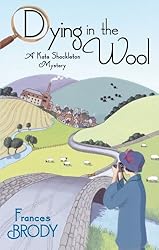
Dying in the Wool by Frances Brody

After I finished reading The Grass is Singing (see my previous post) I felt I needed to read something lighter and easier, so I turned to Dying in the Wool by Frances Brody and it turned out to be just the right book – not too taxing on either the brain or the emotions and a rather interesting mystery too.
It’s the first of Frances Brody’s Kate Shackleton Mysteries set in Yorkshire in 1922, with flashbacks to 1916. Bridgestead is a peaceful mill village, until the day in 1916 when mill owner Joshua Braithwaite went missing after apparently trying to commit suicide. Seven years later his daughter, Tabitha, who is getting married, still can’t believe her father is dead and she asks her friend Kate Shackleton to find out what really happened to him.

This is another post World War 1 crime novel, along the lines of Jacqueline Winspear’s Maisie Dobbs and Carola Dunn’s Daisy Dalrymple books, with an independent female amateur detective. Kate is a widow, her husband was missing in action during the war, presumed dead, her father is a police superintendent and she is a keen amateur photographer. On her father’s recommendation she hires Jim Sykes, an ex-policeman to help her. Once they start asking questions things start to happen with disastrous effects.

I liked the characters, Kate and Jim in particular, and the setting is lovely. The novel is well grounded historically in the aftermath of the First World War. I also liked the way the chapter headings were textile related with an explanation of the terms used and relevant to the events described in the chapters – very skilfully done, I thought. And just like woven cloth this mystery has many separate strands that Kate and Jim have to bring together to reveal what had happened in 1916.

This book fits well into several challenges – see the categories listed above.

Other books in the Kate Shackleton series are:

2. A Medal For Murder (2010)
3. Murder in the Afternoon (2011)
4. A Woman Unknown (2012)
5. Murder on a Summer’s Day (2013)
6. Death of an Avid Reader (2014)

Five Little Pigs by Agatha Christie

There are many things I like about Five Little Pigs, a Poirot mystery first published in 1943. I like the plot and the way it’s structured, the characterisation, the dialogue, and Agatha Christie’s fluent style of writing. In addition the solution is convincing and satisfying.

Caroline Crale was convicted of the murder of her husband, Amyas and died in prison. Sixteen years later, her daughter, a child of five at the time of the murder, asks Poirot to clear her mother’s name, convinced that she was innocent.

Poirot checks the police records, talks to the lawyers who conducted the trial and to the five eyewitnesses, persuading them to write down their versions of events. He finds that she had ample motive for the crime, at no time had she protested her innocence, although she contended that he had committed suicide, and all the eyewitnesses thought she was guilty.

Inevitably there are different versions of the events and conflicting views of Caroline’s character, all very clearly set out. So what did actually happen? Was Caroline innocent or guilty?

Poirot, in his usual methodical manner, goes through the sequence of events, and having gathered together all the people involved, using logic and psychology to detect the incongruous he makes his denouement.

The description of Amyas Crale’s house, Alderbury appears to have been modelled on Agatha Christie’s own house, Greenway, complete with a Battery overlooking the river, just as at Greenway. The book was written in 1943, making it 16 years after 1926, the year of her disappearance before her divorce from her first husband, Archie Christie, so I don’t think that it’s a coincidence that Amyas Crale, a womaniser who was proposing to leave his wife for another woman has the same initials as Archie Christie!

I think the nursery rhyme theme of the title and the chapter headings is rather forced, as it doesn’t really throw any light on the mystery. It seems that Agatha Christie was a bit carried away with her ‘crimes of rhymes’, just as Poirot was obsessed with the jingle:

A jingle ran through Poirot’s head. He repressed it. He must not always be thinking of nursery rhymes. It seemed an obsession with him lately. And yet the jingle persisted.

This little pig went to market, this little pig stayed at home…’ (page 33)

This is the first Agatha Christie book I’ve read this year and I’m pleased it was such a good one!

Five Little Pigs is my 8th TBR book I’ve read this year in the Mount TBR Challenge, and the TBR Triple Dog Dare, the 2nd for the My Kind of Mystery Challenge and the 2nd for the What’s in a Name 7 Challenge (in the category, a book with a number written in letters in the title). And last, but by no means least, it’s the 56th Agatha Christie book I’ve read in the Agatha Christie Reading Challenge.

Reading in January

It’s been a good month for reading. I’ve been making inroads into my own unread books, as well as reading books I’ve had on loan from the library since last year. These are the books I’ve read with links to my posts:

  1. Vengeance* by Benjamin Black
  2. Cloud Atlas by David Mitchell
  3. The Uncertain Midnight by Edmund Cooper
  4. Not Dead Enough* by Peter James
  5. The Hangman’s Song* by James Oswald
  6. Cannery Row by John Steinbeck
  7. Shakespeare’s Restless World by Neil MacGregor
  8. In the Woods* by Tana French

Half of them are crime fiction(*) and my Crime Fiction Pick of the Month is Not Dead Enough by Peter James. For more nominations for the Crime Fiction Pick of the Month see Kerrie’s blog – Mysteries in Paradise.

But my all-round Best Book of the Month is a tie between Shakespeare’s Restless World by Neil MacGregor, a non-fiction book that beautifully recreates Shakespeare’s world through examining twenty objects;
and Cannery Row by John Steinbeck. I came to this book with no idea of what it was about or what to expect. I loved it – there is humour and tragedy, meanness and generosity, life and death all within Cannery Row’s 148 pages.


Reading Challenges progress in January (for details of these challenges see my Challenges page):

  • Mount TBR Reading Challenge – 5 of my own unread books. My target is 48.
  • Read Scotland Challenge – 2 books. My target 13+.
  • Sci-Fi Experience also 2 books read. This ran from December to the end of January. There was no target as such, other than to read sci-fi books and my total was 4.
  • Triple Double Dog Dare – this is to read just my own unread books with some exceptions allowed, so I made it through January. In addition I’m trying not to buy any books, which has been a struggle, but I managed it this month. Somehow I doubt I can keep it up for much longer, nor can I see myself sticking to reading just my own unread books, not with the library van coming round once a fortnight and the temptation of borrowing books (the ones I’ve read so far were ones I’d borrowed last year). In any case I like to be spontaneous in my reading and this is getting to be too restricted for me.
  • What’s in a Name 7 – 1 book (Cloud Atlas in the weather section).
  • Historical Fiction Challenge – no progress. My target is 25 books.
  • Colour Coded Challenge – no progress. The target is to read 9 books in the different colour categories.
  • The Agatha Christie Reading Challenge – no progress!! I’ll be reading some of her books soon.
  • My Kind of Mystery Challenge – starts today!