Booking Through Thursday – And, the Nominees Are’¦.

What fiction book (or books) would you nominate to be the best new book published in 2007?(Older books that you read for the first time in 2007 don’™t count.)
What non-fiction book (or books) would you nominate to be the best new book published in 2007?(Older books that you read for the first time in 2007 don’™t count.)
And, do ‘œbest of’ lists influence your reading?
Looking through the list of books I’™ve read this year I see that most of them are not new books published in 2007, so I don’™t have much difficulty in deciding which ones I would nominate.

In the fiction category my nominations are:

1. Season of the Witch by Natasha Mostert, about mystery, magic, memory, full of psychological tension
2. Playing with the Moon by Eliza Graham, about memories, bereavement and the legacy of war
3. Speaking of Love by Angela Young, about misunderstandings, loss and above all love
4. Over by Margaret Forster about grief and death, heart-breakingly sad

My brief descriptions only give a flavour of the books and although they are all different it seems they have a lot in common ‘“ love and memories and loss.

I have only one nomination in the non-fiction category and that is:

The Verneys by Adrian Tinniswood ‘“ the lives of the Buckinghamshire Verney family in turbulent seventeenth century during the English Civil War ‘“ love, war and madness.

‘œBest of’ lists are interesting and I suppose they do influence my reading to a certain extent. Since I started reading blogs, about two years ago now, I am more influenced by recommendations from bloggers, particularly when I know they have similar reading tastes to mine. I’™m also influenced by books I see in bookshops and especially in my local library. Sometimes I prefer to pick up a book without knowing anything about it or the author and am often surprised by how much I enjoy it.

The Testament of Gideon Mack by James Robertson

An intriguing book. This is the first book I’ve read for the From the Stacks Challenge.

I finished reading The Testament of Gideon Mack by James Robertson at the end of November and have now got round to writing about it. I started it with great enthusiasm and found it a compelling book to read. It is a psychological mystery concerning the nature of belief, faith, and truth. It starts with an account of the disappearance and death of Gideon Mack and the discovery of a manuscript written by him shortly before he was last seen. It is clear right from the start that there is mystery and uncertainty surrounding his disappearance, death and the discovery of his body. The book centres on the manuscript with an epilogue containing ‘notes’ written by a journalist investigating the mystery, considering whether the manuscript was ‘anything other than the ramblings of a mind terminally damaged by a cheerless upbringing, an unfulfilled marriage, unrequited love, religious confusion and the stress and injury of a near-fatal accident?’

Gideon Mack was a minister in the Scottish Church, even though he did not believe in the existence of God. He simply didn’t discuss religion and discovered that ‘it was possible to be a Christian without involving Christ very much’. He concentrated on works rather than on faith and threw himself into raising money for charity. One of his fundraising events was running in the London marathon and he found that running made him ‘immune to the world and its problems.’ Whilst out running in the woods he came across a standing stone that he was sure had not been there before. It is this stone that drew him further into the mysterious events that led to his disappearance. He took photographs of the stone, but they failed to come out. It is not clear whether the stone was actually there or not, any more than it is not clear what actually did happen to Gideon Mack.

Be aware: there are possible spoilers ahead:

As well as being a faithless minister Gideon was married to a woman whom he did not love and he was in love with Elsie, his best friend’s wife. As I read the book I realised that it’s just not clear whether Gideon’s account is truthful and how much of it can be believed. Did he have an affair with Elsie or not? Did he see the standing stone, or was it just a figment of his imagination? Was he mad or deluded or what?

What is clear is that he fell into a ravine, trying to rescue a dog that fell into the Black Jaws and he was ‘churned and spun like a sock in a washing-machine, carried along by an immense, frothing, surging force.’ He thought that he ‘couldn’t possibly have survived the fall’ but even if he had ”the river would have killed’ him. He thought he must be dead. And it is at this point that he found he had been rescued by the Devil and spent three days with him before he eventually returned home. He claimed the Devil had healed his leg, broken from the fall, discussed the nature of belief and God with him and swapped his trainers for Gideon’s shoes. Are the trainers proof that the Devil does exist? When Gideon saw the trainers they triggered his memory – but is his memory reliable? What is real, what is imagined and what is illusion?

The question of whether Gideon believes in God and the Devil as a result of his experience is not answered directly, although in remembering his near-death experience Gideon thought ‘there really is something good on the other side. I don’t know what, but it’s not the end.’

The book kept my interest to the end. I wanted to know what happened to Gideon, why he became a minister when he didn’t believe in God, how he coped with living with the Devil when he had previously believed him to be a figment of his imagination, what was real, what was legend and are myths just metaphors. Like Surveillance this book is open ended. As Gideon said, ‘You either believe or you don’t.’

What’s In a Name? Challenge

I can’t resist joining this challenge, even though I’m already doing a few. This one is hosted by Annie, who is ten or eleven. See Words by Annie for the full picture. The idea is that you read one book from each category over the course of next year. Surely I can do that, especially as I can choose books from my to be read list.

These are the books I’ve chosen for now – I may change them later as who knows what I’ll want to read next year? I’ve been meaning to read these books for quite a while now, so this should push me into reading them.

A book with a colour in the title: Half a Yellow Sun, Chimamanda Ngozi Adichie

A book with an animal in its title: The Tenderness of Wolves, Stef Penney

A book with a first name in its title: My Cousin Rachel, Daphne Du Maurier

A book with a place in its title: Winter in Madrid, C J Sansom

A book with a weather event in its title: Snow, Orhan Pamuk

A book with a plant in its title: Gem Squash Tokoloshe, Rachel Zadok

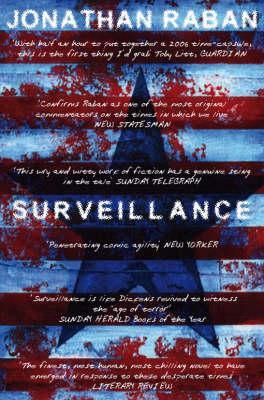
Surveillance by Jonathan Raban

I wasn’t sure what to expect when I started to read Surveillance. The title suggested to me that it is about spying and being spied upon and in essence that is the book’s main theme. However, it is also about paranoia and the many insecurities, fears and weaknesses in our modern society. The Spectator reported Raban’s book should certainly be required reading. Of all the 9/11 books so far, Surveillance is perhaps the most disturbing because it offers scant comfort and no certainties. The Sunday Herald Books of the Year described Surveillance like Dickens revived to witness the ‘age of terror.’

There’s a lot going on in this book. It starts with a bang:

After the explosion, the driver of the overturned school bus stood behind the wreckage, his clothes in shreds. He was cupping his hands to his ears, as if to spare himself the noise of sirens, car alarms, bullhorns, whistles, and tumbling masonry. When he brought his hands away and held them in front of his face, both palms were dripping with blood. His mouth opened wide in a scream that was lost in the surrounding din.

However, things are not always what they seem. The main characters are Lucy, a journalist and single mum, her daughter eleven year old Alida, and Lucy’s friend and neighbour Tad, who is HIV positive and full of conspiracy theories: ‘You think you’™re living in a democracy, then one morning you wake up and realise it’s a Fascist police state and it’s been that way for years.’ Alida, in contrast, believes in facts and is ‘hungry for realism’. She prefers non-fiction to fiction, Ann Frank’s diary to Lord of the Rings and tries to understand human relationships in terms of algebra.

August Vanags (Augie) is a professor of history who has recently written the bestseller ‘Boy 381’, a memoir of his terrible childhood in Europe during World War Two. Lucy has been assigned to interview Augie, said to be a recluse. Augie believes that the world is in a worse state than it was in 1939, presaging a catastrophe for civilisation. Lucy, whilst terrified of terrorism, feels more threatened by natural disasters such as greenhouse gases and earthquakes. The instability of the planet and our precarious existence run parallel with the violence and fear generated by terrorism. As the story unfolds Lucy investigates the truth of Augie’s memoir – was he really a refugee from Hitler’s Europe or did he spend the 1940s on a farm in Norfolk?

Then there is Finn, a schoolboy geek who can ‘rattle out stuff in HTML and Java faster than the girls could write English when they were IM-ing. If Finn had a life, which was doubtful, it lay somewhere out in cyberspace.’ Another character who may or may not be what he seems is Mr Lee, the Chinese landlord of the Acropolis building where Lucy and Tad live. To Tad Mr Lee epitomises what is wrong with society ‘the way the world had lately fallen into the hands of grifters, liars and cheats.’ Tad’s anger with himself, everything and everyone else threatens to overwhelm him and possess him.

As the novel built to a climax I was so engrossed in wondering what was the truth about the characters and what the outcome would be, that I failed to foresee how the book was going to end, even though thinking back over it now I can see that hints were given almost from the beginning. This is not a book where all the ends are tied off, or where all the questions that have been raised are answered. Everything is left unresolved and to my mind there could be no other conclusion.

This Time 10 years ago …

Simon at Stuck-in-a-Book posted earlier this year on books he had read ‘œOn this day ‘¦’ where he listed books he had read on a particular day in the year going back several years ‘“ in his case on 28 September. I haven’™t kept such accurate records as Simon, but as I found a notebook listing books I read in 1997 I thought I’™d look back to see what books I was reading in December in 1997, 2002, 2006 and this December. I didn’™t record the precise dates and have just picked one book out of the books I read in December during those years.

December 1997 ‘“ Homeland and other stories by Barbara Kingsolver. I made just a brief note at the time ‘œv. readable’. This is a book of short stories and I have to admit that at a distance of ten years I can’™t remember much about them. So, I’™ll just quote from the back cover:

‘œExtraordinarily fine. Barbara Kingsolver has a Chekovian tenderness towards her characters ‘¦ The title story is pure poetry.’ New York Times Book Review.

December 2002 ‘“ Lord of the Rings by J R R Tolkein. I first read the books when I was at Library School ‘“ everyone on my course was reading them. I’™ve read them several times since then and this time I read them again, prompted by the films. The films compared quite favourably with the books, although I think the Ents didn’™t live up to my expectations. Ian McKellen as Gandalf was just perfect.

December 2006 ‘“ Alias Grace by Margaret Atwood. I have read several Atwood books and I think this one is one of her best. It’™s based on the true story of the murder of Thomas Kinnear and his housekeeper in Canada in 1843. Grace and fellow servant James are found guilty of the murders. James was hanged and Grace imprisoned for life. The question, never answered to my satisfaction, all through the book is, was Grace guilty?

December 2007 ‘“ All Passion Spent by Vita Sackville-West. I haven’™t read any other books by Sackville-West and was pleased to find it most enjoyable with an awful lot packed into what seems on the face of it to be a novel where not much happens. It’™s a novel of opposites. For example old age and youth are contrasted in looking back over the life of Lady Slane, widowed at the age of 88. I’™ll be writing about this in more detail, after 15 December, as it’™s the chosen book for Cornflower’™s book group.

Cranford – a “Multi-Threaded Production”

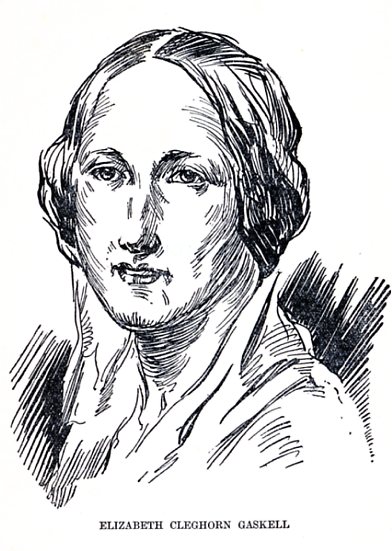
The third episode of “Cranford” is being shown on BBC1 this evening. Over the course of last week I have puzzled over my reaction to the production. If I hadn’™t only recently read Elizabeth Gaskell’s Cranford I might not have been so bemused. I was quite prepared to find that the actors and the locations didn’™t match the pictures in my mind ‘“ how could they? I also didn’™t expect the dramatisation to follow every word in the book ‘“ after all it is a dramatic representation, not a book.

Still, after seeing two episodes and looking at the preview of the third, I think that by amalgamating Cranford with two other books the end result is not Cranford. One difference that really has jarred is concerning Mary Smith. In the novel Mary is the narrator. She lives in Drumble (Manchester) with her father and writes about her visits to Cranford at different intervals over a number of years. Her father is an old friend of the Jenkyns family, maybe even a distant relative, who helps with Miss Matty’™s business affairs. Nowhere in Cranford is there any indication that Mary Smith has a stepmother and stepbrothers and sisters, but they appear in the TV series ‘“ I can’™t see how they add anything to the story. And why was it necessary to make Miss Brown’™s death take place before her father’™s? I could go on.

The BBC’™s Press Office page has some interesting information that explains how the script was written. The creators did not think that there was enough material in the novel suitable for a straightforward adaptation. So, as they wanted to keep ‘œtrue to the spirit of Gaskell’ they took several of her books and interwove them together. This quote from the Production Notes explains the process:

“We took a lot of liberties with Elizabeth Gaskell,” Sue continues. “We lost some of her characters, we amalgamated some and we invented. We shuffled story beats around and we added extras to some of the stories from the other books.

“And we lifted out two comic incidents from her essays about her childhood which weren’t in the novels. In the end, we had interwoven parts of all the three novels so closely that it took on a life of its own, and essentially became a new drama.’

Cranford is thus a multi-threaded production, combining three of Elizabeth Gaskell’™s books and essays as well as introducing new material. They have indeed produced a new drama. My question is ‘“ do I want to watch it? I’™m not so sure that I do.

Francesca Annis is quoted in the Press Pack:

“I read Gaskell’s My Lady Ludlow, and (Cranford writer) Heidi Thomas’s characterisation is quite faithful to her but she obviously had to leave out a huge amount of detail that I found completely fascinating.

“But then this serial isn’t called Lady Ludlow… unfortunately!”

Maybe it shouldn’™t be called ‘œCranford’, either.

One thing I do know is that thanks to this production, I shall read Mr Harrison’™s Confessions and My Lady Ludlow.