What’s On Page 123?

Actually I’ve done this before, but I’ve been tagged by Angela for the page 123 meme and I’m going to do it again – it’s easy.

All you have to do is:

1. Pick up the nearest book.
2. Open to page 123
3. Find the fifth sentence.
4. Post the next three sentences.
5. Tag five people, and acknowledge who tagged you.

Well, I’m not going to stick completely to the rules because the nearest book, would you believe, is Ian Rankin’s A Good Hanging, which is the book that was nearest to me last time. It’s on the desk as I’ve started to write about it. So the next nearest book is one I haven’t started but have been meaning to read ever since I bought it. It’s Paul Auster’s Travels in the Scriptorium, a short book, but fortunately it has 130 pages.

On page 123 the sixth, seventh and eighth sentences are:

Once he got you out of the room, he was planning to kill you.
Ah. I figured as much.’

I’ll have to read the book now.

I didn’t tag anybody last time but now I’m tagging, that’s if they want to do it – Melody, Paula, Stephanie, Lisa and Alison.

A – Z Favourites

Simon at Stuck in a Book has come up with a great idea A – Z Favourites. The idea is to pick a favourite author for each letter of the alphabet, and the accompanying novel. This set me thinking and although it’™s practically impossible for me to decide who my favourite authors are I decided to make it a bit easier and only considered books I’™ve read in the last few years. This means leaving out favourite authors such as Jane Austen, Charlotte Bronte, Wilkie Collins, and Charles Dickens. (There’™s the start of another list.)


ATWOOD, MARGARET ‘“ Alias Grace
BROOKS, GERALDINE ‘“ March
CUNNINGHAM, Michael ‘“ The Hours
DU MAURIER, DAPHNE – Rebecca
ELIOT, GEORGE -Middlemarch

FRANKLIN, ARIANA ‘“ Mistress of the Art of Death
GAARDER, JOSTEIN ‘“ The Solitaire Mystery
HARDY, Thomas ‘“ The Woodlanders
ISHIGURO, KAZUO – Remains of the Day
JAMES, P D ‘“ Original Sin
KINGSOLVER, BARBARA ‘“ The Poisonwood Bible
LIVELY, PENELOPE ‘“ The Photograph

McEWAN, IAN -Atonement
NARAYAN, R K ‘“ The Painter of Signs
OLSSON, LINDA ‘“ Astrid and Veronika

PULLMAN, PHILIP ‘“ His Dark Materials
QUINDLEN, ANNA ‘“ Blessings (the only book I’™ve read recently/ever by an author whose name begins with ‘˜Q’™)
REEVE, PHILIP ‘“ Here Lies Arthur
SANSOM, C J ‘“ Revelation

TOLSTOY, LEO ‘“ War and Peace
U ‘“ none
VICKERS, SALLEY ‘“ Instances of the Number 3
WOOLF, VIRGINIA ‘“ Mrs Dalloway
X – none
YOUNG, ANGELA ‘“ Speaking of Love
ZAFON, CARL RUIZ ‘“ The Shadow of the Wind (the only book I’™ve read recently/ever by an author whose name begins with Z)

After Work Cookbook

After Work, by W H Smith, published by Octopus Publishing Group Ltd 1999.

I’™ve had this book a few years and have made several of the recipes. As the title suggests all the recipes are for making quick meals from fresh ingredients plus some storecupboard items. Each recipe is illustrated with a photograph. Some dishes need more preparation than others, but none of them are difficult to make ‘“ just what you need at the end of a busy day.

There’™s a good mix of recipes divided into sections:

· ‘˜light bites’™ ‘“ sandwiches, salads and soups
· ‘˜international flavours’™ ‘“ a selection from around the world ‘“ pasta, stir-fry, curry, chow mein etc
· ‘˜quick fish dishes’™ ‘“ fish cakes, fish casserole etc
· ‘˜’™meat and poultry for dinner’™ ‘“ family meals and special occasions
· ‘˜sweet endings’™ ‘“ using fruit and chocolate eg double chocolate brownies

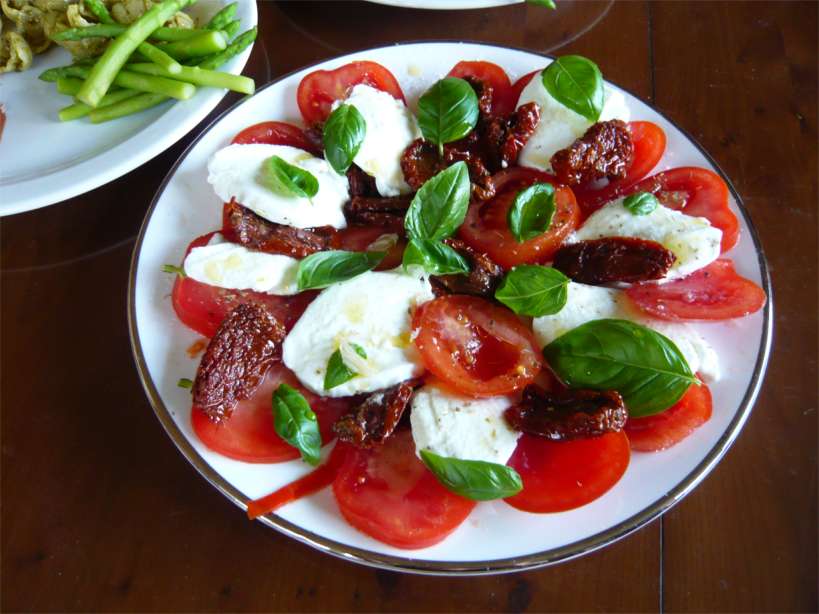
Today I made Two-Tomato Mozzarella Salad, one of my favourite recipes from this book. Really all you do is put it all together and eat it. It only takes a few minutes to prepare.

two tomato mozzarella
For 4 people you need:

· 500g fresh plum tomatoes sliced ‘“ or as many as you like
· chopped oregano
· 375g mozzarella cheese sliced ‘“ or use as much or you like – buffalo mozzarella is the nicest
· 12 sun-dried tomatoes preserved in oil and cut into strips. I don’™t cut them up unless they are very large ‘“ again you can use as many as you want
· fresh basil leaves
· salt and pepper ‘“ I use rock or sea salt and freshly ground black pepper

For the dressing, whisk the following ingredients together in a small bowl or put in a screw top jar and shake well to combine:

· 5 tablespoons extra virgin olive oil
· 3 tablespoons oil from the sun-dried tomatoes
· 3 tablespoons red wine vinegar
· ¼ garlic clove crushed – I usually use a whole clove
· pinch of sugar

1. Arrange the plum tomato slices in a single layer on a large plate and sprinkle with salt and pepper to taste together with the oregano.
2. Arrange the slices of mozzarella on top of the sliced tomatoes and tuck in the sun-dried tomatoes between them.
3. Scatter the basil leaves over the top and drizzle on the dressing.

Sometimes we just have this with maybe some crusty bread. Today we added some Parma ham, pasta shells with green pesto and asparagus tips ‘“ simply delicious.

Also posted on Soup’s On! blog.

Just the Right Book?

I still can’™t decide which book to read next. I’™ve picked up The Sixth Wife, by Suzannah Dunn but it seems wrong somehow; another time might be better for that book. I’™ve read three of the short stories in Ian Rankin’™s A Good Hanging ‘“ they’™re OK but not riveting. I don’™t fancy Dante’™s Descent into Hell (Inferno) today ‘“ I want something more cheerful, and not historical. They’™re not the right books just now.

I had to go to the dentist yesterday as a filling had come out. Fortunately he was able to replace the filling and I didn’™t have to have an injection, which I really dislike ‘“ I have a needle phobia, I think. Anyway to reward myself I went to the library for a mooch. I had only just got passed the returns desk when I saw The Maytrees by Annie Dillard on a display stand. I’™d read somewhere that this is a good book and as I’™ve read several of her books, particularly Pilgrim at Tinker Creek, I hoped this would be just the right book.

Then I saw Going into a Dark House by Jane Gardam on another display stand and thought that might be the right book. This is a collection of short stories, maybe as good as The Sidmouth Letters and Old Filth. But maybe not just the right book yet ‘“ I’™m not really in the mood for short stories.

Further into the library and I came upon the autobiography/biography section, where I picked up two books by Joan Bakewell. Now I like Joan Bakewell, so I had a look at both of them. The Centre of the Bed is about her life from her childhood in Stockport, growing up during the war, life at Cambridge University and with the BBC as a radio and television broadcaster ‘“ called ‘œthe thinking man’™s crumpet’, no less. Stockport is near where I was born and that was enough for me to borrow this book, that and the description on the book cover that said she ‘œprovides a fascinating record of the changes in British society and culture over the last seventy years.’ That should be good.

Right next to that book was The View from Here: Life at Seventy, which promises to be ‘œan exhilarating, funny and always thought-provoking take on the human condition that most of us dread and yet count ourselves lucky to achieve: old age.’

I’™m not as old as that yet, but I hope to get there, so it’™s best to be prepared. This may be Just The Right Book.

Then again, maybe now is the right time for The Needle in the Blood, by Sarah Bower – it’s been sitting on my bookshelves for months now …?

Oscar Wilde

Oscar Wilde and the Candlelight Murders by Gyles Brandreth (published in the USA as Oscar Wilde and a Death of No Importance), John Murray Publishers Ltd, 2008, 355 pages).

I suppose you could call this book an ‘historical whodunit’. It’s set in 1889 – 1890, fin-de-siècle London and Paris and the mystery begins with Oscar Wilde finding the naked body of Billy Wood, a 16 year old boy in the candle-lit room in a small terraced house in Westminster, close to the Houses of Parliament. Billy’s throat has been cut and he is laid out as though on a funeral bier, surrounded by candles, with the smell of incense still in the air. It’s a combination of fiction and fact, with both real and imaginary characters. Wilde with the help of his friends Arthur Conan Doyle and Robert Sherard sets out to solve the crime. Sherard (the great grandson of William Wordsworth) who wrote poems, novels, biographies (including five of Oscar Wilde) and social studies is the narrator.

The story reads quickly (so quickly that I didn’t want to stop to make notes as I read) and is full of colourful characters such as Gerard Bellotti, who runs an ‘informal luncheon club for gentlemen’. Bellotti is

‘grossly corpulent’ giving the impression of ‘a toad that sits and blinks, yet never moves’ wearing ‘an orange checked suit that would have done credit to the first comedian at Collins’ Music Hall and on the top of his onion-shaped head of oily hair, which was tightly curled and dyed the colour of henna, he sported a battered straw boater.’

Wilde is a fan of Conan Doyle’s Sherlock Holmes stories so much so that as the mystery is unravelled he picks up clues in the manner of Holmes, observing and deducing, exclaiming when questioned by Conan Doyle ‘Come, Arthur, this is elementary stuff -Holmes is where my heart is.’ I think it is this combination of fact and fiction that I enjoyed most in reading the book. I knew little about Wilde or Doyle and nothing about Sherard before reading it, but I think I learned a lot about all three people, about their characters, their views on life and love, and their works, as well as about the society in which they lived.

According to The Oscar Wilde Murder Mysteries website the book is peppered through with quotes from Wilde, or Brandreth’s versions of Wilde’s words, together with Brandreth’s own inventions. I couldn’t tell which was which, as I’ve only read Wilde’s The Picture of Dorian Gray and seen a TV production of The Importance of Being Ernest, but it all seemed perfectly in character to me. I found the details of Wilde’s love for his wife Constance particularly interesting in contrast to his trial for gross indecency in 1895. In fact I came away from the book really liking Wilde and wanting to read more about him and by him. Fortunately the biographical notes at the end of the book give more details of works by and about Wilde, Conan Doyle and Sherard.

I didn’t find the mystery too difficult to work out, with lots of clues throughout the book, but that didn’t detract from my enjoyment. On the contrary it made it all the more pleasurable. The next book in the series, Oscar Wilde and the Ring of Death, is due out in the UK in May and in the USA, called Oscar Wilde and the Game of Murder, in September. Apparently there are seven more in the pipeline. That should mean I end up knowing an awful lot more about Oscar Wilde!