Weekend Cooking: Italian Cookbooks

Weekend Cooking is hosted by Beth Fish Reads. It’s open to anyone who has any kind of food-related post to share: Book (novel, nonfiction) reviews, cookbook reviews, movie reviews, recipes, random thoughts, gadgets, fabulous quotations, photographs.  For more information, see the welcome post.

I love Italian food. I have a few books such as Jamie’s Italy, the two River Cafe Cookbooks by Rose Gray and Ruth Rogers and Perfect Pasta by Anne Willan, but my favourite books to look at with longing are The Love of Italian Cooking by Mary Reynolds and The Heritage of Italian Cooking by Lorenza De’Medici.

The Love of Italian Cooking, now out of print was a birthday present from my son:

What I like, apart from the recipes and colour photos is the description of the various regions of Italy, highlighting their traditions and specialities, from Sicily and Sardinia moving north through the country to Piemonte in the north-west corner.

One of my favourite recipes in this book is Minestrone Alla Casalinga in the chapter on Lombardy, a large region that includes most of the Italian lakes. It stretches from the Alps in the north to the valley of the River Po in the south. It takes hours to make, plus the time overnight to soak the haricot beans and is very filling. If you click on the photo below you may be able to see the recipe, but if not here are the ingredients – haricot beans, onion, garlic, bacon rashers,  tomatoes, carrots, potatoes, turnip, celery, cabbage, macaroni pieces or small pasta (shells, stars etc), fresh marjoram and parsley, pepper and water.

Minestrone Alla Casalinga

Saute the onions, garlic and bacon for a few minutes, add water, tomatoes (skinned, seeded and chopped) and marjoram and parsley and simmer for 2 hours uncovered. Add the other ingredients – carrots (diced) first for 10 minutes then everything else sliced, diced or shredded and cook until tender. Stir in grated parmesan to taste.

I’ve made it without the bacon and with different vegetables, according to what I have at the time – I suppose then you could call it Minestrone Alla Margherita or Margaret’s Minestrone.

The Heritage of Italian Cooking is also out of print, but used copies are available. It is a most beautiful book, lavishly illustrated with not only photos of fantastic food, but also Italian Renaissance paintings of banquets, illuminated manuscripts, still-life, harvest-time and rural scenes. There are recipes from Renaissance menus, old diaries and Italian cookbooks  – traditional and modern recipes. It really is a sumptuous display of Italian food. A lovely book just to look at and read and also to inspire me to cook.

It’s arranged by type of dish, including chapters ranging from Antipasti and Pasta to Desserts, Breads and Menus. Here are a few photos from the book:

What am I cooking today? Even after looking at all this Italian food, I have to admit that later I’ll be cooking British roast beef with yorkshire puddings, roast potatoes and sprouts.

Friday Finds

This week I received a copy of The Widow’s Tale by Mick Jackson, via LibraryThing’s Early Reviewers’ Programme.

I’ve never read anything by Mick Jackson before, but I’m hoping this will be good. It’s described on the back cover as

The long awaited third novel from the Booker Prize shortlisted author of Five Boys and The Underground Man.

A newly-widowed woman has done a runner. She just jumped in her car, abandoned her (very nice) house in north London and kept on driving until she reached the Norfolk coast. Now she’s rented a tiny cottage and holed herself away there, if only to escape the ceaseless sympathy and insincere concern.She’s not quite sure, but thinks she may be having a bit of a breakdown. Or perhaps this sense of dislocation is perfectly normal in the circumstances. All she knows is that she can’t sleep and may be drinking a little more than she ought to.

But as her story unfolds we discover that her marriage was far from perfect. That it was, in fact, full of frustration and disappointment, as well as one or two significant secrets, and that by running away to this particular village she might actually be making her own personal pilgrimage.
By turns elegiac and highly comical, The Widow’s Tale conjures up this most defiantly unapologetic of narrators as she begins to pick over the wreckage of her life and decide what has real value and what she should leave behind.

This meme is hosted by MizB at Should be reading.

Reading Dilemma – a Surfeit of Crime Fiction!

I feel I’m overdosing on crime fiction right now and need to read something else. I’m in the middle of Ian Rankin’s Dead Souls and whilst I think it’s a good story, I’m being sucked down to the dark side. Rebus is pessimistic:

…  once again Rebus’s speech had gone unspoken, the one about how he’s lost any sense of vocation, any feeling of optimism about the role – the very existence of policing. About how these thoughts scared him, left him either sleepless or scarred by bad dreams. About the ghosts which had come to haunt him, even in daytime. About how he didn’t want to be a cop any more. (page 17)

It doesn’t help that one of his colleagues has died after falling off Salisbury Crags – was it suicide or not? In addition as Mairie Henderson (journalist) says to him “I think something’s gone bad inside you.” He doesn’t disagree. There’s a paedophile who is being persecuted by his neighbours; an old girlfriend’s son has disappeared and he keeps wondering what his life would have been like if he’d not become a cop; he’s surveilling a killer who has returned to Edinburgh courtesy of the US government and he know it’s a waste of time; he has bad memories and is feeling guilty – he’s in a bad way.

I need to counter-balance this with something different, something unrelated to crime. But when I look at the other books I’ve started and those I’ve recently borrowed from the library I see they’re all crime fiction of one sort or another.

Back to my to-be-read piles, then. So, should I read … ?

  • The Snow Geese by William Fiennes. Marina Warner on the back cover states “he has renewed the variety and wonder of the world.”  It’s a blend of  natural history, the snow geese migration, and autobiography, meditations and philosophy.
  • The Pursuit of Happiness by Douglas Kennedy – but the back cover states it is a tragic love story of divided loyalties and the random workings of destiny. It’s set in 1945 in Manhattan. Not sure I want tragedy right now.
  • The Warrior’s Princess by Barbara Erskine. Maybe I’m in the mood for historical fiction. This is a dual time story – the present and two thousand years earlier at the time of Caractacus, king of the British tribes during a battle with the invading Romans.
  • An Equal Music by Vikram Seth. A friend gave me this one saying it’s a wonderful book. Again, (paraphrased) from the back cover – this is a book about love, music and loss – “the power of music to transform human experience.”
  • Maybe romantic comedy with The Sex Life of My Aunt by Mavis Cheek – “a modern morality tale … about the age-old conflict between love and money.”
  • Or how about Firmin: Adventures of  Metropolitan Lowlife by Sam Savage. Fimin is a rat, a literary rat living in the basement of a bookstore, who develops the ability to read.

Games, Sets and Matches

I find lists of books fascinating and when I saw this way of discovering patterns in their to-be-read books on Kerrie’s, Maxine’sBernadette’s, and Dorte’s blogs I had to have a go too, as if I haven’t got anything else to do! …

These are all fiction, but not all crime fiction:

1. Death

  • The Brief History of the Dead, Kevin Brockmeier
  • The Cause of Death, Patricia Cornwell
  • Death on the Nile, Agatha Christie
  • Dead Souls, Ian Rankin
  • The Death Maze, Ariana Franklin
  • Faithful Unto Death, Caroline Mortimer
  • The Secret Hangman, Peter Lovesey

2. Ghosts

  • The Ghost, Richard Harris
  • The Ghost Road, Pat Barker
  • Great Ghost Stories, Aldous Huxley et al
  • The House of the Spirits, Isobel Allende 

3. Names

  • Iris and Ruby, Rosie Thomas
  • Julius, Daphne Du Maurier
  • Molly Fox’s Birthday, Deirdre Madden
  • Mrs Jordan’s Profession, Claire Tomalin
  • Mysterious Flame of Queen Loana, Umberto Eco
  • Ripley Under Water, Patricia Highsmith 

4. Snow

  • The Snow Tiger, Desmond Bagley
  • Storm Island, Ken Follet
  • Snowbound Six, R M Stern
  • Snow Orhan Pamuk
  • The Snow Geese, William Fiennes

5. Time

  • The Meaning of Night, Michael Cox
  • At the Going Down of the Sun, Elizabeth Darrell
  • No Moon Tonight, Don Charlwood
  • The Friday Night Knitting Club, Kate Jacobs
  • Sands of Time, Barbara Erskine

6. Colours

  • The Dark Horse, Rumer Godden
  • Home Before Dark, Sue Ellen Bridgers
  • Set in Darkness, Ian Rankin
  • The Black Rubber Dress, Lauren Henderson
  • Blonde, Joyce Carol Oates
  • Purple Hibiscus, Chimamanda Ngozi Adichie 

7. Girls

  • The Girl with the Dragon Tattoo, Steig Larsson
  • The Girl who played with Fire, Steig Larsson
  • Goldengirl, Peter Lovesey
  • The Intimate Adventures of a London Call Girl, Belle de Jour
  • The Welsh Girl, Peter Ho Davies
  • The Girl of the Sea of Cortez, Peter Benchley

8. Murder

  • The Interpretation of Murder, Jed Rubenfield
  • A Murder is Announced, Agatha Christie
  • The ABC Murders, Agatha Christie

Crime Fiction Alphabet: Q is for Quintin Jardine

letter QThis week in the Crime Fiction Alphabet meme hosted by Kerrie at Mysteries in Paradise we’re up to the letter Q. My contribution is:

Quintin Jardine. I found his books in my local library – the one in Scotland, which is most appropriate as Quintin Jardine is Scottish. He was born in Motherwell, Lanarkshire and has homes in both Gullane, East Lothian and Trattoria La Clota, L’Escala, Spain. He has been a journalist, government information officer, political spin-doctor and media relations consultant before becoming a crime fiction writer with two  series of detective novels – the Bob Skinner novels set in Edinburgh where Skinner is a Deputy Chief Constable and the Oz Blackstone mysteries, in which Oz is a movie actor trying to forget that he was ever a “private inquiry agent”.

For more biographical details and list of books see his website.

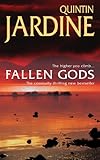
Fallen Gods is the 13th in the Bob Skinner books. It’s set in both Scotland and  America. The beginning of this book is quite confusing, which is down to me and not the author as I’ve jumped into the Bob Skinner books mid-stream as it were. It’s confusing because at the beginning of the book it appears that Bob is dead, ‘dropping in his tracks’ at his wife’s parents’ funeral. Sarah, his wife, says

His heart stopped, just like that. Makes you think, doesn’t it. There is no Superman; there is no Planet Krypton. Not even the great Deputy Chief Constable Bob Skinner was invulnerable. (page 6)

I had to double check.  I’d  read  the blurb before I started to read Fallen Gods and that stated that Bob’s career is ‘hanging by a thread’; that his brother’s body has been found in the detritus of a flood – a brother whose existence he has kept a secret for many years;  and that a valuable painting was burnt in the Royal Scottish Academy in Edinburgh. Whilst he and his team are investigating these events, his wife, Sarah is left in America with their children, recovering from the death of her parents. She finds comfort in the arms of an old college lover and then is faced with ‘a seemingly inevitable murder conviction’.

So how could Bob Skinner be dead? All was revealed as I read on and what a tangled web Quintin Jardine has woven (as Sir Walter Scott would say).

So, I have found another detective series to read. This is a complex book, with believable characters and it switches seemlessly between the crimes in  Scotland and America with ease. I was never unsure where I was or who I was with and there are a lot of characters to get your head round. It kept me guessing throughout as to the culprits and is really more about the characters and their personal lives than about the crimes.

I enjoyed this book and will be reading more of Bob Skinner in the future – there are 19 in total so far.

The Sunday Salon – Today’s Books

Today I started reading the ninth Inspector Rebus book  The Hanging Garden by Ian Rankin. Rebus is investigating a suspected Nazi war criminal living in Edinburgh, and a rival gang leader to Big Ger Cafferty, Tommy Telford. Rebus has given up drinking! It’s gripping stuff.

By way of contrast I also started Poetic Lives: Shelley by Daniel Hahn. I received this book from the publishers through LibraryThings Early Reviewers programme. It’s a slim little book of biography with extracts from Shelley’s poems. This morning I read how Shelley as a shy schoolboy was bullied at Eton, where he was nicknamed ‘Mad Shelley’ and later the ‘Eton Atheist’. It’s easy reading but I’m getting irritated by Hahn’s use of the word ‘would‘ in so many sentences.

It reminded me that I still haven’t read Ann Wroe’s book Being Shelley, which I’ve had for a while now. This is not a chronological account of Shelley’s life, but is about Shelley the poet rather than Shelley the man. Ann Wroe explains:

Rather than writing the life of a man into which poetry erupts occasionally, my hope is to reconstruct the world of a poet into which earthly life keeps intruding. (page ix)

I think reading the two in tandem should be interesting.