The House at Sea’s End by Elly Griffiths: a Book Review

The House at Sea’s End by Elly Griffiths is the third Ruth Galloway Investigation. I enjoyed the first two more than this last one. I found the use of the present tense in this book grated on me more than the other two and I thought the mystery element less than satisfactory – I solved it straight away! But having said all that it was still an enjoyable book, because of the characters.

It’s all about Ruth, her job as a forensic archaeologist, her baby and its father, and how she copes with juggling work and bringing up a child, or rather how she struggles with it all.

The bones of six people are found in a gap in the cliff, a sort of ravine, where there had been a rock fall at Broughton Sea’s End. Sea’s End House stands perilously close to the cliff edge above the beach.

High up on the furthest point of the cliff, is a grey stone house, faintly gothic in style, with battlements and a curved tower facing out to sea. A Union Jack is flying from the tower. (location 51)

These bones aren’t as ancient as those Ruth usually investigates and date back to about fifty or sixty years earlier. Chemical tests indicate they are of German origin and there are local stories about strange happenings concerning the Home Guard during the war. The captain of the Home Guard was Buster Hastings, the father of the current owner of Seas End House, Jack Hastings. Does he know more than he is admitting?  Added to this mystery there is also the death of Dieter Eckhart, an investigative journalist to solve. Who wanted him dead and why?

This brings DCI Harry Nelson into the picture and as in the earlier books Ruth is drawn into great danger as she delves further into both mysteries. Other characters from the earlier books are also here – Ruth’s friends, Shona and Cathbad, the part-time Druid. I found some of the back stories slowed the action down too much for my liking and I just wanted it to move along. I found this at odds with the present tense, which does rush my reading. I really, really do wish these books weren’t written in the present tense!

  • Format: Kindle Edition
  • File Size: 475 KB
  • Print Length: 352 pages
  • Publisher: Quercus (6 Jan 2011)
  • Sold by: Amazon Media EU S.à r.l.
  • Language English
  • ASIN: B004MME2H4
  • Source: I bought it

Looking forward to …

… P D James’s new book – Death Comes to Pemberley, which is due out on 3 November.

I don’t usually like sequels to books written by a different author, but I think I’ll have to make an exception for this one. It’s set six years after the events of Pride and Prejudice, Jane Austen’s tale of romance and social advancement and sees Darcy and Elizabeth’s marriage thrown into disarray when Lydia Wickham arrives unannounced and declares her husband has been murdered.

For more information see this BBC page after P D James’s talk on Radio 4 the other day, although she declined to give any further details saying, “It’s rather secret at the moment, because it’s something entirely new.”

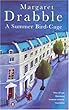
Book Beginnings: A Summer Bird-Cage by Margaret Drabble

Last Friday I quoted the opening sentences of Life Support by Tess Gerritsen, which was going to be the next book I read. I did read on for a couple of chapters but had to stop as I was just not in the mood for reading a medical thriller set in a hospital – too close to the bone! I fancied reading something less disturbing, so I took A Summer Bird-Cage by Margaret Drabble down from the bookcase and began to read that:

I had to come home for my sister’s wedding. Home is a house in Warwickshire, and where I was coming from was Paris. I was keen on Paris, but will refrain from launching into a description of the Seine. I would if I could, but I can’t. (page 7)

A Summer Bird-Cage was Margaret Drabble’s first novel. It was first published in 1963 and is set at the in the early 1960s, about the lives of two sisters – Sarah, the narrator who has just graduated from Oxford University and is wondering what to do with her life, and her beautiful sister Louise who at the start of the book is about to marry, Stephen, a rich novelist. From what I’ve read so far, neither of them seem happy and there is definitely tension between them.

Interesting I think, and I’m wondering if it maybe a bit autobiographical – Margaret Drabble is the younger sister of A S Byatt. Maybe this sentence was personal, comparing the two sisters, when Sarah says – ‘As far as tags go she is grande dame where I am jeune fille, and she leads all her life to match it.’ Or maybe I’m reading too much into that.

Book Beginnings on Friday is hosted by Katy at A Few MorePages.

Two New Acquisitions

I was really pleased to find these two books on recent visits to local bookshops.

First is Lilian Nattel’s The River Midnight. I’ve been reading Lilian’s blogs A Writer Reads and A Novelist’s Mind for a while and was interested in reading her books. Lilian also has a website with details of more of her books. Amazon UK has some copies of her first novel, The River Midnight for sale, the new ones at prices from £13.98 up to £40, with secondhand copies too, more reasonably priced (which you can see via my link to the book) and I was thinking about sending off for one. But I was thrilled to find a good paperback copy in The Border Reader Bookshop one of the local secondhand bookshops I visit, so I snapped it up. I love the cover.

It’s set in the tiny, fictional village of Blaska in Russian-occupied Poland at the end of the 19th century and the beginning of the 20th. Pogroms are a recent memory for the Jewish community, yet life in Blaska is rich and the bonds of friendship unbreakable. It’s a place where anything – even magic can happen (taken from the back cover).

The second book I was excited to find was from Barter Books, another favourite secondhand bookshop. I’d recently watched the film, Schindler’s List for a second time and was very moved by it – it had me in tears. So I wanted to find the book on which Steven Spielberg had based his film.  It was there at the top of a very high bookcase in the main body of Barter Books and D got up the step-ladders to retrieve it for me.

Thomas Keneally’s 1982  Booker Prize winning book was first published as Schindler’s Ark. It recreates the story of Oskar Schindler, a member of the Nazi party, who risked his life to protect Jews in Nazi-occupied Poland. He rescued more than a thousand Jews from the death camps.

Both books are based on real historical events, both set in Poland and about Polish Jews. Both have used contemporary sources and are based on historical research. Lilian has included  a selection of the sources she used and Thomas Keneally used a mass of Schindler material including testimonies of survivors, photographs of the period, documents, some of them produced by Oskar himself, copies of SS telegrams, and the famous list of Swangsarbeitslager Brinnlitz, Oskar’s second camp.  I think these two books go together and I’m planning to read them consecutively as soon as I can.

Book Beginnings: Life Support

Life Support by Tess Gerritsen is the fourth book I’ll be reading in the RIP IV Challenge. According to the back cover this is ‘a quick, delightfully scary read‘, which fits in well with the RIP challenge criteria.

It begins:

A scalpel is a beautiful thing.

Dr Stanley Mackie had never noticed this before, but as he stood with head bowed beneath the OR lamps, he suddenly found himself marveling at how the light reflected with diamondlike brilliance off the blade. It was a work of art, that razor sharp lunula of stainless steel. So beautiful in fact, that he scarcely dared to pick it up for fear he would somehow tarnish its magic. In its surface he saw a rainbow of colors, light fractured to its purest elements. (Page 13)

This will be the first book by Tess Gerritsen that I’ve read. It’s been on my bookshelves for quite a while now and I have been wary of reading it in case it’s too gory for me. I didn’t buy it, it was a free book with the magazine Woman and Home, which I buy now and then. When I read the Introduction I was even less sure this book was for me as Tess Gerritsen wrote that she got the idea for the book whilst at medical school (she is a doctor), when she heard the professor say the words ‘human cannibalism’ in his lecture on Creutzfeld-Jakob disease, a viral infection of the brain.

So I put this book way down on my to-be-read books, but since then I’ve read several favourable reviews of other books by Gerritsen so I thought I’d try this one. I like the style of writing in this first paragraph and it does make me want to read on, so when I’ve finished one of my current reads I’m going to start Life Support. Let me know what you think if you’ve read it?

Book Beginnings on Friday is hosted by Katy at A Few More Pages.

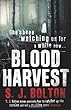
Blood Harvest by S J Bolton: a Book Review

I thoroughly enjoyed Blood Harvest, even though (or maybe because) it’s a dark, scary book and one that I found disturbing, but thoroughly absorbing . Each time I had to stop reading it I was eager to get back to it. I’ve previously read S J Bolton’s earlier books – Sacrifice and Awakening – and think that Blood Harvest surpasses both of those.

It’s set in the fictional town of Heptonclough in Lancashire and there is a very helpful map at the start of the book showing the layout of the town. There are two churches, the ancient ruined Abbey Church and standing next to it the ‘new’ church of St Barnabas. The Fletchers have just moved into a new house built on the land right next to the boundary wall of the churchyard:

The Fletcher family built their big, shiny new house on the crest of the moor, in a town that time seemed to have left to mind it’s own business. They built on a modest-sized plot that the diocese, desperate for cash, needed to get rid of. They built so close to the two churches – one old, the other very old – that they could almost lean out from the bedroom windows and touch the shell of the ancient tower. And on three sides of their garden they had the quietest neighbours they could hope for, which was ten-year-old Tom Fletcher’s favourite joke in those days; because the Fletchers built their new house in the midst of a graveyard. They should have known better, really. (page 17)

Tom has a younger brother, Joe and they’re playing in the graveyard when they catch glimpses of a girl watching them, and hear voices. Their little sister, two-year old Millie sees her too.  Tom is terrified, convinced something terrible will happen and then Millie disappears. Harry is the new vicar, getting to know the locals and their strange rituals and traditions. He too hears voices, in the church but can’t find anyone there. Evi, a psychiatrist has a new patient, Gillian, unemployed, divorced and alcoholic, who can’t accept that her daughter died in the fire that burnt down her home. The Renshaws own most of the land, old Tobias, his son Sinclair and his two daughters, Jenny and Christiana.

Heptonclough is not a good place for little girls, three have died over the past ten years and Christiana asks Harry to tell the Fletchers to leave:

‘So many little girls’, she said. ‘Tell them to go, Vicar. It’s not safe here. Not for little girls.’ (page 353)

It’s not safe at all for the Fletcher family. I was completely convinced not only by the setting but also by the characterisation that this place and these people were real. It’s full of tension, terror and suspense and I was in several minds before the end as to what it was all about. I had an inkling but I hadn’t realised the full and shocking truth.

An excellent book to read for Carl’s RIP IV Challenge.