Operation Mincemeat by Ben Macintyre: a Book Review

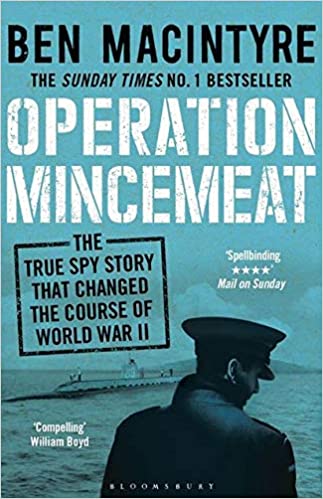
Subtitled The True Spy Story that Changed the Course of World War II, Operation Mincemeat is about the Allies’ deception plan codenamed Operation Mincemeat in 1943, which underpinned the invasion of Sicily. It was framed around a man who never was.

The success of the Sicilian invasion depended on overwhelming strength, logistics, secrecy and surprise. But it also relied on a wide web of deception, and one deceit in particular: a spectacular con trick dreamed up by a team of spies led by an English lawyer. (page xi)

At first I found this book a little confusing and far too detailed, but as I read on I became absolutely fascinated and amazed at what had actually happened. The plan was to take a dead body, equipped with false documents, deposit it on a beach in Spain, so that it would be passed over to the Germans and divert them from the real target into believing that the preparations to invade Sicily were a bluff.

Operation Mincemeat would feed them both a false real plan, and a false cover plan – which would actually be the real plan (page 58)

The corpse was a Welsh tramp who had committed suicide. His body was clothed in the uniform of an Royal Marine with documents identifying him as Major William Martin and letters about the top-secret Allied invasion plans. This involved creating a fictional character, a whole host of imaginary agents and sub-agents all with their own characteristics and imaginary lives – just as in a novel. The details of the deception were dreamt up by Ewan Montagu, a barrister and Charles Cholmondeley (pronounced Chumley), a flight-lieutenant in the RAF seconded to MI5, the Security Service. Both were enthusiastic readers, which stood them in good stead:

For the task of the spy is not so very different from that of the novellist: to create an imaginary credible world, and then to lure others into it, by words and artifice. (page 62)

The plan was not without its faults and and indeed it contained some potentially fatal flaws, but incredibly it succeeded.

Operation Mincemeat was pure make-believe; and it made Hitler believe something that changed the course of history. (page 307)

This is a book, totally outside my usual range of reading. I wasn’t expecting to enjoy it as much as I did and I think I did enjoy it because it was so far-fetched to be almost like reading a fictional spy story. I marvelled at the ingenuity of the minds of the plans’ originators and the daring it took to carry it out.
Library Loot/Teaser Tuesday

It’s been a while since I wrote a Library Loot post and as I went to the library today I thought I’d combine it with a Teaser Tuesday post.

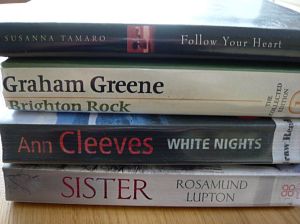
I’ve dipped into each book. From top to bottom they are:

Follow Your Heart by Susanna Tamaro, translated from the Italian by Avril Bardoni. I fancied reading something different from my usual type of book – this book won the Premio Donna Citta di Roma in 1994. From the book jacket – ‘it reflects on feelings and passions and how failure to communicate leads to futility, misunderstanding and tragedy – a meditation on existence.’ An old woman writes to her granddaughter:

As I have wandered aimlessly through the empty house these last few months, the misunderstandings and bad temper that marred our years together have vanished. The memories surrounding me now are of you as a child – a vulnerable, bewildered little creature. (page 3)

Brighton Rock by Graham Greene. A book I’ve known of for so many years and never read. I had no idea that it is a detective story! I love the way it begins:

Hale knew, before he had been in Brighton three hours, that they meant to murder him. With his inky fingers and his bitten nails, his manner cynical and nervous, anybody could tell he didn’t belong – belong to the early summer sun, the cool Whitsun wind of the sea, the holiday crowd. (page 1)

I can just see the scene!

White Nights by Anne Cleeves. I’ve been looking out for this book, the second in her Shetland Quartet, ever since I enjoyed reading the first one – Raven Black. Shetland detective Jimmy Perez investigates what seems at first to be a straightforward suicide. This is my teaser:

‘I don’t know my name’, he said flatly. No drama now. ‘I can’t remember it. I don’t know my name and I don’t remember why I’m here.’ (page 16)

Sister by Rosamund Lupton. More crime fiction, a psychological thriller. I’d read about this book on a blog (sorry, can’t remember which one – it may have been more than one blog) and thought it sounded good. Beatrice’s younger sister Tess is missing. She refuses to give up looking for her and  is determined to discover the truth about Tess and what has happened to her.

For a moment, amongst the crowd, I saw you. I’ve since found out it’s common for people separated from someone they love to keep seeing that loved one among strangers; something to do with recognition units in our brain being too heated and too easily triggered. This cruel trick of the mind lasted only a few moments, but was long enough to feel with physical force how much I needed you. (page 26)

I have high hopes of all four books.

Wherever You Go by Joan Leegant: a Book Review

I really enjoyed reading Wherever You Go by Joan Leegant. When Joan emailed me to ask if I would like a review copy I nearly said no thank you, because I have so many books to read and I couldn’t say when I’d get round to reading it. I’m glad I didn’t because when it arrived I soon found myself reading it and then I couldn’t stop. It’s a dramatic (but not melodramatic) and thought provoking book.

It’s about three people, and the narrative moves between them beginning with Yona Stern, an American visiting her sister Dena, a settler living in the territories near Hebron on the West Bank. Yona has come to make peace with Dena, after being estranged for ten years. It then moves on to Mark Greenglass, a Talmud teacher in Jerusalem, now visiting his parents in New York, before returning to Jerusalem. He’s come to a crisis point in his life where he is questioning his faith, his life and his career. The third person is Aaron Blinder, a young American and a somewhat pathetic individual who gets involved in an unofficial commune just outside Jerusalem. Events gradually connect the three, changing all three lives.

Wherever You Go is convincing, with a strong sense of location, believable characters and a fast-paced plot. I’m neither Jewish or American but I thought this was an interesting view of life in Israel, and of the relationship between Israel and America and of Jewish Americans living in both countries. It also conveys the conflicts and tensions of Israeli life, emphasising the dangers of religious and political extremism. But it’s not just a commentary on the political and religious issues, as it explores each of the characters’ personal issues – seeking forgiveness, looking for the truth in religious beliefs, and reconciling family relationships. All in all, a well-rounded novel, which captivated me.

  • Paperback: 253 pages
  • Publisher: W. W. Norton & Co.; Reprint edition (9 Sep 2011)
  • Language English
  • ISBN-10: 0393339890
  • ISBN-13: 978-0393339895
  • Source: review copy from the author
  • My rating 4.5/5

Saturday Snapshot

I’ve been reading Joan Leegant’s novel Wherever You Go, which is set in Israel and America. I’ll be writing about this book, which I really liked in a future post. It reminded me of our visit to Israel in 1993, so I got out the photo albums and here are just a few:

First a sight of camels on the skyline – photo taken from the coach on the way to Jerusalem.

Then a view of Jerusalem showing the Dome of the Rock, but not the usual view of the golden dome because this was in 1993 when the covering was being refurbished. It was covered with scaffolding all around it!

The Chagall Windows get a brief mention in Wherever You Go, when one of the characters talks of them disparagingly – Mariah the self-appointed arbiter of taste saying to Yona, one of the main characters:

I suppose you’ll go see the Chagall windows in the famous hospital in Jerusalem, Mariah had sniffed, the legendary artist deemed by the gallery crowd to be the painterly equivalentof Fiddler on the Roofall mush and sloppy sentimentality, colorful art, like colorful clothes, against the law. (page 122)

The beautiful Chagall Windows in the Synagogue of the Hadassah Medical Centre were on our tour and I loved them. You couldn’t take photos inside but here is one of the outside:

I bought a tapestry canvas of one of the windows, Zebulon, whilst I was there. I still haven’t bought the wool to actually stitch the tapestry! I’d love it to look something like this when I’ve stitched it:

The whole visit was very memorable, and we have loads of photos, but one in particular was very special – the Yad Vashem Memorial. The photo shows the statue at the entrance to the Children’s Memorial in an underground cavern. You go down into a dark chamber where candles are reflected so it seems as though you are lost in space surrounded by stars:

Maybe sometime I’ll post more photos of our visit.

Saturday Snapshot is hosted by Alyce on her blog At Home With Books.

The Nature of the Novel

I was interested to hear the Chair of the Man Booker Prize Judges – Dame Stella Rimington’s ideas about the nature of the novel last night in her speech at the Award ceremony.

She said:

 This year I have attracted some opprobrium by mentioning the dread word ‘˜readability’ – taken by some to mean that we were prioritizing easy reading against quality, or, as some put it, that we were dumbing down. That was certainly not our intention and I don’t believe that’s what we’ve done. But it does raise the interesting question – what’s a novel for? For me it’s to be read.

Read, enjoyed, marvelled at, thought about and even learned from. But definitely enjoyed, because it’s true of most people – that if they don’t enjoy a book, they’ll put it down unread. People enjoy very different things, of course, but I’m delighted that our shortlist has sold so well – and that very many people are telling us that they’re enjoying reading the books.

But for some, the sales seem to be a cause for anxiety. So clearly they must think a novel is for something different.

The debate our shortlist has created takes me back to when I was a student of English Literature at Edinburgh University in the ‘˜50s. It was just a few years after F R Leavis had published ‘˜The Great Tradition’, in which he set out his criteria for the great novel: ‘˜a vital capacity for experience, a kind of reverent openness before life and a marked moral intensity’ – what’s wrong with that?

I agree with her definition. What is wrong with being readable? For me a novel must be readable in the first place, because why plough through books that you’re not enjoying or learning anything from?  In the second place it must also be one that makes me think – gives me new ideas or new ways of looking at things, and finally if it’s one that takes me out of myself, transports to me to another time or place it’s one to marvel at and treasure.

I haven’t read any of this year’s shortlisted books because, apart from the winner Julian Barnes’s The Sense of an Ending – they didn’t really appeal to me. But after watching BBC2’s fascinating programme on The Culture Show‘Britain’s Biggest Book Prize: A Village Decides (Again)‘, earlier last night, in which the villagers of Comrie in the Highlands voted Stephen Kelman’s Pigeon English as their winning book, I’m encouraged to give that one a go too.

Fair Exchange by Michèle Roberts: a Book Review

Fair Exchange by Michèle Roberts is from my to-be-read pile. I’ve had it for years and had started to read it once (it still had a book mark in it, but I had to begin again as I’d completely forgotten it) and stopped. I can’t remember why, because this time round I found it very readable. It’s historical fiction set in England and France in the late 1700s/early 1800s during the French Revolutionary period.

The Author’s Note at the beginning of the book explains that although she began with the idea of writing a novel about William Wordsworth’s love affair at the beginning of the French Revolution, with Annette Vallon, but as she wrote it, it turned into a novel about William Saygood a fictional friend of Wordsworth’s. Mary Wollstonecraft appears in the novel but Roberts has ‘plundered various aspects of her life’  for the character, Jemima Boote.  I like the fact that upfront you know that some of the events, places and people are fictional and that she hopes readers will forgive her ‘for the liberties’ she has taken. Well, I do.

It begins in France in 1792, thus:

In her youth Louise Daudry, née Geuze, had committed a wicked and unusual crime. At that time, autumn 1792, she wanted money very badly, so she put aside her knowledge that what she was doing was wrong and would hurt others. She told herself that virtue was a luxury the poor could not afford. She let herself be persuaded that no one would ever find out. (page 3)

Then it goes back in time and place to England years earlier when Jemima Boote met Mary Wollstonecraft. As you would expect there is a fair bit in this book about women’s rights and their place in society, and about the question of nurture versus nature in bringing up children. Jemima is a strong character, a free spirit but her life doesn’t turn out how she expected, affected not only by the Revolution but also by events in her personal life.

Intertwined with Jemima’s life are those of Louise, who works for the Vallons,  Annette Vallon, who falls in love with an English poet, and William Saygood, and Polly his sister (based on William and Dorothy Wordsworth?). When Annette discovers she is pregnant, Louise takes her to live in her mother’s house in the countryside and it is there that Annette and Jemima (also pregnant) meet, thus setting in motion the events that change both their lives.

I liked the ambiguity in this book, the uncertainty of what exactly was the crime that Louise had committed. It’s well written and kept me guessing almost to the end of the book. It’s one I’d like to re-read (if only I had the time!) to see if I could pick up the hints about what happened.

  • Paperback: 256 pages
  • Publisher: Virago Press Ltd; New edition edition (3 Feb 2000)
  • Language English
  • ISBN-10: 1860497640
  • ISBN-13: 978-1860497643
  • Source: my own copy (a Christmas/Birthday present)
  • Rating: 3/5