Sleeping Murder by Agatha Christie: a Book Review

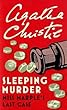
Sleeping Murder is Miss Marple’s last case, published posthumously in 1976, although Agatha Christie had written it during the Second World War. Miss Marple investigates a murder that had happened 18 years ago.

 As I began to read I thought it seemed familiar and then I realised I’d watched the TV version a few years ago, with Geraldine McEwan as Miss Marple and after a couple of chapters I remembered who the murderer was. This didn’t spoil my enjoyment as I was able to see the clues as they cropped up.

Newly married Gwenda has bought a house in Devon. She had only recently returned to England from New Zealand where she had been brought up by an aunt after the death of her parents when she was a small child. She immediately felt at home in the house, but then began to have strange premonitions and whilst she was at the theatre watching The Duchess of Malfi  she had a vision of a murder at the house she had just bought. She heard the words:

‘Cover her face. Mine eyes dazzle, she died young …’

Gwenda screamed.

She sprang up from her seat, pushed blindly past the others out into the aisle, through the exit and up the stairs and so to the street. She did not stop, even then, but half walked, half ran, in a blind panic up the Haymarket (Page 27)

She is convinced that she is going mad, but she is helped by Miss Marple, whose nephew, Raymond West is a distant cousin of Gwenda’s husband, Giles. It’s a most baffling ‘˜cold case’, because first of all they have to discover who, if anyone, had been killed, where, when and why. It does all rather depend on a number of coincidences, beginning with the fact that Gwenda has bought the house that she had lived in as a very young child, but as Miss Marple explains to Gwenda:

‘˜It’s not impossible, my dear. It’s just a very remarkable coincidence – and remarkable coincidences do happen. You wanted a house on the south coast, you were looking for one, and you passed a house that stirred memories and attracted you. It was the right size and a reasonable price, so you bought it. No, it’s not too wildly improbable. Had the house been merely what it is called (perhaps rightly) a haunted house, you would have reacted differently, I think. But you had no feeling of violence or revulsion except, so you have told me, at one very definite moment, and that was when you were just starting to come down the staircase and looking down into the hall. (Pages 33-4)

That moment, as it turned out was very significant, indeed.

Sleeping Murder is a satisfying puzzle and I liked this last view of Miss Marple, compassionate and shrewd and this description of her appearance:

Miss Marple was an attractive old lady, tall and thin, with pink cheeks and blue eyes, and a gentle, rather fussy manner. Her blue eyes often had a little twinkle in them. (page 26)

  • My rating: 4/5
  • Paperback: 304 pages
  • Publisher: HarperCollins; Masterpiece edition (Reissue) edition (2 Jun 2008)
  • Language English
  • ISBN-10: 0007121067
  • ISBN-13: 978-0007121069
  • Source: I bought the book

Book Beginnings on Friday: The Inspector’s Daughter

How to participate: Share the first line (or two) of the book you are currently reading. Book Beginnings is hosted by Katy at A Few More Pages every Friday.

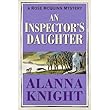
I found The Inspector’s Daughter by Alanna Knight in my local library recently. I’d never come across this author before but see from the book cover that she has written more than 40 novels, 4 non-fiction books, numerous short stories and 2 plays!

With some many books to her name I thought I’d once again jumped into a series of books, but I was lucky because The Inspector’s Daughter is the first in the Rose McQuinn Mysteries. In this book set in 1895 Rose has returned home to Edinburgh from the American Wild West and it’s not long before she steps into her father’s shoes by agreeing to investigate the strange behaviour of her friend’s husband.

The book begins:

Soon I would be safe.

The journey from nightmare was almost ended. Every turn of the train’s wheels, every drifting smoke wreath closed the door more firmly on the past.

Beyond the hills, the blue glimpse of the sea, Edinburgh was fast approaching, epilogue to ten years in America, so-called land of opportunity but for me a land of tragedy and loss.

So, this opening shows that Rose has had a bad time – ‘a nightmare’, and  a ‘tragedy’ in America, but raises questions, such as – what happened? What was the loss? And why did she go to America and what is she coming home to? I haven’t read much further so I don’t know the answers yet – but this opening does make me want to read on to find out.

I’ve borrowed this book from the library but I see on Amazon that a Kindle edition is available. Alanna Knight has a website, where I see she not only writes but also paints!

The Woman in White by Wilkie Collins: a Book Review

I read The Woman in White (TWIW) by Wilkie Collins in January and have been wondering how to do justice to it in a post, because it’s a real chunkster of over 700 pages. (For a summary of the plot, with spoilers see the article on the book on Wikipedia.)

It’s one of the first if not the first ‘sensation novel‘. A ‘sensation novel‘ is one with Gothic elements  – murder, mystery, horror and suspense – within a domestic setting. Since reading TWIW I’ve read The Sensation Novel by Lyn Pykett, which describes such novels as a ‘minor subgenre of British fiction that flourished in the 1860s only to die out a decade or two earlier.’ They have complicated plots, are set in modern times, and are reliant on coincidences, with plots hinging on murder, madness and bigamy. They exploited the fear that respectable Victorian families had of hidden, dark secrets and explored the woman’s role in the family. There is a pre-occupation with the law – wills, inheritance, divorce and women’s rights over property and child custody. They are emotional dramas about obsessive and disturbed mental states, with villains hiding behind respectable fronts, and bold assertive women, as well as passive, powerless and compliant women.

These issues and more are present in TWIW. It has several first person narrators, who are each not in possession of the whole story. Their accounts from letters, diaries and formal statements are limited to what each one knew or had experienced, and are not always reliable. It begins with Walter Hartright’s meeting with the mysterious Woman in White, as he is on his way to take up the position of drawing master to Marian Halcombe and Laura Fairlie at Limmeridge House, in Cumberland.

 There, in the middle of the broad bright high-road – there, as if it had that moment sprung out of the earth or dropped from heaven – stood the figure of a solitary Woman, dressed from head to foot in white garments, her face bent in grave inquiry on mine, her hand pointing to the dark cloud over London as I faced her.

Just who she is only becomes clear much later on the story. During their conversation she reveals that she knows Limmeridge House and its occupants. Walter helps her, but then is filled with guilt when he is told that she had escaped from an asylum.

Laura and Marian are half-sisters, living with their uncle, Frederick Fairlie, a weak, effeminate invalid. Walter is immediately struck by the beauty of Marian’s figure, but astonished when he saw her face:

The lady is ugly! …

The lady’s complexion was almost swarthy, and the dark down on her upper lip was almost a moustache. She had a large, firm, masculine mouth and jaw; prominent, piercing, resolute brown eyes; and thick coal-black hair, growing unusually low down on her forehead.

Marian, clever and assertive is in complete contrast in both appearance and character to the lovely Laura. Walter falls in love with Laura, but she is pledged to marry Sir Percy Glyde, a marriage arranged by her dead father. Matters are complicated by the fact that Laura and the Woman in White look remarkably alike, which is central to the plot. Sir Percy attempts to gain total control of Laura’s money and property, aided by the villainous Count Fosco.

I found it a book of two halves – slow to get going, full of descriptive writing and I was beginning to wonder when something was actually going to happen. Then in the second half the pace increased, the action was fast and complicated, with plenty of tension and melodrama. I enjoyed it, although I do prefer The Moonstone.

I read this book as part of November’s Autumn Classics Challenge and The Book Garden’s Tea and Books Challenge (reading books of over 700 pages).

Weekend Cooking – Curried Carrot & Apple Soup

It’s been a while since I wrote a Weekend Cooking post – Weekend Cooking is hosted at Beth Fish Reads and is open to anyone who has any kind of food-related post to share: Book (novel, nonfiction) reviews, cookbook reviews, movie reviews, recipes, random thoughts, gadgets, fabulous quotations, photographs. For more information, see the welcome post.

I had quite a lot of apples recently and after making various puddings I looked in my cookery books and found a recipe for curried carrot and apple soup in the Kitchen Doctor Low-Cholesterol Cooking for Health.

I adapted the recipe to make enough for two rather than four. Here is the recipe as detailed in the book, click on the image to enlarge:

It’s really easy to make – first heat the oil and gently fry the curry powder for 2-3 minutes. Then add the carrots, onion and apple, stir and cover the pan, cooking over a low heat for about 15 minutes until they soften. I added the stock and brought it to the boil.

Then I blitzed it with a hand-held blender, seasoned it with salt and coarse ground black pepper. If you like add a swirl of yoghurt (I didn’t this time) and serve.

The curry and the apple tone down the sweetness of the carrots – delicious.

The book contains over 50 low-cholesterol and low-fat recipes, with sections on soups and starters, meat, poultry and fish main courses, plus pasta, pulses and vegetable dishes and desserts, cakes and bakes.

Book Beginnings on Friday

How to participate: Share the first line (or two) of the book you are currently reading. Book Beginnings is hosted by Katy at A Few More Pages every Friday.

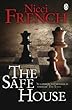
I’m in the middle of reading The Safe House by Nicci French. It begins:

The door was the first thing. The door was open. The front door was never open, even in the wonderful heat of the previous summer that had been so like home, but there it was teetering inwards, on a morning so cold that the moisture hanging in the air stung Mrs Ferrer’s pocked cheeks. She pushed her gloved hand against the white painted surface, testing the evidence of her eyes.

‘Mrs Mackenzie?’

Silence. Mrs Ferrer raised her voice and called for her employer once more and felt embarrassed as the words echoed, high and wavering, in the large hallway. She stepped inside and wiped her feet on the mat too many times, as she always did. she removed her gloves and clutched them in her left hand. there was a smell now. It was heavy and sweet. It reminded her of something. the smell of a barnyard. No, inside. A barn maybe.

These paragraphs drew me into this mystery/psychological thriller and I wanted to know why the door was open and the source of the barnyard smell. There’s not long to wait because that becomes clear on the next page. After a dramatic opening the book settles down to a more leisurely pace, but slowly building up the tension.

I am wondering just how safe the Safe House of the title really is.

Crime Fiction Pick of the Month: January

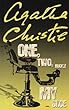
I didn’t read much crime fiction in January, just two books, if you don’t count The Woman in White by Wilkie Collins. They are The Burry Man’s Day by Catriona McPherson and One, Two, Buckle My Shoe by Agatha Christie.

And I’ve chosen One, Two, Buckle My Shoe as my crime fiction pick of the month. This was first published in 1940 (in the USA it was published as The Patriotic Murders).  Hercule Poirot and Inspector Japp investigate the apparent suicide of Mr Morley, Poirot’s Harley Street dentist, who was found dead in his surgery, shot through the head and with a pistol in his hand. Each chapter is entitled after a line of the nursery rhyme and the first line contains an important clue.Earlier in the morning Poirot had visited his dentist and as he was leaving the surgery another patient was arriving by taxi. He watched as a foot  appeared.

Poirot observed the foot with gallant interest.

A neat ankle, quite a good quality stocking. Not a bad foot. But he didn’t like the shoe. A brand new patent leather shoe with a large gleaming buckle. He shook his head.

Not chic – very provincial! (page 26)

The importance of the shoe and its buckle don’t become clear until much later in the book!

Mr Morley had seemed in good spirits when Poirot saw him and had shown no signs of wanting to take his own life. Was it coincidence that his assistant, Gladys, had been called away from his surgery on that day, leaving him on his own in his surgery? As Poirot and Japp interview the other patients it becomes obvious to Poirot that it was murder not suicide. Then one of the patients, a rich Greek, Mr Amberiotis is found dead, and another patient, Miss Sainsbury Seale, the owner of the buckled shoe, goes missing. Poirot begins to wonder if Morley had been killed by mistake whilst another of the patients Alistair Blunt, a banker was the intended victim.

This really is a most complicated plot, and even though the facts are clearly presented and I was on the lookout for clues, Agatha Christie, once again fooled me. Not all the characters are who they purport to be and the involvement of international politics and intrigue doesn’t help in unravelling the puzzle. Poirot, himself, is perplexed until during a church service he is alerted to the trap that has been set for him:

Hercule Poirot essayed in a hesitant baritone.

‘The proud have laid a snare for me,’ he sang, ‘and spread a net with cords: yea and set traps in my way …’

He saw it – saw clearly the trap into which he had so nearly fallen! (page 215)

It all fell into place and he saw the case ‘the right way up’.

Written in 1939, this book reflects the economic and political conditions of the time, with  a definite pre-war atmosphere of a world on the brink of war. But Poirot is concerned with the truth, with the importance of the lives of each individual, no matter how ordinary or insignificant they may seem.

  • My Rating: 4.5/5
  • Paperback: 294 pages
  • Publisher: HarperCollins; Masterpiece edition (Reissue) edition (18 Aug 2008)
  • Language English
  • ISBN-10: 0007120893
  • ISBN-13: 978-0007120895

You can see other people’s crime fiction picks of the month at Mysteries in Paradise.