Crime Fiction Alphabet: W is for Wycliffe …

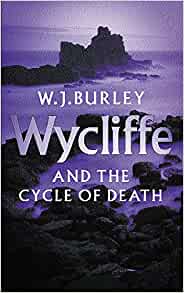
… Wycliffe and the Cycle of Death by W J Burley.

From the back cover:

When Matthew Glynn, a respectable bookseller is found bludgeoned and strangled, Chief Superintendent Wycliffe is mystified. Why would anyone want to kill him, and in such a brutal manner?

But a look at Glynn’s background reveals tension within the family. Alfred Glynn, an eccentric recluse, has held a grudge against his brother for years and the older brother, Maurice, argued bitterly with Matthew over the sale of family land. Add to this a discontented son, valuable documents in the bookseller’s safe, and the mysterious, still unexplained disappearance of Matthew’s wife years earlier, and Wycliffe faces one of his most impenetrable cases yet.

Then another Glynn dies and the murderer’s identity seems obvious. But Wycliffe is not convinced – and soon uncovers some very murky secrets, and the possibility of another murder …
My view:

The story is set in Penzance and its immediate neighbourhood, so Burley, who knew the area well (he lived near Newquay), sets the scene well. The three Glynn brothers didn’t get on, with a long-standing quarrel between Matthew and Alfred, which was connected to their mother, and a more recent row between Matthew and his other brother, Maurice, who objected to Matthew’s proposal to build houses near to Maurice’s pottery. And as Trice, the local DI,  tells Wycliffe, the locals are suspicious of outsiders – he’s talking not just about Cornwall, but about the local area, Penwith, which in Cornish means ‘ … “the extreme end”. The people here feel different – they are different.’

And this is a murder mystery with a difference, because all is not clear by the end. There are plenty of suspects, not just the brothers but also their sister and grown-up children. The reader is left to work out the puzzle, indeed Wycliffe struggles to come to terms with his suspicions and his mind is in turmoil:

With something approaching desperation, Wycliffe was trying to see the events in perspective, to relate them one to another and to imagine the repressed tensions and accumulated bitterness which had finally surfaced. But what troubled him most was the thought that he was being pushed beyond his role as an investigating officer into decisions which were either moral or judicial or both. (page 185)

I liked the book very much, with its complex plot, convincing characters, and in particular the way Wycliffe’s humane and thoughtful character is portrayed. The ending certainly makes you think.

  • Paperback: 320 pages
  • Publisher: Orion; New Ed edition (2 Aug 2001)
  • Language: English
  • ISBN-10: 0752844458
  • ISBN-13: 978-0752844459
  • Source: I bought the book
  • My Rating: 4/5

A Crime Fiction Alphabet post for the letter W.

October Prompt: A Classics Challenge

This month’s prompt in Katherine’s Classics Challenge 2012 is:

Chapter Musings
Jot down some notes about the chapter you’ve just read or one that struck you the most. It can be as simple as a few words you learned, some quotes, a summary, or your thoughts and impressions.

I’ve just started to read The French Lieutenant’s Woman by John Fowles. (I have read this book years ago and seen the film.) The first chapter is very short and sets the scene in a few paragraphs. The narrator is looking back to March 1867, presumably from the twentieth century. Three characters are present, none named in this first chapter, a man and a woman walking along the Cobb, ‘ a long claw of old grey wall that flexes itself against the sea’, and a solitary figure, standing at the end of the Cobb:

It stood right at the seawardmost end, apparently leaning against an old cannon-barrel upended as a bollard. Its clothes were black. The wind moved them, but the figure stood motionless, staring, staring out to sea, more like a living memorial to the drowned, a figure from myth, than any proper fragment of the petty provincial day.

The narrator is authoritative, contrasting the Victorian Lyme of a hundred or so years earlier with that of the present day and contrasting the style of dress and manners. There are literary and historical allusions, including the verse (quoted at the beginning of the chapter) from Thomas Hardy’s poem ‘The Riddle‘, and the vocabulary is also formal and academic. There are some unfamiliar words – just what I wondered are ‘dundrearies’ that the gentleman (for that is what is implied) was wearing:

… the taller man, impeccably in a light grey, with his top hat held in his free hand, had severely reduced his dundrearies, which the arbiters of the best English fashion had declared a shade vulgar – that is, risible to the foreigner – a year or two previously.

I had to look up this word – ‘dundrearies’ were long sideburns worn with a clean-shaven chin (a bit like Bradley Wiggins, who won this year’s Tour de France, maybe?).  There is also a hint that there is more to this story than a love story, for there is also a ‘local spy’.

This first chapter promises an intriguing novel.

Sweet Tooth by Ian McEwan: my view

I finished reading Sweet Tooth feeling disappointed. To my mind it falls well short of Atonement, but is better than Solar.

It began so well and Ian McEwan’s writing is smooth, eloquent and richly descriptive. I couldn’t fail to visualize the scenes and for the most part the characters were distinct and believable, but I really couldn’t warm to any of them – purely a personal reaction, and one that shouldn’t detract from the novel.

Set mainly in the 1970s, it’s written in the first person as Selena Frome, looks back from forty years later. The first paragraph reveals that she was sent on a secret mission by the British Security Services; the mission failed, she was sacked and her lover was ruined. From then on the novel expands on this plot. But this is not primarily a spy story, nor even a love story, although there is a lot about that and about the politics of the 70s (which dragged a bit), it’s about deception, about writers and writing and readers and reading, with multiple stories within stories. I should have enjoyed that, but it all fell a bit flat and contrived. And I really disliked the ‘unexpected twist in the tale’ at the end.

KevinfromCanada has written a more detailed analysis of Sweet Tooth, which expresses just what I felt about it. And for more positive reviews there are those in The Observer and The Telegraph, and for a slightly more reserved look at the book there is this article in The Independent.

  • Hardcover: 336 pages
  • Publisher: Jonathan Cape (21 Aug 2012)
  • ISBN-10: 0224097377
  • ISBN-13: 978-0224097376
  • Source: my own copy
  • My Rating: 3/5 (because I liked the writing)

Crime Fiction Alphabet: V is for Vargas

This week’s letter in Kerrie’s Crime Fiction Alphabet is V.

My choice of book is The Chalk Circle Man by Fred Vargas, translated from the French by Siân Reynolds. This is the first of her Commissaire Jean-Baptiste Adamsberg novels.

From the back cover:

Jean-Baptiste Adamsberg is not like other policemen. He doesn’t search for clues; he ignores obvious suspects and arrests people with cast-iron alibis; he appears permanently distracted. In spite of this his colleagues are forced to admit that he is a born cop.

When strange blue chalk circles start appearing on the pavements of Paris, only Adamsberg takes them – and the increasingly bizarre objects fround within them – seriously. And when the body of a woman with her throat savagely cut is found in one, only Adamsberg realises that other murders will soon follow.

My view:

As soon as I began reading this book I was entertained – the writing is fluent (unlike the translation I read of her later book Seeking Whom He May Devour) and easily conveyed the quirky nature of Vargas’s plot and characters. As the book cover summary describes, Adamsberg just doesn’t fit the usual detective profile – well, he is a loner, so that’s pretty standard, but apart from that he stands out  – an outsider from the Pyrenees, newly appointed to Paris as Commissaire of police headquarters in the 5th arrondissement. His colleagues don’t understand him, especially Inspector Danglard, who likes a drink and isn’t too reliable after about four in the afternoon.

Vargas goes into some detail both about Adamsberg’s history, appearance and characteristics, and about Danglard. Adamsberg is a thinker – but a vague thinker – he works mainly on intuition, whereas Danglard doesn’t trust feelings and gut instincts. He prefers to follow procedure, looking for clues and proof. Adamsberg claims that some people just ooze cruelty:

And most premeditated murders require the murderer not only to feel exasperation or humiliation, or to have some neurosis, or whatever, but also cruelty, pleasure in inflicting suffering, pleasure in the victim’s agony and pleas for mercy, pleasure in tearing the victim apart. It’s true, it doesn’t always appear obvious in a person, but you feel at  least that there’s something wrong, that something else is gathering underneath, a kind of growth. And sometimes that turns out to be cruelty – do you see what I’m saying? A kind of growth. (pages 17-18)

The chalk circle man intrigues Adamsberg and it is his meditation on his character that leads him to solve the mystery – but before that two other murders have taken place. Is the chalk circle man the killer, or is the killer using the circles to his own advantage? And why does he leave a lingering smell of rotten apples?

Adamsberg and Danglard are not the only eccentric characters – the book is full of them, all delightfully different including Mathilde, the marine biologist who prefers fish to people. She lets rooms to Charles, the beautiful blind man with a chip on his shoulder and to Clemence, the old lady who lives on the top floor. Clemence at seventy is still looking for the love of her life. She has an unattractive appearance with a bony face and sharp little teeth like a shrew-mouse and wears far too much make-up. I thought the interactions and conversation between these people was fascinating.

This is a very cleverly constructed and quirky mystery, and I was pleased that I did half guess the solution; I only half-guessed because there is a twist at the end which took me totally by surprise. I’ll certainly look out for more of Fred Vargas’s books to read.

  • Paperback: 256 pages
  • Publisher: Vintage; First PB Edition edition (4 Feb 2010)
  • Language: English
  • ISBN-10: 0099488973
  • ISBN-13: 978-0099488972
  • Source: Library book
  • My Rating: 4.5/5

Book Beginnings …

I’m currently reading  Ian McEwan’s latest book, Sweet Tooth. At the moment I’m still quite near the beginning of the book.

It didn’t take me long to decide that I wanted to read Sweet Tooth. I like Ian McEwan’s books, although I wasn’t that keen on his previous book, Solar, but this one looked good when I picked it up from one of the display tables in a local bookshop. Set in 1972, it’s about Serena Frome, the daughter of an Anglican bishop, who is a compulsive reader of novels. She works for MI5 in a very junior position, until she is assigned to a ‘special mission’ called ‘Sweet Tooth’, which brings her into the literary world of a promising young writer.

I’m hoping it’s going to be as good as Atonement, one of my favourite books.  Like Atonement, Sweet Tooth is both a love story and a book about writing.

It begins:

My name is Serena Frome (rhymes with plume) and almost forty years ago I was sent on a secret mission for the British security service. I didn’t return safely. Within eighteen months of joining I was sacked, having disgraced myself and ruined my lover, though he certainly had a hand in his own undoing. (page 1)

For more Book Beginnings on Friday see Gilion’s blog Rose City Reader.

The Judgement of Strangers by Andrew Taylor

The Judgement of Strangers is the second in Andrew Taylor’s Roth Trilogy, an ideal choice for  R.I.P.VII. This second book fills in some of the back story of the first, The Four Last Things, which I wrote about earlier. It covers events that took place in 1970 and although there is an atmosphere of suspense and mystery it is by no means as chilling and scary as The Four Last Things.

It’s narrated in the first person by David Byfield, who is a sexually frustrated, widowed parish priest with a mysterious past. When he marries Vanessa, his beautiful teenage daughter, Rosie, seems to accept her. But, it’s obvious that David is unaware of Rosie’s psychological troubles and is beset with problems – his own passions, the attentions of the menopausal spinster churchwarden, Audrey Oliphant, as well as his obsession with Joanna, the new young owner of Roth Park.

And then the murders begin and it seems that the influence of Francis Youlgreave, a 19th century opium addict, poet and priest who committed suicide at Roth Park is still prevalent. Vanessa is fascinated by him. The sole surviving member of the family, Lady Youlgreave, now  senile lives in the Old Manor House with her equally senile dogs, Beauty and Beast. She allows Vanessa to study Francis Youlgreave’s journals. The pressure and suspense build, with the climax at the village fete, which ends in disaster. 

 In some ways this book is a bit like an Agatha Christie mystery – set in a village (there’s a helpful map), with a mix of characters, locals, gentry and newcomers. The plot is complex and although it can be read as a self-contained novel, it really is best to read the trilogy in order, because there are answers in this book to some of the questions posed in the first and I think it could spoil the suspense if you read them the out of order. There are also intriguing glimpses into the past. I’m keen to read the third book – The Office of the Dead – as soon as possible. And I’d like then to re-read them in reverse order, just to see the difference.