Winter In Madrid by C. J. Sansom

The devastation, desolation and waste of war had me in tears as I was reading Winter In Madrid. I already knew from reading his 16th century crime thrillers that C. J. Sansom is a master storyteller and this book exceeded my expectations. It is an action packed thrilling war/spy story and also a moving love story and historical drama all rolled into this tense and gripping novel.

Sansom vividly conveys the horror and fear of the realities of life in Spain during the Spanish Civil War and the first two years of the Second World War. The opening chapter dramatically sets the tone for the book with the brutality of the Battle of Jarama in 1937 then leaps straight into the bombing of London in 1940. Then Harry Brett, traumatised by his injuries at Dunkirk is sent to Spain to spy for the British Secret Service. He is plunged into the terrible living conditions in Madrid where people are starving, children are left homeless to fend for themselves and wild dogs roam the rubble of bombed houses.


He turned into a square. Two sides had been shelled into rubble, all the houses down, a chaos of broken walls rising from a sea of shattered bricks and sodden rags of bedding. Weeds had grown up between the stones, tall scabrous dark-green things. Square holes in the ground half filled with green scummy water marked where cellars had stood. The square was deserted and the houses that had been left standing looking derelict, their windows all broken.

Harry had never seen such destruction on such a scale; the bombsites in London were small by comparison. He stepped closer, looking over the devastation. The square must have been intensively shelled. Everyday there was news of more raids on London – did England look like this now?

This is a long and detailed book, but it moves along rapidly, with believable characters, including the bullying Ambassador, Sir Samuel Hoare, Alan Hillgarth, the chief of intelligence (both of whom are real historical figures), diplomats, Spanish Monarchists and Falangists and the ordinary Spanish people. Franco’s Madrid is shown as a place where fear, poverty and corruption stalk the streets; where hatred and suffering are paramount. It’s a chilling picture, but Harry finds love too when he meets Sofia and plans her escape with him to England after he has completed his mission.

The question is will Franco maintain Spain’s neutrality and enter the war in support of Hitler? Harry’s cover is as an interpreter, whilst his mission is to make contact with Sandy Forsyth, who he had known at public school in England, gain his confidence and discover the truth behind the rumour that gold deposits have been discovered in Spain, which would boost the economy making Spain less reliant on British support. Harry, a reluctant spy, soon finds himself in danger. He is plagued by memories of another school friend Bernie Piper, an ardent Communist who had enlisted in the International Brigades and had disappeared, reported killed at the Battle of Jarama. Barbara, an ex- Red Cross nurse, now Sandy’s girlfriend and Bernie’s former lover is convinced Bernie was not killed She appeals to Harry for help in finding Bernie, and so the story moves to its climax.

With its haunting themes of corruption, murder, the power of authority and heroism Winter In Madrid captivated my imagination. I expect it will be made into a film but I don’t think I could bear to watch it after enjoying this book so much.

Note: This book qualifies for the following Challenges – From the Stacks (I’ve had it unread for months), the Chunkster Challenge (it’s 530 pages) and What’s In a Name?
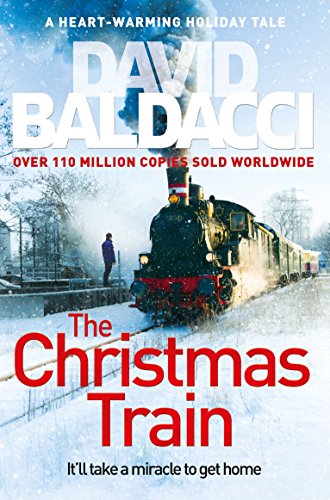
A Journey Across America: The Christmas Train

I’ve been reading The Christmas Train by David Baldacci and got engrossed in the route taken by Tom Langdon as he travelled by train from Washington DC across America to Los Angeles. I’ve had to look at Google Maps and Google Earth, Wikipedia and other internet sites in my quest to learn more about the places the train journey passed through. Knowing next to nothing about the geography of the USA I’ve found this a fascinating exercise.

I wouldn’t have read this book at all if Sam at The Life and Times of Me hadn’t mentioned it in her comment on my post on Christmas Books. Basically this is a love story. Tom, a world-weary journalist is travelling from Washington DC to spend Christmas with his girlfriend who lives in Los Angeles. It’s also a detective story as there is a thief on the train and I didn’t work out the thief’s identity at all, so that was a surprise. Added to that are the stories of the staff and other passengers, including Eleanor, the long-lost love of Tom’s life, and her employer, Max a movie director – what is the real reason they are travelling by train, after all Max has his own private jet?

The book is easy to read but what really interested me were the journey and some references that are really extra to the plot. First the references – Mark Twain and The Cumberland Gap. Tom has decided to use the time on the train to write a story about the journey, inspired by the fact that Sam Clemens, otherwise known as Mark Twain had married one of his ancestors. There was a legend that Twain had never published the story of his transcontinental railroad trip taken at Christmas time during the latter part of his life and Tom’s father had asked him to finish the story Twain had never published. Tom refers to Twain’s Innocents Abroad, an account of a five-month journey on a steam ship to Europe and the Holy Land, as ‘one of the funniest, most irreverent travel books ever written. I’d like to read that book. I’ve already got Tom Sawyer and Huckleberry Finn lined up to read this year, so now I’m looking out for Innocents Abroad, Life on the Mississippi and The Man Who Corrupted Hadleyburg as well.

The Cumberland Gap I knew of before reading this book is the song by Lonnie Donegan from the late 1950s and I’d never realised that it referred to a gap in the Appalachian Mountains in Tennessee, a natural breach in the mountains on the route to the Plains and the Pacific; an ancient path widened by Daniel Boone to take wagons into the western frontiers. Reading the book I had the words of the song going through my head over and over again – I suppose that’s not the effect that David Baldacci would have expected from his readers, but I enjoyed it.

Photo of Cumberland Gap licensed under the Creative Commons License

I think David Baldacci must like Mark Twain, Hitchcock films maybe (North by Northwest starring Cary Grant gets a mention), and above all I think he must like trains. He obviously has researched the passenger train service, Amtrak – the Capitol Line from Washington D C to Chicago and then the Southwest Chief on to Los Angeles. I got to know a bit about the places the trains either stopped at or went by – Rockville, Maryland where F Scott Fitzgerald is buried, Harper’s Ferry West where John Brown made his raid on the federal army before the Civil War started – another song going through my head – ‘John Brown’s body lies a’mouldering in the grave.’ Cumberland Gap, over the Mississippi and yet another song in my head, this time Paul Robeson’s ‘Ol Man River‘; Kansas City and Dodge City – thinking of outlaws, Gunsmoke and High Noon. On the train goes through the Raton Pass, Apache Canyon (more western films pop into my head), Las Vegas in New Mexico, La Junta and Pike’s Peak in Colorado and the Sangre de Cristo Mountains, Albuquerque (visions of the Rio Grande) and Gallup before reaching Los Angeles. The climax comes as the train is halted in its tracks with no way back to Chicago or forward to Los Angeles and they need a miracle to survive.

I enjoyed this book on several levels. I liked the story. It’s an entertaining easy read with a few surprises along the way. I liked the characters, the snapshot insights into the lives of a variety of people and the passing scenery of the numerous places on the journey. David Baldacci has written numerous books, so there are plenty more of his for me to read and I’ll be looking out for them.

NB see more Christmas titles here – Suggest a Christmas Title.

The Good Thief’s Guide to Amsterdam by Chris Ewan

This is the 2007 winner of Long Barn Books First Novel Award. From the back cover of A Good Thief’s Guide to Amsterdam: Charlie Howard writes caper novels about a career thief. He also happens to be one.
It’s set in Amsterdam, conveying its atmosphere, canals and buildings well for some one like me, who has never been there. He is asked by an American to steal two little monkey figurines to make up the set, ‘See no evil, hear no evil, speak no evil‘. They don’t appear to have any value and he has to steal them from two different people on the same night. Then the American is found murdered and at first Charlie is suspected of being the murderer.

From that point on the book moves at a fast pace through all the ins and outs of the mystery – who did murder the American, why, and what is the significance of the monkeys? At the same time he has a problem with a book he is writing and spends time on the phone discussing the difficulties of sorting out the plot with Victoria, his agent in London.

It kept me guessing and amused. The only problem I had reading it was that I raced through it to find out what happens. The three monkeys have always interested me, ever since I was given a small ‘speak no evil’ monkey. It is valuable to me as it was given to me by my favourite aunty. I don’t know where it came from or why there is only one. I always wondered where the other two were. Maybe there is some mystery surrounding this set as well.

There are more Charlie Howard mysteries to come. At the end of the book he leaves Amsterdam for Paris and A Good Thief’s Guide to Paris will be the next book in a series of Charlie Howard mysteries, so I’m looking forward to reading more from Chris Ewan.


The Spoilt City by Olivia Manning

The Spoilt City was first published in 1962, published by Arrow Books in 2004. 295 pages.

It is the second in Olivia Manning’s Balkan Trilogy. (I wrote about the first book The Great Fortune here.) It continues the story of Guy and Harriet Pringle’s life in Bucharest during 1940. The ‘Phoney War’ is now over and the invasion by the Germans is ominously threatened causing much unrest and uncertainty.

Harriet and Guy’s ideas clash; with Harriet longing to return to England and Guy determined to stay in Bucharest. The difference in their characters is also developed. Harriet is more critical of people than Guy, who prefers to like people, knowing this is the basis of his influence over them. Her criticism troubles him, but he recognises that she is stronger than him in some ways and he is influenced by her. Harriet takes a more general view than Guy and has ‘rejected the faith which gave his own life purpose.’

Guy is however, pragmatic and sees religion as ‘part of the conspiracy to keep the rich powerful and the poor docile’. He is not interested in ‘fantasy’ but in‘practical improvement in mankind’s condition.’ Harriet is not so practical, but she comes to appreciate that Guy is right: ‘Wonders were born of ignorance and superstition. Do away with ignorance and superstition and there would be no more wonders, only a universe of unresponsive matter in which Guy was at home, though she was not. Even if she could not accept this diminution of her horizon, she had to feel a bleak appreciation of Guy, who was often proved right.’

Guy’s generosity to everyone frustrates Harriet in her attempts to survive and indeed to leave the country. They are ordered to leave but he persists in staying put as the escape routes were being blocked. As Guy argues the case for staying ‘we represent all that is left of western culture and democratic ideas”, Harriet begins to think that even though they have only been married for one year that the bonds between them are loosening.

Once again Yakimov comes to the fore, providing some comic relief. He is one of the people that Guy tries to help. He visits Von Flugel, a Nazi and an old friend in Cluj. Von Flugel thinks Yaki is a British spy, but even so he gives him 25,000 lei to return to Bucharest to buy an Ottoman rug for him. When he gets to Bucharest he finds everything has changed for the worse, the army has been called out and an attack on the palace is expected. He quickly packs up and leaves on the Orient Express for Istanbul using the money from Von Flugel.

As the blitz on London begins Harriet increases her efforts to leave the country but Guy still wants to stay. They go for a short ‘holiday’ in Predeal in the mountains and Harriet becomes increasingly critical of Guy and feels bored in his company. As both their relationship and the situation in Rumania deteriorate Guy persuades Harriet to leave without him after their flat is raided and ransacked.

This is a bleak story and as I was reading it I thought it was not as good as the first book in the trilogy, The Great Fortune, but thinking about it now, that maybe because it is set in such an adverse situation set against the backdrop of war. I became increasingly critical of Guy and impatient for him to agree with Harriet. Perhaps that is the measure by which I should consider the book – it certainly seemed real to me and conveyed the tension and fears of living in Rumania at that time as well as chronicling the Pringles’ marriage. As with The Great Fortune there is a great deal of information about the political situation, which was new to me and at times I did find that difficult to follow, which didn’t help with my enjoyment of the book. What I did enjoy was the character development and their relationships. I also enjoyed Olivia Manning’s descriptive writing eg:

‘The air was furred with heat. On the pavement the Guardist youths with their banners and pamphlets, were still trying to rouse revolt. Although a sense of revolt agitated the nerves like an electric storm that would not break, the city was lethargic, the palace dormant, its white blinds drawn down against the tedium of the afternoon. … The height of summer was past. The dahlias were ablaze in the Cismigiu. Up the Chaussee, the trees were parched, their few leaves dangling like burnt paper, as they had been the first time she saw them. The brilliant months had gone down in fear and expectation of departure.’

The story is continued in Friends and Heroes, the third book in the trilogy. The Outmoded Authors Challenge finishes at the end of this month and it’s not looking as though I’ll read the third book before then, but I will definitely read it before long.

Remainder by Tom McCarthy


From the back cover of Remainder‘œMcCarthy has a precision, a surreal logic and a sly wit that is all his own. It will be a long time before you come across a stranger book, or a truer one.’ Rupert Thomson, The Observer.

Yes, a strange book indeed. I started to read it in August and at first I was interested because it explores the nature of memory, identity, human nature and behaviour. There is very little plot and the main character is a man who, after an accident, is suffering from amnesia and brain damage. We never find out any details of the accident that nearly killed in and left him in a coma and somehow it’™s unimportant, because what is important is what happens to him when he recovers. He receives eight and a half million pounds as compensation and embarks on a series of actions in an attempt not only to regain his memory but also to feel natural when he does things.

I think this is fascinating part of the book. The way we perform our actions is spontaneous without thinking how we actually move and do things, but as that part of his brain that controls the motor functions of the right side of the body had been damaged he had to learn how to move by first visualising a movement, then understand how the tendons, muscles and joints work and in what order, before actually performing a movement. What is even more fascinating is that having done this he realised that his actions and movements weren’™t seamless and natural ‘“ he was having to think each movement through before he could perform them.

I was fine with this and felt the book was going to be really good, but gradually as he goes over and over everything in his mind and tries to reconstruct his former life from fragments of memory it became tedious. Then it moved into realms of fantasy, but dull, banal fantasy in which he hires people to act or rather re-enact time after endless time certain scenes, cats falling off a roof, a woman frying liver and a pianist practising a piece of music etc, etc. It becomes increasingly unreal as he tries to be more real.

McCarthy explained the title in a press release: ‘œThe hero, his body and his mind are a remainder, what the accident leaves,’ explains McCarthy. ‘œThe world he reconstructs is a remainder, made up of fragments left over from his ideal ‘˜remembered’™ world. And I love the provocation of calling a book Remainder.’

I cannot say I enjoyed this book. I found it tedious and disturbing as he descends into what I consider to be madness. I stopped reading it twice and went back to it as I did want to know what happens at the end. The ending is like the rest of the book; it’™s madness and endless repetition of the same actions over and over again and then right at the very end ‘“ well, there is a completion of sorts.

Would I read it again? No.

The Sidmouth Letters by Jane Gardam

The Sidmouth Letters

The Sidmouth Letters is a collection of eleven short stories. It’s a short book of just under 150 pages, so it doesn’t take long to read the whole book. With a collection of short stories I tend not to read from the start to the end, picking and choosing which ones to read, but with this one I read the stories in the order they are in the book. I was glad I did as I think the last one is the best. The stories are nicely varied in style and content with convincing and authentic characters. I liked some more than others.

The first story is ‘The Tribute’, a perceptive and amusing study of a trio of Kensington widows exposing their small-minded attitude to a former nanny, when they receive news of her death.

I wasn’t too keen on ‘Lychees for Tone’. It is written in the present tense, which I find irritating. A lonely mother lives with her son. As she waits for him to bring home a new girlfriend she ponders what she will be like and her isolation and prejudices become apparent. I thought the ending was disappointing with a predictable play on words.

‘The Great, Grand, Soap-Water Kick’ is a story about a tramp, Horsa looking for a house in which he can have a bath, which only happens every second year or so. You can imagine the state he is in and the state of the house by the time he has finished. I liked the idea and the structure of the story. Although I liked the imagery and the style of writing does reflect the character, I found it jarring and disjointed. But then I don’t think you’re actually meant to like Horsa.

Up steps smelly Horsa.
Rings bell no answer.
Ringsgain no answer.
Ringsgainturns look updown. Not living soul. Not motor car. Not bike. Only cat gatepost watch through yellow slits. Cat stands, stretches on four fat sixpences, turns round, curls upgain, goes sleep.

In ‘Hetty Sleeping’ a married woman on holiday with her two children meets a former lover, and wonders what her life could have been like.

In ‘Transit Passengers’ two young students are leaving Greece and go their separate ways. Will their love survive, or is it as transitory as their journey?

‘The Dickies’ are a married couple. Mrs Dickie is neurotic and has to suffer her husband’s infidelities. All is not as it seems, however.

I particularly liked ‘A Spot of Gothic’. A young army wife living in the remote countryside is driving home alone late one night when she encounters a woman standing in her garden waving to her. It’s the loneliest part of the road and she is shaken and frightened at the sight. She wonders if she saw a ghost. When she returns to the road the next day she feels she is being watched and sees a woman who asks her the time and walks away, leaving the young wife feeling terrified: ‘The dreadful sense of loss, the melancholy, were so thick in the air that there was almost a smell, a sick smell of them.’ Who has she seen?

The last story ‘The Sidmouth Letters’ deals imaginatively with Jane Austen’s love life. Annie meets a former professor who had claimed credit for her work when she was a student. He has discovered that love letters, supposedly written by Jane Austen have been found and he sends Annie off to Sidmouth with instructions to buy the letters. The story reveals how Annie gets her own back on the professor. The question is – did Jane Austen write the Sidmouth letters? This story was the reason that I read the book and it didn’t disappoint.