
The Gargoyle by Andrew Davidson

gargoyle-1I didn’t know what to expect from this book, which was just as well as I probably wouldn’t have considered reading it if I had, and that would have been a pity. Despite having to read it too quickly – see yesterday’s post – by the time I’d finished it I discovered that I had actually enjoyed it very much. It was the title that made me pick it up in the first place as I find gargoyles fascinating in their ugliness.

The first part of this book is ugly too, with its all too convincing descriptions of the horrors of burning and its treatment. I won’t go into detail – there’s enough of that in the book. At first I thought the car crash was illusionary, that the unnamed victim was playing a computer game, but no it was real.

I was in a car crash when I was seventeen, nothing like this one fortunately but that has made me more aware of the horrors that this particular crash involved and I remember even now the slow-motion yet immediate impact of the experience of going through the windscreen. This describes it well:

There was a brief moment of weightlessness: a balancing point between air and earth, dirt and heaven. How strange, I thought, how like the moment between sleeping and falling when everything is beautifully surreal and nothing is corporeal. How like floating towards completion. But as often happens in the time between existing in the world and fading into dreams, this moment over the edge ended with the ruthless jerk back to awareness.

And back to reality and pain.

But what follows after left me wondering. Just what was going on with Marianne Engels, the beautiful, wild and clearly unhinged sculptress who takes the burns victim, once a beautiful young man and a porn-star but now a hideous distortion of his former self , home with her to live. Is Marianne a manic-depressive schizophrenic or is she really 700 years old having formerly lived as a nun in medieval Germany when the two of them were lovers?

I was really taken with the references to Dante’s Inferno. Marianne claims that she produced the first translation of Dante’s poem into German soon after it was written. Dante’s epic allegorical poem describes his descent into Hell where sinners recieve their just rewards. The poem begins with an exciting episode at the gates to the underworld in a dark, confusing wood, symbolising doubt, sin and the sterility of the soul. Dante, the narrator, has lost the path and is guided by Virgil through Hell and Purgatory to Paradise. So The Gargoyle too starts with the car crash on a mountain side within a dark wood and the narrator is plunged into his own inferno. By the end of the book he is in the City of Dis the lower part of Hell, with winged monsters, and the Circle of Deceivers. Or is he; is he delusional, hallucinating as a result of morphine withdrawal?

Then there are the gargoyles themselves, screaming out to Marianne to be released from the stones that imprisons them. Gargoyles are the grotesque figures on the roofs of buildings designed to convey water through a spout in their mouths, or to ward off evil spirits, or even to portray evil forces. Marianne is possessed by them; as she seeks to free them from the stone she barely stops to eat or sleep for days on end in a frenzy of work.

There are so many topics within this book – too numerous to go into any detail here – and I did find them just a bit wearisome by the end. The stories Marianne tells cover many legends and fantasy tales, from Viking raids to Japanese feuds, from Victorian England to medieval German mercenaries and monasteries.

descent-into-hell1As a result of reading this book I’ve already started to read The Descent Into Hell, Dorothy L Sayers translation of Dante’s Inferno. This is a small easily manageable book and then I really must finish reading the much longer book – Dante’s The Divine Comedy, which I began last year.

A Final Thought, which does contain a spoiler:

Whilst reading this book I kept wondering whether the narrator was manipulating Marianne to his own advantage. She is wealthy and mentally sick. He is cynical, by his own account a liar and deceiver of women, and he doesn’t believe the stories Marianne tells him. I think he did love her but I also think he knew she had left him everything in her will and he did nothing when she went into the sea knowing she was not coming back . He doesn’t say he didn’t know about her will just that

They questioned me at length but the investigation showed that I had no knowledge of the will, and the teenagers who drank beer on the beach testified that it was not uncommon for “the burnt guy” and “the tattooed chick with the weird hair” to come late at night. She often went swimming, they confirmed regardless of the weather. On that particular night, I had done nothing but sit on the beach while the dog ran round in circles.

How convenient for him!
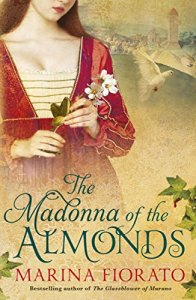
The Madonna of the Almonds

I’ve just finished reading Marina Fiorato’s new novel, The Madonna of the Almonds, which will be out on 14 May. It is a love story above all, but there is so much more as well. It’s set in Italy in the 16th century, about a young widow, Simonetta di Saronno, struggling to save her home, who meets the artist Bernadino, a protege of Leonardo da Vinci. 

 I was fascinated most of all by the artist Bernardino Luini who is employed to paint frescos in the church of Santa Maria dei Miracoli in Saronno, just at the time when Simonetta is trying to cope with the death of her husband at the Battle of Pavia. Little is known of Bernardino’s life. He was born around 1480/82 and died in 1532 and I enjoyed how Marina wove descriptions of his paintings into her story. Now I want to go to Saronna to see the actual paintings and to the Monastery of San Maurizio in Milan where his frescos adorn the church walls.

Bernardino was so captivated by Simonetta’s beauty that her face is the face of every female Saint, every Magdalene and every Madonna that he painted. Simonetta at first resists Bernardino’s advances but of course eventually falls in love with him, causing scandal in the local community. Bernardino has to leave Saronna for Milan, leaving Simonetta to fend for herself. With the help of a Jew, known as Manodorata (because of the golden hand replacing his own hand that had been chopped off by the Spanish Inquisition) she discovers how to make a delicious liqueur, Amaretto, from the almond trees, the only crop growing on her estate. The persecution of the Jews  forms a chilling strand in this book as Manodorato flees from his burning house with his two young sons, unable to rescue his wife from the flames.

Interwined within the story of Bernardino and Simonetta’s story are many tales of the Saints which inspire him to paint the frescos, seeing them in his mind’s eye as he listens to their stories told to him by the Abbess, Sister Bianca. Eventually he returns to Saronna determined to marry Simonetta if she is still free. But there are yet more obstacles to be overcome …

I love the story-telling aspects of this book, its rich descriptions of art and the detailed history of the period. I love Italy, history, art history and almonds, especially Amaretto, so this book just could not fail to delight me.

Georges Simenon’s The Man On The Boulevard

I borrowed The Man on the Boulevard by Georges Simenon, translated by EileenEllenbogen, from my local library. It is the third Maigret book I’ve read in the past few months and all the way through I was thinking this was the best of the three, until the end that is. It has a puzzling murder to solve – Louis Thouret is found stabbed in a little alleyway. Seemingly a perfectly ordinary man of regular habits who leaves his home in the suburbs to go to his job as a storekeeper in Paris for the past twenty five years. His wife is surprised to find he was wearing light brown shoes because he always wore black, a flamboyant tie unlike the one he normally wore and that there were two cinema tickets in his pocket as well as more money in his wallet than he normally carried with him.

So it turns out that Louis has a double life that his wife knows nothing about. It appears he has been having an affair and for the past three years he has not had a job, so how has he managed to bring home his monthly salary? Where does he change his shoes every day and why?   It’s the shoes that set Maigret on the right track to solving the mystery. The book was originally called Maigret et l’homme du banc or Maigret and the man on the bench – it just so happened that Louis spent part of the day sitting on a bench talking to an unknown man, ‘the sort of person who sits on benches’ and that forms another important clue.

man-on-the-b

There were lots of things I liked in this book – the attention to detail, the descriptions of the weather (cold and wet), and the characters themselves.  It’s set in Paris and without knowing the location of the various boulevards I could still get a good impression of the city and its suburbs.  I liked the theme of a man following a double life and the way Louis resolves his problem of keeping up appearances with his wife and family although I thought his method of maintaining his income was rather implausible.

Maigret and his colleagues gradually discover Louis’s secrets and I was beginning to wonder just where this was taking me as I couldn’t work out who had killed him. I really had no idea who it could be.  And then the book was spoiled for me by the abrupt and unsatisfactory ending. The culprit was someone who hadn’t been mentioned at all. It was such an anti-climax as though Simenon just ran out of inspiration.

When Will There Be Good News?

When Will There Be Good News? (Jackson Brodie, #3)


Complex but so very satisfying!  This has had very mixed reviews on Amazon which just goes to show that you have to make up your own mind about a book. I read it very quickly because I loved it. I know I missed bits – just when did Jackson lose his jacket? I’ve tried to track it down but I can’t spot it, so I’m thinking of reading it again before I have to take it back to the library.

It really is a case of bad news all round. To start at the beginning – six year old Joanna witnesses the murder of her mother, older sister and baby brother.  It goes from bad to worse with several interlinking plots (some with convenient coincidences) to keep me guessing what disaster would happen next.Thirty years later the killer is about to be released. Joanna, is now Dr Hunter, and has a baby and an unlikeable husband Neil. She is helped by Reggie, an extremely likeable and resourceful sixteen year old girl. When Joanna goes missing Reggie is the one who insists the police in the form of Detective Chief Inspector Louise Monroe (not very likable) investigates. Louise has her own problems in the form of a likeable husband. Then there is Jackson Brodie, formerly a police officer and private investigator, who gets involved due to being in the wrong place at the wrong time.

At times the plots got so complicated that I couldn’t quite remember who did what – one problem of reading too quickly. Reggie had to leave school after the death of her mother. She is still doing her A-Levels and is tutored by her former teacher, Ms MacDonald who is suffering from cancer. Her brother Billy and his ‘friends’ threaten both Reggie and Ms MacDonald with unpleasant consequences. Then there is Alison living in dread of the return of  her homicidal maniac of a husband who is on the run, a train crash, and the unexplained murder of two men in a burnt down house – etc, etc.

It seems like a catalogue of disasters but it’s also funny and light at the same time and there are plenty of allusions to keep me working out where they come from. The easiest were the nursery rhymes Joanna sings to her baby and that Kate Atkinson works into the text. It’s set in Edinburgh, a place that is new to me, but as my son and family are now living nearby, of great interest and I could identify some of the locations. There is plenty of action, good  characterisation and dramatisation of how relationships work – or don’t work.

I’ve previously read Kate Atkinson’s Case Histories, also featuring Jackson Brodie and I thought I’d read One Good Turn, the second Jackson book – but I haven’t. It’s a toss-up now between re-reading When Will there Be Good News? and One Good Turn (which I own). I just hope no one has reserved the library book!

a Leap

I received an Advanced Reader’s Copy of a Leap by Anna Enquist, translated by Jeannette K Ringold from LibraryThing Early Reviewer’s Program. It’s a very short book (80 pages), to be published in April 2009, made up of six monologues. Overall they are sad, even tragic stories.

The first one, Alma, was commissioned by the Rotterdam Philharmonic Gergiev Festival and its performance preceded a performance of Gustav Mahler’s Sixth Symphony. I liked the fact that it’s based on historical facts taken from letters and diaries. Alma was Gustav’s wife and she reflects on her life, having given up her own music to support him. It seems he forced her to do so and she is at once repelled and intoxicated by him, but she is torn between her love for him and Alex, a former lover. This is my favourite of the monologues.

The second story, Mendel Bronstein, shocked me. It’s about a Jewish tailor who decides to leave Rotterdam in 1912 to make a new life in America. He is desperate not to forget his own language, with disastrous consequences. This story actually made me squirm.

Cato and Leendert, form the interlinked monologues three and four. Set again in Rotterdam in the spring of 1940 they are a pair of young lovers. Cato first waits in the kitchen for Leendert as the bombs drop on the city and then goes out to search for him as the Germans take control. Meanwhile Leendert is still working at the zoo and ordered to kill the dangerous animals, including his favourite lion, Alexander. I thought this was a touching story full of pathos. It was also based on historical sources and together with Mendel Bronstein was written for the production of Lazarus as part of Rotterdam Cultural Capital of Europe in 2001.

The Doctor is a very short monologue also set in Rotterdam during World War II from a doctor who saves the life of a wounded German general. He wonders if he has done the right thing. This was commissioned by the Bonheur theater company in 2005 for the commemoration of the bombing of Rotterdam in 1940.

The final monologue is  …and I am Sara. Sara is alone in her parents house. She is twenty seven and so far her life has not turned out how she wanted. So much has gone wrong, but now it seems life is set to improve but then disaster overtakes her.

In all these stories fate or circumstances take control, no matter how the characters have struggled in their lives. Anna Enquist is a musician, and a psychoanalyst as well as a poet and novelist. Her writing is clear bringing the people and places to life. I particularly liked the stage directions in first and last monologues and the insights into the characters’ thoughts.

Sunday Salon – An Ordinary Couple?

Sunday Salon

After  ploughing my way through White Noise and feeling a bit jaded I turned to an old favourite – Agatha Christie and this week I read By the Pricking of My Thumbs. After such a rambling, verbose book as White Noise it was so refreshing to read this book, posing a mystery to be solved – what had happened in the house by the canal, whose child had died and how, and where was Mrs Lancaster?

pricking-of-my-thumbs

This is the first Tommy and Tuppence story I’ve read, but it’s not the first Agatha Christie wrote – there were earlier ones featuring Tommy and Tuppence, which I’m now going to look out for. Outwardly they are an ordinary couple, pleasant and past the prime of life, just like any other old couple. But appearances are deceptive and in By the Pricking of My Thumbs Tuppence in particular has no hesitation about getting mixed up in dangerous situations. Her daughter wishes that ‘her age she’d learn to sit quiet and not do things.’ There’s no chance of that after Tuppence met Mrs Lancaster in the nursing home where Tommy’s Aunt Ada had died. Seemingly incoherent and rambling Mrs Lancaster referred to ‘something behind the fireplace’ and a ‘poor child’ and when she disappeared after leaving behind a painting of a house by a canal Tuppence sets out to investigate.

As you would imagine from the title of the book (taken from Shakespeare’s Macbeth), ‘something wicked’ is afoot, there is evil about and Tuppence’s life is in danger. A dark and sinister tale.

I was still feeling like reading another mystery and picked up Kate Atkinson’s When Will There Be Good News? Jackson Brodie featured in the other book by Kate Atkinson that I’ve read – Case Histories – and I was pleased to find he’s in this one too. I read this in a couple of days, finishing it this morning as I just had to find out what happened. My faith in books has been fully restored as this is a very good book, and very satisfying – a complex and complicated plot with lots of action, good characterisation and drama.  More about that in a separate post.