I finished reading two of Ian Rankin’s books recently, neither of which feature Rebus. The first one was A Cool Head, which he wrote for the World Book Day Quick Reads Promotion. As you would expect it is a very quick read at 107 pages in a large font size. But I found it surprisingly complex and had to keep reminding myself who was who and who did what.

It’s about Gravy (called Gravy because he works in the graveyard) and what happens to him when his friend Benjy turns up at the graveyard in a car Gravy doesn’t recognise. Benjy who has a bullet hole in his chest asks Gravy to hide him and look after his gun. Then he dies and Gravy finds a bag full of money in the car. Gravy then finds himself caught up in a most unpleasant sequence of events. What happens next is told from the different characters perspective in short sharp chapters. A fast paced book that kept me entertained, but not a great read.
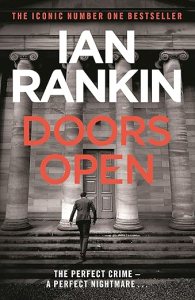
Then a much longer and more satisfying book – Doors Open; the first Rankin book post-Rebus and I was immediately swept along with the action. It’s about an art heist – planned by Mike Mackenzie, a self-made man, rich and bored with life, Robert Gissing, the head of Edinburgh’s College of Art and Allan Crickshank a banker with a passion for art that he cannot afford to buy on his salary. Between them they devise a plan to steal some of the most valuable paintings from the National Gallery of Scotland on the day that buildings normally closed to the public throw open their doors and invite them in – one such building being the warehouse at Granton where the National Gallery stored their overflow. It was going to be the perfect crime – so perfect that nobody would know the paintings had been stolen. That is until Chib Calloway, a gangster who was at school with Mike, gets involved.
This is full of action, as violence and mayhem erupt and I just had to read chapter after chapter as quickly as I could to find out how or if they were going to get away with it and then as their options seemed to disappear how the book would end. I liked so much about this book – the story, the characters, the view of the art world and how as one door closed another door opened …



 But I did manage to squeeze in Emily Bronte’s
 is an excellent mix of fact and fiction. She has taken what she knows of her family history and woven it into an imagined version of the past. She explains in the Foreword that in every generation of her family there was someone who “went in for writing long, outspoken, sometimes outrageous letters, and detailed recollections.”

