Sunday Salon

Today’s reading:

I finished reading Pardonable Lies by Jacqueline Winspear this morning. I’ve read a couple of the Maisie Dobbs mystery books before and this one is  very good. Set in 1930 Maisie is asked by Sir Cecil Lawton to prove that his son, Ralph really did die in 1917 during the First World War. Sir Cecil’s wife, who had recently died, had been convinced that Ralph was still alive and on her deathbed made him promise to search for their son. This takes Maisie on a traumatic and dangerous trip to France – to the battlefields where she had been a nurse. Knowing she is going to France her old friend from Girton, Priscilla whose brother, Patrick died in France asks her to find out where he is buried. Maisie’s investigations reveal a number of photographs and a journal written in code leading her to to discover what actually did happen in 1917.  She then has to decide whether telling the truth is the right thing to do. Parallel with her investigations in France, Maisie is also involved in discovering the truth about a young girl accused of murdering her ‘uncle’.

I like the Maisie Dobbs books. They’re easy to read, but not simple, the plots are nicely complicated and Maisie’s own story is seamlessly interwoven with the mystery. They give a good overall impression of the period, describing what people were wearing, the contrast between the rich and the poor and the all-pervading poisonous London smog. The horror of the War is still  strong, people still grieving for friends and relations killed or missing, visiting the battlefields and working to improve life for the soldiers who had returned home injured, and for the homeless children forced into life on the streets. Maisie is an example of a working girl who has moved out of her ‘class’, driving an MG and supporting herself independently.

With the description of a police woman in the first chapter I wondered when women were first employed in the police force. The Metropolitan Police Service’s website provided the answer – in 1914 Margaret Damer Dawson, an anti-white slavery campaigner, and Nina Boyle, a militant suffragette journalist founded the Women Police Service and by 1923 – 30, women police were fully attested and given limited powers of arrest. I also found it interesting that later in the book Maisie and Billy see

one of the new female recruits to criminal investigation disguised as a passer-by

and the undercover police using

 a new police wireless radio … invented at the request of the chief of police down in Brighton. Scotland Yard have been testing it for about a month now – it looks as if it might come in handy today. (page 310)

I have the latest book in the series, Among the Mad on loan from the library, so I can continue reading about Maisie Dobbs very soon. But maybe I should read the earlier books first. Now I want to get back to Wolf Hall by Hilary Mantel, even though I’m tempted to read another crime fiction – Murder Being Once Done by Ruth Rendell – which I borrowed from the library yesterday. As usual I have too many books clamouring to be read and I haven’t done the ironing or any de-cluttering ready for moving house!
The Bradshaw Variations by Rachel Cusk: a Book Review

I expected  The Bradshaw Variations by Rachel Cusk to be much better than it is. It begins well, and every now and then I thought this is really good, but at times it seems to get lost in itself. It’s about the life of a family – the Bradshaws, mainly concentrating on Thomas and his wife Tonie – over the course of a year. Not a lot happens on the surface but underneath everyone’s life is in turmoil and change.

Thomas is the middle brother. Howard is his older brother, married to Claudia; Leo, is his younger brother married to Susie. We also meet his parents and Tonie’s parents. The book is a series of episodes in their lives, both individually and collectively. It’s a mixture of straight forward narrative about their daily lives, interspersed with interesting reflections on such themes as what is real/unreal/artificial, what is the value and nature of success, what is art, the duality of character, the question of work/home balance, women going out to work versus staying at home, progress, the impossibility of perfection, the nature of love, the importance of wanting what you have and of avoiding not wanting what you have and so on and so forth.

 Thomas, the house-husband, is learning to play the piano whilst he is at home looking after Alexa, their eight-year old daughter, and much of the description of him has a musical theme – he is a “symphony” crashing about. Tonie, getting on with her career, seems a very negative character, usually dressed all in black and uncertain of what she wants from life. The crisis comes when Alexa falls ill and Thomas has to cope on his own. Howard and Claudia are muddling along with their three children and Skittle, their little dog and their crisis comes as they are preparing to go away on holiday – I found this chapter one of the most “real” in the book, describing the “ordeal” of it all.

My overall impression of it is that although it’s intense, it’s also emotionally detached; the characters are well drawn for the most part, but just as I was getting involved with them, the narrative moved away.

(The Bradshaw Variations – an Uncorrected Proof copy supplied by LibraryThing Early Reviewer Programme)

Elephants Can Remember by Agatha Christie: a Book Review

Collingwood Arms books

My posts may be a bit  hit and miss for a while as we have recently sold our house and are busy searching for somewhere to live in Northumberland/Scottish Borders. Whilst we were away over the last few days I did take some of my current books with me to read but as the hotel had two bookcases of books to choose from I picked up Elephants Can Remember to read instead.

It’s not the best Agatha Christie book I’ve read, but I found it entertaining, if rather repetitive and predictable – I worked out the mystery quite easily. Celia’s parents, apparently a happily married couple, were found shot dead on a cliff top – apparently as a result of a suicide pact. Some twelve to fifteen years later Mrs Burton-Cox, concerned that Celia is about to marry her son, approaches Mrs Ariadne Oliver, the mystery novelist, at a literary luncheon and asks the question – who killed whom? As Ariadne is Celia’s godmother she is curious and starts investigating, enlisting the help of Hercule Poirot.

ElephantsThe mystery is unravelled by Poirot and  Ariadne  by talking to the people who knew the couple and comparing their stories. Mrs Oliver interviews several elderly witnesses who she describes as “elephants” because they can remember certain incidents from the past. Much hinges on memory and interpretation of the events, highlighting the unreliable nature of witnesses and their memories, and the brilliance of Poirot in getting to the truth.
In my opinion it would have better if it were shorter and more concise, but then this was Agatha Christie’s last Poirot mystery, published in 1972 when she was in her eighties!

I did like the comments Ariadne makes about the relationship between authors and their readers, but as I put the book back on the hotel’s bookshelf I can’t give any quotes! This is only the second book I’ve read featuring Mrs Oliver, but occurs to me that Agatha Christie was using her to express her own views on writing and her reaction to her readers. Ariadne doesn’t like “literary lunches” and is shy about talking to people about her books, especially disliking those who simply gush and tell her how wonderful her books are. I can see I’ll have to read Agatha Christie’s Secret Notebooks and her autobiography.

AC autobiog


Strange Affair by Peter Robinson: a Book Review

Peter Robinson has written a series of Inspector Banks books. Strange Affair is the first one I’ve read but not the first in the series. I borrowed this one from the library as it was the earliest in the series available on the shelves. Although it’s one of the later ones in the series it does work on its own, as enough information is given about earlier events for me to get the gist of Banks’s history, but I would like to read the novels in the order they were written.

As soon as I started reading it I was hooked. It’s a great read – I didn’t want to stop reading. Detective Chief Inspector Alan Banks receives an urgent phone call from his brother asking for his help. He has never been close to his brother Roy, but alarmed by the message on his answerphone he sets off from the Yorkshire Dales for London to see exactly what the problem is. But on his arrival he finds his brother’s house empty and no-one knows where he is.

Meanwhile back in Yorkshire DI Annie Cabbott is investigating the death of a young woman found in her car. She had Banks’s name and address scribbled on a piece of paper in her pocket. Unaware that Banks has gone to London, Annie tries to find him to discover the link between them. Although officially on leave from work Banks, who is still recovering from his depression after the fire that destroyed his house and possessions, immediately gets involved in delving into Roy’s life whilst trying to find out what has happened to him. Just how has Roy made his money, what shady deals has he done, who are his connections? The more Banks discovers the worse it gets, until he fears for his parents’ safety, not just his brother’s.

A tense and gripping novel – I loved it and can’t wait to read more by Peter Robinson.

The Hound of Death by Agatha Christie: a Book Review

Hound of deathI borrowed The Hound of Death by Agatha Christie from the library. It’s a collection of twelve short stories, stories of unexplained phenomena, in most cases tales of the supernatural rather than detective stories.

Of the twelve stories I think The Witness for the Prosecution is the best. Agatha Christie later wrote a play based on this story which has subsequently been adapted for film and television. It’s the story of Leonard Vole, a young man who has been arrested for the murder of an elderly lady, Miss Emily French. He befriended this rich lonely old woman who left him everything in her will. He protests his innocence and is astounded when Romaine (who lives with him as his wife) refuses to back up his story at the trial. It is up to his lawyer Mr Mayherne to get to the truth.

I also liked the more supernatural stories – those with no explanation and those where the supernatural either have natural, scientific explanations or are plain con tricks. The narrator in The Hound of Death is unsure of how to view the events during the First World War where a Belgian nun, Sister Marie Angelique is said to have caused her convent to explode when it was invaded by German soldiers. He reflects:

But of course it is all nonsense! Everything can be accounted for quite naturally. That doctor believed in Sister Marie Angelique’s hallucinations merely proves that his mind too, was slightly unbalanced.

Yet sometimes I dream of a continent under the seas where men once lived and attained to a degree of civilization far ahead of ours …

… Nonsense – of course the whole thing was merely hallucination! (p36)

There are stories of premonitions, intuition or a sixth sense, stories of seances, haunted houses, nightmares, amnesia and a very strange tale The Call of Wings in which a millionaire hears a tune, played by man with no legs.

It was a strange tune – strictly speaking, it was not a tune at all, but a single phrase, not unlike the slow turn given out by the violins of Rienzi, repeated again and again, passing from key to key, from harmony to harmony, but always rising and attaining each time to a greater and more boundless freedom. (p269)

The music makes him feel he is being released from all his burdens as he is carried higher and higher. This story, with its mystical overtones reveals the power of music to transport the soul.

Years ago I read as many of Agatha Christie’s books as I could find, but they were all the detective stories – Poirot or Miss Marple. I was unaware that she wrote anything else, so these collections of short stories are a bonus for me. She really was a superb storyteller.

This year’s Agatha Christie Week is being celebrated at The Southbank Centre in September and on the English Riveria too, along with new radio productions and publications of previously unpublished stories – see the Agatha Christie website.

Company of Liars by Karen Maitland: Book Review

company-of-liarsCompany of Liars: a novel of the plague by Karen Maitland is a great yarn. Set in England in 1348 it tells the tale of a group of people fleeing across the country as the plague moves inland from the ports. The narrator is Camelot, a pedlar. A “camelot” in medieval times was a person who also carried news and had a reputation for trading in goods that were not always genuine. This Camelot is no exception, scarred and with only one eye, pedalling relics such as skeins of Mary Magdalene’s hair, “white milk of the Virgin Mary in tiny ampoules no bigger than her nipples” and “hair from the very ass that bore our blessed Lord into Jerusalem”.  Camelot is an unreliable narrator.

As you would expect from the title the members of the group, a conjuror, a one-armed storyteller, a musician and his apprentice, a young couple on the run, a mid-wife and a strange child who can read the runes are all liars, with secrets that gradually exposed as they journey on.  Some secrets are not that well hidden and I’d guessed them all before the end of the book.

They make their way from Kilmington on the south coast through Thornfalcon in Somerset (where incidentally we stayed last year in an old farmhouse) heading north to North Marston in Buckinghamshire seeking the shrine of Sir John Schorne. He was the rector of North Marston and had discovered a well, the waters of which were reputed to have miraculous healing powers. The shrine  had become a popular place of pilgrimage after Sir John Schorne’s death in 1313. Camelot thought they would be safe there as the pestilence would not reach it before the winter frosts came killing off the plague. However, they are thrown out of the pub where they were staying and forced to move on after trouble with the locals.

I also liked the storytelling in the novel – it’s not only Cygnus, the storyteller but each character has a tale to tell, some obviously tall stories, mingling magic and myth. Cygnus is a strange character with his left arm that wasn’t an arm but the pure white wing of  a swan. A sense of menace develops as it is not just the plague they are fleeing from – there is a hue and cry out for Cygnus believed to be the killer of a little girl and they are being followed by a wolf, howling in the night. Their safety is also threatened when Jofre, the young apprentice musician gets drunk  and is then found dead, presumably killed by a pack of wolves. But strangest of all is the white-haired child Narigorm who seems to be controlling events.

This is a memorable story, with a colourful cast of characters. It’s a long book (over 550 pages) and there are many other characters than the group of nine. Yet I had no difficulty keeping track of who was who and it was actually a quick read as I was keen to know what would happen next. It is full of suspense and drama.

I liked the fact that the places in this novel are real places and that the details of the plague, its causes and ways of dealing with it are based on fact. Thornfalcon is not the only location in this book that is familar to me. North Marston is not far from where we live and so we went to have a look at the shrine. It was renovated in 2005.

sir-john-schornes-well

Also in the shrine is a boot representing the boot in which the rector whilst exorcising a man suffering from gout is said to have captured the devil. Apparently the devil made himself as small as a beetle and flew away through one of the lace-holes.

sir-john-schornes-shrine-boot

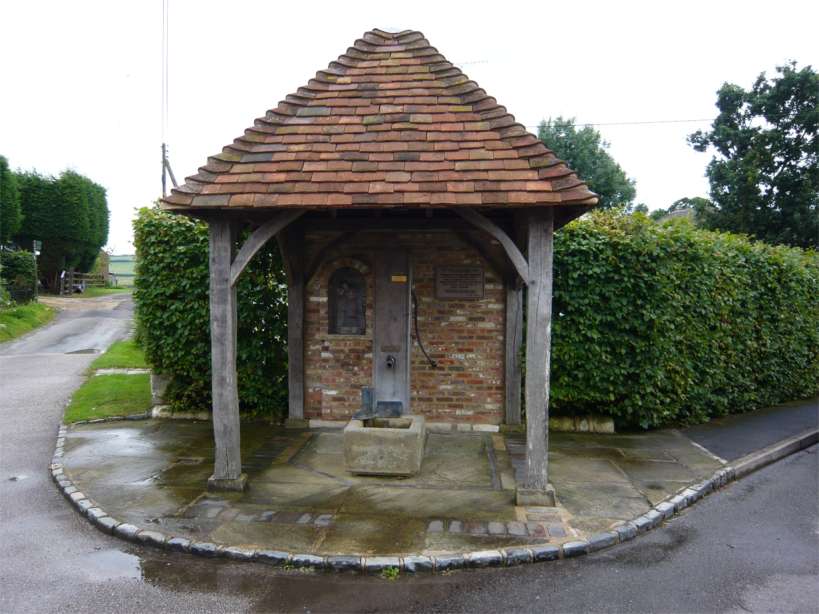
This is how the well looked before it was renovated in 2005. For more photos see here.

sir-john-schornes-well-history1

The shrine is near to the parish church, which dates back to the 12th century. The inner part of the tower is from the 15th century, whereas the stone in the outer walls were all replaced between 2002  and 2004.

north-marston-church