Crime Fiction Alphabet: G is for A Good Hanging

My choice for the letter G in Kerrie’s Crime Fiction Alphabet meme is  A Good Hanging by Ian Rankin. I first wrote about this book when I read it in April 2008. It was one of the first books by Rankin that I had read, although I was familiar with Rebus from the TV series.

A Good Hanging is a collection of twelve short stories featuring Inspector John Rebus, set in Edinburgh. All the stories are concise and I think convey the character of Rebus; he is cynical and analytical, a lone worker, who drinks and smokes too much. None of the stories pose complex mysteries and are easily solved by Rebus.
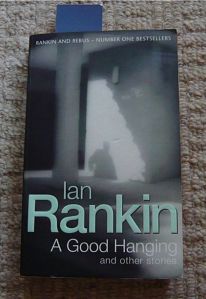
A Good HangingFirst published in 1992 it’s one of the earlier Rebus books. The first story in this book is called ‘Playback‘. It’s a bit dated now with Rebus impressed by being able to phone your home phone ‘from the car-phone’ to get ‘the answering machine to play back any messages.’ As the title indicates, solving the crime in this story hinges on phone messages. The police receive a phone call from the murderer confessing his crime. He panics and tries to flee, only to be caught as the police arrive on the scene of the crime. He then insists on his innocence. Rebus disentangles the puzzle even though this seems to be ‘the perfect murder’.

In ‘The Dean Curse‘ Rebus is reading Hammett’s novel ‘The Dain Curse‘, which he tosses up into the air disgusted by how far-fetched and melodramatic that book was, piling on coincidence after coincidence ‘corpse following corpse like something off an assembly line’, when he receives a phone call with news of a car bomb that had just gone off in Edinburgh. He cannot believe it has happened. It seems as though this is the work of terrorists, the bomb having all the hallmarks of an IRA bomb and it had gone off seconds after the car had been stolen. It seems to Rebus as if the coincidences in the Hammett story have nothing on his case. But there is more to this case than at first meets the eye.

My favourite in the book is the title story ‘A Good Hanging‘ in which Rebus solves the crime through his knowledge of ‘Twelfth Night‘. It’s set during the Edinburgh Festival period, when the city is full of young, theatrical people. A Fringe group, comprising a number of students are staging a play called ‘Scenes from a Hanging’ promising a live hanging on stage. The story starts with the discovery of a young man found hanging from the stage scaffold in Parliament Square. It appears to be suicide according to the note in his pocket ‘Pity it wasn’t Twelfth Night’. But Rebus investigates and finds that all is not as it seems.crime_fiction_alphabet

The other stories involve the discovery of a skeleton buried beneath a concrete floor, a Peeping Tom, and blackmailers. One story I particularly like is ‘Being Frank‘ about a tramp who overhears two men talking about a war that’s coming. He is well known for making up stories and informing the police of numerous conspiracies so they just laugh at him. But fearing the end of the world Frank confides in Rebus who eventually begins to suspect that this time Frank is not lying.
The Builders by Maeve Binchy: Book Review

I think The Builders is a brilliant little book. I suppose it’s really a long short story, or a novella. It’s part of the Open Door series written by Irish authors for adult literacy learners, so it’s a quick read. It took me about 30 minutes to read it and I was amazed at how much detail and characterisation was packed into its 87 pages and in such a simple, direct style.

It’s the story of a lonely woman, Nan who finds friendship when the builders start to work on the house next door. At the same time her relationships with her three adult children undergo a radical change. I enjoyed it very much but I’m glad I borrowed it from the library as at £4.99 I think it’s overpriced.

Crime Fiction Alphabet: The Falls by Ian Rankin

My contribution this week for Kerrie’s Crime Fiction Alphabet meme isletter F

F is for The Falls.

The Falls (Inspector Rebus, #12)

I first  wrote about The Falls by Ian Rankin last March. Since then I have watched the TV version which was very different. I wonder why I bother to watch dramatised versions after I’ve read a book because they very rarely live up to my expectations and this version was particularly bad because it completely changed the story. Instead of investigating the disappearance of university student Philippa Balfour, known as ‘Flip’ to her friends and family, the TV version starts when a retired doctor gets killed in his home, tied to a chair, his wrists slit, bleeding to death.

The book is so much better.  DI Rebus and his colleagues have just two leads to go on – a carved wooden doll found in a tiny coffin at The Falls, Flip’s home village and an Internet game involving solving cryptic clues. Rebus concentrates on the tiny coffin and finds a whole series of them have turned up over the years dating back to 1836 when 17 were found on Arthur’s Seat, the extinct volcano within Holyrood Park, east of Edinburgh Castle. DC Siobhan Clarke meanwhile tries to solve the cryptic clues.

There are many things I liked about this book – the the interwoven plots, throwing up several suspects; the historical references to Burke and Hare, the 19th century resurrectionists; the spiky relationship between Rebus and his new boss Gill Templeton; Siobhan Clarke whose liking for doing things independently matches Rebus’s own maverick ways; and above all the setting in and around Edinburgh. All the way through I kept changing my mind about ‘who did it’ and it was only just before the denouement that I worked it out.

Nocturnes: Five Stories of Music and Nightfall by Kazuo Ishiguro

Nocturnes by Kazuo Ishiguro is a quintet of stories exploring the themes of love, music and the passing of time. All have narrators who are musicians. As I wrote in an earlier post I’m not a great fan of short stories but these are better than most as they do flesh out the characters in more detail, although some of them just seem to stop rather than ending, leaving me wanting more. There’s nothing dramatic here, rather they are gentle stories with a touch of nostalgia and a sense of loss for what has gone or what could have been.

The first story is The Crooner set in Venice. A young Hungarian musician playing in a cafe meets his mother’s favourite singer, the ageing Tony Gardner. Tony enlists the musician’s help in seranading his wife, Lindy from a gondola.  He reminisces, looking back with nostalgia over the 27 years he and Lindy have been married. They rehearse the songs he’s going to sing to her, all the while going round in circles passing the same palazzo several times. By the end of the story I was left feeling sad – things were not what they initally seemed.

I wasn’t quite sure what to make of Come Rain or Shine. Ray goes to stay with his friends Emily and Charlie. Their marriage is obviously going through a bad patch and when he is left alone in their flat bored with reading Mansfield Park and browsing their CD collection he can’t stop himself from reading Emily’s diary. What follows is farcical as in his attempts to hide the fact he read the diary he ends up wrecking the room and pretends that it was the neighbour’s dog.

The Malvern Hills, is another sad story about a young musician who’s struggling to make his way in the rock world. He retreats to the Malvern Hills to compose love songs. There he meets an older couple, Swiss folk singers Sonja and Tilo, whose lives are on the point of change.

Noctune, the title story again features Lindy some years later. She and a saxophonist are neighbours, convalescing in a luxury hotel after they’ve both had plastic surgery. A sad bittersweet story as they listen to CDs and then go on a nocturnal walk around the hotel in the early hours of the morning. But their lives have not lived up to their dreams and a plastic surgeon can’t fix that.

The last story Cellists completes the cycle – back in the same cafe in a piazza in Venice seven years later. Tibor, one of the cellists, meets and falls under the spell of Eloise, an American who is apparently a distinguished musician. Their encounter changes his life for the worse.

These stories are full of longing and regret, something which I think Ishiguro does well.

The Perfect Summer by Juliet Nicolson

The Perfect Summer: Dancing into Shadow in 1911 by Juliet Nicolson is a fascinating look at life in Britain during the summer of George V’s Coronation year, 1911.
When I finished reading this book I decided that the summer of 1911 was not “the perfect summer”. It was one of the hottest years of the twentieth century, making life most uncomfortable at a time when most people had no means of getting out of the sweltering heat. Even a trip to the seaside for working class people meant they donned their Sunday best clothes and spent the day standing because they couldn’t afford to hire deck chairs!

Men rarely removed their hats, and the poorer female holidaymaker, possessing neither a special holiday outfit nor light-weight summer clothes, was constrained by the weight of her ‘Sunday best’ – since women dressed for a holiday as they did for a strike – from scrambling over the rocks. These women made an arresting sight against the backdrop of a sparkling blue sea in their artificial-flower-laden hats, their long black skirts brushing the sand as they stood, stifling, in their sturdy black shoes. (page 224)

It was also a summer of discontent as the country was almost brought to a standstill by industrial strikes and the enormous gap between the privileged and the poor was becoming more and more obvious.

Focussing on just the period from May to September this book covers a wide spectrum – from King George’s accession to the throne, Queen Mary’s anxiety over the Coronation and worries about their visit to India (what could she wear?) to debutantes, politicians, poets, factory workers, writers, and women trade unionists. There is little about the suffragettes – they agreed a summer truce for the Coronation. With the benefit of hindsight the threat of the First World War is evident, with the new German warship Panther on its way to Morroco, feared by Winston Churchill (then Home Secretary) and Sir Edward Grey (Foreign Secretary) to be an excuse for territorial aggression.

For me this book was at its best in describing the minutiae of everyday life of both the rich and the poor. One character that sticks in my mind is Eric Horne, a butler. He kept a secret diary:

Not quite the faithful servant he was assumed to be by the deluded individuals who employed him, Eric’s was an increasingly cynical view of the changing world. Some of the noblemen and women he worked for had what seemed to him ‘a kink in the brain’. … Eric bridged the gap between the servers and the served. The evolving memoir, written in his idiosyncratic and uncorrected style, recorded what life was like not only in his pantry below-stairs but in the drawing rooms and bedrooms above. It was incriminating and explosive stuff. Eric knew too much; in fact he knew the truth. (page 149)

He later published two volumes of his memoirs: What the Butler Winked At (1923) and More Winks (1932).

I borrowed The Perfect Summer from the library but there is so much in it that I think I may buy a copy for myself. All the time I was reading it I was thinking this was the world when my grandmother was a young woman and I wondered what it was like for her – how she felt and how much she knew of the national events, living as she did in Wales. The Royal Pageant was at Caernarfon Castle on 13 July that year for the Investiture of the Prince of Wales where ten thousand people attended – I doubt very much she was there!

There is a helpful Dramatis Personnae, a bibliography and useful index. Although the bibliography is extensive, I think I prefer non-fiction to have footnotes, even though they can be a bit distracting, because I like to see the source of the information.

Crime Fiction Alphabet:Death of a Chief by Douglas Watt

Letter DThis week’s letter in Kerrie’s Crime Fiction Alphabet is D:

Douglas Watt is a historian, poet and novelist. Death of a Chief is his first novel.

From the back cover:

The year is 1686. Sir Lachlan MacLean, chief of a proud but poverty-stricken Highland clan, has met with a macabre death in his Edinburgh lodgings. With a history of bad debts, family quarrels, and some very shady associates, Sir Lachlan had many enemies. But while motives are not hard to find, evidence is another thing entirely. It falls to lawyer John MacKenzie and his scribe Davie Scougall to investigate the mystery surrounding the death of the chief, but among the endless possibilities, can Reason prevail in a time of witchcraft, superstition and religious turmoil?

Death of a Chief is set in pre-Enlightenment Scotland – a long time before police detectives existed.

I seem to be reading a lot of crime fiction set in Edinburgh recently with Ian Rankin’s Rebus series, but Death of a Chief is set in a different period and at times, it seemed, a different place!  One location that puzzled me was the Nor’ Loch below Castle Rock, where a second body is found – that of James Jossie, the apothecary – I just couldn’t picture a loch actually within the city. I found the answer in Wikipedia  – this area is now occupied by Princes Street Gardens, between the Royal Mile and Princes Street. How different it was before it was drained in 1759, with its muddy shoreline, and its dark dank water in the shade of the black mass of the Castle Rock!

Although I know very little about 17th century Scotland it seemed to me that this book brought that time and place to life well.The differences between the Highlanders and Scots Lowlanders are highlighted. Scougall a devout Presbyterian Lowlander has been brought up believing the Highlands to be a barbaric place ‘roamed by bands of murderers and in the grip of Popery’. The difficulties of  language also confront Scougall – he can’t speak Gaelic. As MacKenzie and Scougall travel into the Highlands to attend Sir Lachlan’s funeral and search for Campbell of Glenbeg, a notorious drunkard and gambler and a suspect for the murders, it seems that Scougall’s fears are justified when they are attacked by a group of “caterans”, men without a clan who were hired to kill them.

Although the locations are well described and MacKenzie (based on a real historical figure) and Scougall are well drawn some of the other characters are a bit sketchy and I had a little difficulty identifying them as I read. I had to backtrack to remind myself who they were. But I liked Watt’s style of writing. I enjoyed the book’s historical background and  the way he portrayed the political and religious conflict. The tension is well paced and the mystery is intriguing. I just had to keep turning the pages to find who was the culprit and I didn’t work it out until just before the denoument.