Wolf Hall by Hilary Mantel – Final Thoughts

I began reading Wolf Hall last year and at first I found it hard to get interested in it. For one thing it’s written in the present tense and that usually jars with me and then it’s so physically big and heavy. So I put it to one side whilst we moved house, only going back to it recently.

I’ve referred to the book in a few posts including one on a small extract containing the word waffeting and one on my thoughts as I was reading it. Now I’ve finished it I can reflect on it as a whole. Overall, despite being written in the present tense and despite the over-frequent and confusing use of the pronoun ‘he’, I think it’s one of the best books I’ve read this year, if not the best one. It is satisfying in depth and breadth, with a host of characters and detail.

It is, of course the story of Thomas Cromwell, the son of a blacksmith, and his political rise, set against the background of Henry VIII’s England and his struggle with the Pope over his desire to marry Anne Boleyn. It’s a brutal time. What I found most enjoyable was the way this book transported me back to that time, with Mantel’s descriptions of the pageantry, the people, the places and the beliefs and attitudes of the protagonists. My knowledge of the period has been built up over time, from history lessons at school, films, books and TV series and it all seemed secondhand. In this book you are there in the thick of it all. Here, Thomas More is not the saint I thought he was from watching ‘A Man for All Seasons’, Anne Boleyn is a coy, flat-chested, manipulator and schemer and Thomas Cromwell is not the hard hearted, cold and stern character I’d read about before, but is humane, kind and considerate, taking care of his family whilst weaving his way through the intricacies of court life. He is hardworking, generous and cultured. But he is tough and ruthless too. Here Chapuys, the French ambassador is talking to Cromwell after Anne’s coronation:

‘Well, you have succeeded where the cardinal failed, Henry has what he wants at last. I say to my master, who is capable of looking at these things impartially, it’s a pity from Henry’s point of view that he did not take up Cromwell years ago. His affairs would have gone on much better. … When the cardinal came to a closed door he would flatter – oh beautiful yielding door! Then he would try tricking it open. And you are just the same, just the same.’ He pours himself some of the duke’s present. ‘But in the last resort, you just kick it in.’ (page 465)

The descriptions of Cromwell’s house, Austin Friars, and his family brings it all to life, the reality of the daily lives of ordinary people as well as of the court. I wondered about Austin Friars, whether it still exists and found an article by Mantel in the Timesonline where she writes:

Very near the Bank of England, at the foot of the glass cliff of Tower 42, there is a secret city garden that now belongs to Draper’s Hall. A plaque on the wall says: ‘On this site, once part of the Augustinian Priory, Thomas Cromwell built his palace and in 1536 plotted the downfall of Anne Boleyn, second wife of Henry VIII.

“Palace’ is perhaps an inflation. The building at Austin Friars was an opulent merchant’s house, which from 1530 accreted new wings, storerooms, strongrooms, and tighter and tighter security. It was a powerhouse of Tudor politics, and over a decade, its master became one of the richest and most powerful men in England: councillor and secretary to the king, Master of the Rolls, Lord Privy Seal and eventually Earl of Essex. Austin Friars was not a quiet spot. Twice a day, 200 of London’s poor swarmed to the gate to be fed by the great man’s kitchen.

I’m still a bit puzzled about the title – why Wolf Hall, when Wolf Hall, the home of the Seymour family hardly figures at all in the book. It could be that it is symbolic of the times, when ‘man is wolf to man’ (page 572).  The Seymour family is a seemingly of little significance, sneered at by Anne as ‘those sinners at Wolf Hall.’  But there are tantalising glimpses of Jane Seymour at the court, ‘ a little pale girl … the sickly milk-faced creeper’ who Anne calls ‘Milksop‘ and thinks no one will ever want, let alone Henry! The future is signalled as the book ends, with Cromwell’s intention to visit Wolf Hall.

As well as being shortlisted for the Orange Prize for Fiction, Wolf Hall is also shortlisted for the Walter Scott Prize for Historical Fiction.

I hope it’s not too long before her second book on Cromwell is published, taking his story up to his execution in 1540 .
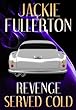
Revenge Served Cold by Jackie Fullerton

Revenge Served Cold by Jackie Fullerton was kindly sent to me by the publishers, Thomas House Publishing. It’s her second book featuring Anne Marshall, a part-time court reporter and law student. I think it slots into the “cozy mystery” category, with the crime being solved by amateur sleuths rather than the police, who are always one step behind. If  there is a category for “paranormal crime fiction” that applies too. In some respects it reminded me of that TV series – Randall and Hopkirk (Deceased), a remake with Vic Reeves of a 60s TV series about private detectives, one of whom was dead and appearing in a white suit could only be seen by his partner.
Anne’s father died three years earlier, and his ghost appears to her, helping her to solve crimes. She is the only person who can see him, although others can smell his pipe tobacco. The book begins with the death of Professor Elliot Spence, Anne’s law lecturer and her father’s former colleague, when a car apparently driven by Kathy, Elliot’s wife runs him down.

Kathy’s friend Shirley, who works with Anne at the law courts, convinces her of Kathy’s innocence and Anne together with her fellow law students start looking for evidence to prove it. Her father also helps, which really means that you have to suspend your disbelief in following everything that happens. As a ghost he is able to be at police interviews unseen, and report back to Anne thus giving her information she wouldn’t otherwise have and also send text messages on her phone. One thing  that made me pause for thought is that at one point he breathed a sigh – ghosts can’t breathe as far as can tell, but if I can accept his presence in the story I also have to accept that he can breathe and smoke and chat to Anne.

I found this a light and entertaining book and although I found the style stilted in parts, with too many short sentences and repetitive, it moves along at a rapid pace. Even though it was obvious early on who killed Elliot Spence there were enough plot twists and turns to hold my interest in the story to its dramatic ending.

The Breaking Point: Short Stories by Daphne Du Maurier

The Breaking Point, first published in 1959, is my first book for the Daphne du Maurier Challenge. It’s a collection of eight short stories written after The Scapegoat and before The Infernal World of Branwell Bronte. Sally Beauman sums up the stories well in her introduction:

The stories here reflect the concerns of those adjacent books: they are dark, difficult, perturbing – and sometimes shocking. Du Maurier grouped them together under the title The Breaking Point – and they were written during a period when she herself came close to a severe nervous breakdown. They reflect and echo that psychological stress; it runs through them like a fault line. Here, we are a stylistic world away from the smooth technical assurance of her bestselling novels of the 1930s and 1940s: these stories are jagged and unstable; they constantly threaten and alarm; they tip towards the unpredictability of fairy tale, then abruptly veer towards nightmare. They are elliptic, awkward – and they are fascinating. (page ix)

I don’t really need to add much more, other than to indicate the stories themselves.

  1. The Alibi – about a man wanting to escape his ordinary life who takes on a new identity. He lives a double life, which ends as he becomes involved in two deaths.
  2. The Blue Lenses – a truly strange tale of a woman undergoing an eye operation who then sees everyone around her having an animal’s head appropriate to their character. She discovers that she is a victim, subject to betrayal and exploitation, fooled by those close to her.
  3. Ganymede – set in Venice, where a man on holiday is seduced by the beauty of a boy who is killed in a water-skiing accident. He returns home but inevitably he cannot escape his own nature.
  4. The Pool – a supernatural story with a mystical quality about a young girl reaching puberty and her overwhelming sadness at the loss of the hidden secret world she inhabited.
  5. The Archduchess – has a fairy tale atmosphere, about an imaginary principality in southern Europe, where the Archduke’s benign reign is overthrown by the insidious influence of two greedy and jealous men.
  6. The Menace – a silent movie star, a heart-throb until the advent of the ‘feelies’ when it is discovered that his magnetism is almost non-existant. Despite the efforts to raise it by the usual means,such as pretty girls, nothing can be done, until he meets an old friend. This one is much more optimistic than the other stories.
  7. The Chamois – about a married couple hunting for chamois in the Pindus; a chilling story of fear and fanaticism.
  8. The Lordly Ones – about a boy who cannot speak and is thought to be backward. Terrorised by his parents and unable to communicate he finds refuge for a while with the ‘lordly ones’.

The stories tell of double lives, split personalities, paranoia and conflict, each one with a ‘breaking point’. My favourite is The Pool.

Agatha Raisin and the Haunted House

I’ve not been around much on my blog this week, time out for looking after grandchildren in Scotland for one thing. I have still been reading, though I didn’t take Wolf Hall away with me as I knew I wouldn’t be able to concentrate much on reading and Wolf Hall deserves that.

I read a much less substantial book – Agatha Raisin and the Haunted House by M C Beaton. I’ve only read one of her books before, Death of a Gossip, which I thought was awful. I decided to give her books another go as I know other people enjoy the Agatha Raisin series. I’m sorry to say that I wasn’t enthralled by this book. It’s number 14 in the series, but I know a bit about the earlier books from an article in newbooks Crime Supplement, so it wasn’t difficult to follow. It’s definitely a ‘cozy’ mystery with three deaths for Agatha to resolve. An old woman reports that her house is haunted and is later found murdered. More deaths follow.

Agatha Raisin is an amateur sleuth and a very amateur one indeed. She blunders around and every now and then lands on something relevant. But this book is all rather silly and Agatha herself is a silly woman. It’s like reading an Enid Blyton book for not so very grown up adolescents, as she goes ga-ga over her new neighbour, Paul a married man, repeatedly changing her clothes and renewing her make-up to  catch his eye. Then there is the haunted house and a secret passage, reminding me of the Famous Five etc. For example she and Paul hide behind a hedge at dead of night keeping watch, stumble around in the garden trying to find the entrance to the secret passage and even worse, Agatha dressed up in a bright red wig and a long droopy tea-dress goes out at two in the morning to push a note through the police station door. I could go on … and  …. on.

So, a second book by M C Beaton hasn’t made me want to read any more.

Sunday Salon

Today I’ve been reading more from Wolf Hall by Hilary Mantel and I’m now almost at the halfway stage. At times I’m loving it and at times I’m thinking why, oh why is she writing this in the present tense? See, it’s getting to me – I’m not overly fond of books in the present tense. And why does she keep using ‘he’ and I’m not sure which ‘he’ she means? Sometimes it’s Thomas Cromwell, but it could be any number of other ‘he’s’ too. But on the whole she’s winning me over and I have to keep on reading. What a character this man Cromwell is, a man who Cardinal Wolsey describes as:

… rather like one of those square-shaped fighting dogs that low men tow about on ropes. Not that you are without a fitful charm, Tom. (page 86)

Cromwell knows that

You don’t get on by being original. You don’t get on by being bright. You don’t get on by being strong. You get on by being a subtle crook … (page 60)

I didn’t expect Wolf Hall to be relevant to the current state of affairs and yet it’s about power, who holds the purse strings, who can command. People, then as now, want change, always hoping for something better. I read this as the present election campaign was in flow with the politicians’ slogans ‘Vote for Change’ and ‘Change that Works for You’. Just see what Geroge Cavendish thought in 1529

‘But what do they get by the change? ‘ Cavendish persists. ‘One dog sated with meat is replaced by a hungier dog who bites nearer the bone. Out goes the man grown fat with honour, and in comes a hungry and a lean man.’ (page 55)

Talking about elections, Thomas Cromwell’s campaign to be ‘elected’ was rather different from today’s methods.  His constituency was Taunton which he held with the agreement of the king and the Duke of Norfolk because seats in the House of Commons were

…  largely, in the gift of the lords; of lords, bishops, the king himself. A scanty handful of electors, if pressured from above, usually do as they’re told. (page 161)

Well, at least that is different these days.

Wolf Hall engages me on different levels – it’s historical fiction of period I used to know well and as I read it all comes back to me – Henry VIII’s wives and all that. It’s also made me think about writing styles and what I’m comfortable reading. It’s a dense book, one that you have to take your time reading and it helps if you know the history because nothing happens quickly in this book, which is full of description and lots of characters. I’m not finding a page-tuner but a fascinating study in particular of Thomas Cromwell.

Wolf Hall is a long book, and I need to vary my reading. I’m also at the beginning of The Very Thought of You by Rosie Alison, very different from Wolf Hall and also listed for the Orange Prize for Fiction. Moving forward 400 years from Tudor England to Britain in the 20th century on the brink of war with Germany is quite a leap, but it still feels like historical fiction. The Very Thought of You begins with Anna’s evacuation from London in September 1939 to Ashton Park, a large Yorkshire estate. This is the calm before the storm.

It’s a very different style from Wolf Hall and I’m enjoying the contrast. So far, it has a warm, family feel about it, yet connected to world events with the parallel activity in Poland as Hitler invaded. The British ambassador in Warsaw, Sir Clifford Norton, watched the city burn and abandoned the embassy as the Nazis and the Soviets invaded.

I don’t envy the Orange Prize judges their task – how do you compare such different books?

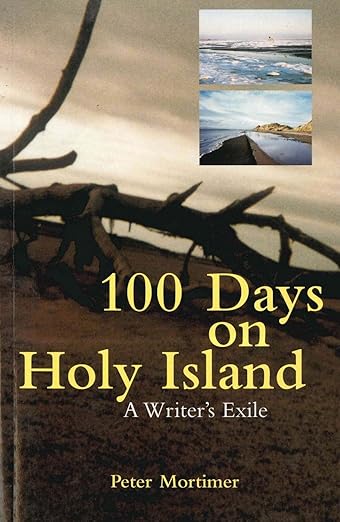
100 Days On Holy Island: a Writer’s Exile by Peter Mortimer

After I finished reading 100 Days On Holy Island the main impression it made on me was that Peter Mortimer endured his hundred days there, feeling insecure, wanting company and to be accepted. He always felt an ‘outsider’, not accepted by the locals. He recognised his paranoia:

Part of Mortimer’s paranoia while on Lindisfarne was of being constantly observed and judged, that my every act was noted and recorded by some amorphous body established purely to note down all behaviour of nosy incomers such as I. The truth, of course, was that people had their own lives to live but anyone in a similar position to mine will know what I mean. (page 199)

This sense of being an outsider pervades the book. It can’t have helped that people knew he was on the island in order to write about his experience. He wasn’t there as a tourist, nor had he gone to settle there, but he went with the intention of seeing how he coped with living there  for one hundred days and writing about it. This book is written with empathy for the island and its inhabitants but because of his sense of being an ‘incomer’ all the time I was reading it I found it uncomfortable, whether he was sitting in one of the pubs on his own, or visiting some of the people he did get to know, or spending time on St Cuthbert’s Isle alone. 

I now know a bit more about the geography of the island, and the way the tide cuts it off from the mainline (which I knew before but this book emphasises the isolation it brings). Most of all I suppose I know more about Peter Mortimer, a writer I had never heard of before. He is a playwright and a poet. His other memoirs are The Last of the Hunters about the six months he spent at sea working with North Shields fisherman, and Broke Through Britain, about his 500 mile odyssey from Plymouth to Edinburgh.

His time on Holy Island was from January to April 2001, when foot and mouth disease swept through the UK, and although it never got to Holy Island it was affected by the closure of the countryside. The islanders were hit by the threat to the tourist trade. It was freezing cold, blasted by snow storms and afflicted by power cuts. It was also a bad time for Mortimer to be away from his family, as his father died just before he went, his mother was in hospital desperate to see him, his son had his 17th birthday and his nephew was seriously ill. Although he did go and visit his mother, he couldn’t have picked a worse time, which may well be a major reason he struggled there on his own.

Holy Island (also known as Lindisfarne) is a place of pilgrimage, known as the Cradle of Christianity, a place of spiritual heritage. I don’t think Mortimer mentioned Lindisfarne Priory in his book and very little about Lindisfarne Castle, either. This is not a guide book, nor is it about the history of the island, or about Christianity. He does examine his own beliefs and went to the talks on faith at the Heritage Centre, but realised that he

was having trouble with these lecture overall; not the people so much as the basis. I wasn’t enthused. They didn’t tap into my own life passions, the things that excited and moved me, which I was becoming increasingly aware, had very little to do with religion. (page 194) 

He spent time doing jobs such as clearing the overgrown garden of one of the island pubs, painting Ray Simpson’s (who ran the society of St Aidan and St Hilda) bathroom and decorating it with a haiku, dragging a stone from one of the beaches and inscribing it with another haiku. He also helped out at the island school, went to lots of meetings, and walked around as much of the island as he could. The days he spent on St Cuthbert’s Isle are interesting. He called that his Three Tides for St Cuthbert. St Cuthbert taught at the monastery on Holy Island and when he died in 687 he was buried in the church, although eventually his bones were buried at Durham. St Cuthbert’s Isle is the place Cuthbert went for solitude and to meditate. Mortimer describes it thus:

The island was bleak terrain, tortured volcanic rock on the top of which was tufted spongy grass whose uneven surface and hidden potholes made walking difficult. The stone remains of Cuthbert’s cell were slightly sunken, offering some slight protection from the wind, which was, it appeared, on a 24-hour-a-day, 7-day-a week contract. At one end of the cell was an impressive oak cross erected 60 years previously. …

The sky seemed massive. The view back to Holy Island took in the Priory ruins, St Mary’s church and the row of desirable properties named Fiddler’s Green. Through the binoculars I could trace the progress of the Dinky-sized cars on the distant causeway. This would continue to 11.30am. To the west, across the water, lay the mass of the Northumberland mainland. (page 195)

In some ways I found it a remarkable book which kept me wanting to read it but by the end his own wish to go back home got the better of me and I was glad it ended.

His own summary of the book and his stay on Holy Island ends the book:

I wrote various small poems during my 100 days and finish with another tiddler completed soon after my return, an image that stayed in my mind and in some ways reinforces the fact that I can never belong to, yet never will be free of, that small huddled island which is simultaneously well known and yet not known at all.

On the Cullercoats carpet

My yanked-off boots

spill North Shore sand.