Crime Fiction Alphabet – Letter F

This week Kerrie’s Crime Fiction Alphabet has reached the letter F and I’ve chosen to highlight Frances Fyfield and in particular her novel The Art of Drowning.

Frances Fyfield is a British crime writer who as a lawyer worked for the Crown Prosecution Service. She has written a number of books and won the following awards:

  • Edgar Awards – Best Novel Nominee (1990): A Question of Guilt
  • Dagger Awards – Best Novel Nominee (2006) Safer Than Houses
  • Dagger Awards – Best Novel Winner (2008) Blood from Stone

The Art of Drowning

  • Paperback: 384 pages
  • Publisher: Sphere; New edition edition (4 Oct 2007)
  • Language English
  • ISBN-10: 0751536202
  • ISBN-13: 978-0751536201
  • Source: Library Book

Description from Amazon:

Rachel Doe is a shy accountant at a low ebb in life when she meets charismatic Ivy Schneider, nee Wiseman, at her evening class and her life changes for the better.

Ivy is her polar opposite: strong, six years her senior and the romantic survivor of drug addiction, homelessness and the death of her child. Ivy does menial shift work, beholden to no one, and she inspires life; as do her farming parents, with their ramshackle house and its swan-filled lake, the lake where Ivy’s daughter drowned. As Rachel grows closer to them all she learns how Ivy came to be married to Carl, the son of a WWII prisoner, as well as the true nature of that marriage to a bullying and ambitious lawyer who has become a judge and who denies her access to her surviving child.

Rachel wants justice for Ivy, but Ivy has another agenda and Rachel’s naïve sense of fair play is no match for the manipulative qualities of the Wisemen women.

My thoughts:

This is a very edgy and tense crime thriller as Rachel determines to find Carl and bring about a reconciliation between him and Ivy and her parents. Right from the start I felt all was not it seemed to be on the surface and actually disliked most of the characters. But that didn’t prevent me liking this book.  The story is compelling, well paced and full of that creepy feeling of something not quite right – sinister references to past events signalling that not all the characters can be trusted – just who is telling the truth and how did Ivy’s daughter die?

Crime Fiction Alphabet – Letter E

I’ve chosen Edgar Wallace’s The Clue of the Twisted Candle to illustrate the letter E in Kerrie’s Crime Fiction Alphabet. This is the first book by Edgar Wallace (1875 – 1932) that I have read. I downloaded it from Gutenberg. I’m not sure when it was first published – from different sources it appears to between 1916 and 1918. Edgar Wallace was a prolific writer and produced 175 novels, including The Four Just Men, screenplays, including the original draft of King Kong and many short stories.

The Clue of the Twisted Candle is not the one of the most puzzling murder mysteries I’ve read. It’s a bit rambling and disjointed. Basically it’s about John Lexman a writer of crime novels, his wife Grace, and Remington Kara a wealthy Greek/Albanian, a rich and handsome man who is also a notorious criminal. Grace fears Kara, whose marriage proposal she had rejected. T X Meredith, an Assistant Police Commissioner and friend of Lexman’s is investigating Kara, who in apparent fear of his life has made his bedroom into a virtual safe:

… its walls are burglar proof, floor and roof are reinforced concrete, there is one door which in addition to its ordinary lock is closed by a sort of steel latch which he lets fall when he retires for the night and which he opens himself personally in the morning. The window is unreachable, there are no communicating doors, and altogether the room is planned to stand a siege.

Lexman is found guilty of killing a moneylender, Vassalaro and imprisoned. He escapes from prison just after, unknown to him, he has been pardoned and T X is convinced that he and Grace have been abducted by Kara. In due course, Kara is found murdered inside this locked room and a small twisted Christmas candle is found inside in the middle of the room, along with the stub of an ordinary candle under the bed. The mystery is who murdered Kara and how did the murderer escape from the locked room? Why does Belinda Mary, Kara’s secretary disappear, and what is the explorer, George Gathercole’s  role? It’s not too difficult to work out who killed Kara. Everything is explained before a gathering of international police officials at the end of the book and the ingenious method of escaping from the locked room is revealed. All in all an entertaining book, but not one to tax the ‘little grey cells’ very much.

Perfume:the Story of a Murderer by Patrick Suskind

Perfume by Patrick  Süskind, translated from the German by John E üWoods was first  published in 1985. It is an extraordinary novel, a Gothic work in the vein of Edgar Allen Poe, or Oscar Wilde’s Picture of Dorian Grey. It depicts the strange life of Jean-Baptiste Grenouille and is a book of smells. Grenouille, himself has no body smell, but an acute sense of smell. He can recognise and locate the source of smells from miles away. His absence of smell alienates him from other people and he in turn is disgusted by their odour. He is an outsider.

On the trail of an elusive but exquisite smell he tracks it down to a young girl and kills her to possess  her scent for himself.  This puts him in a state of ecstatic happiness and

… he felt he knew who he really was: nothing less than a genius. And that the meaning and goal and purpose of  his life had a higher destiny: nothing less than to revolutionise the odoriferous world. (page 46)

He knew he had to become a creator of scents, the greatest perfumer of all time.

From then on his life became even stranger, if that was possible. He learnt the various processes of making perfume, then withdrew from the world, living for seven years in total isolation in a cave. There he existed in a world with no human smells, whilst he lived in his mind recreating the exquisite scent of the young girl he had killed.

He had withdrawn solely for his own personal pleasure, only to be nearer to himself. No longer distracted by anything external, he basked in his own existence and found it splendid. He lay in his stony crypt like his own corpse, hardly breathing, his heart hardly beating – and yet he lived as intensively and dissolutely as ever a rake had lived in the world outside. (page 128)

I was fascinated by the descriptive language, by so many different smells, scents, perfumes, stenches and obnoxious odours. The descriptions of how perfume is made, when you know what he had in mind was chilling. He wants the delicious scent of the girl he killed, to peel it off her and make it his own. Quite simply this is a horror story, one that made me not want to read it and yet also want to read it to the bitter end. It’s a tale of obsession, the atmosphere Süskind evokes is tremendous, and the detail it contains adds to the realism. Maybe Grenouille is a modern Dracula.

To say that I ‘enjoyed’ it is not true, but it is a tremendous story and well written.

Publisher: Penguin (re-issue edition April 2010)
Paperback: 272 pages
ISBN-10: 0141041153
ISBN-13: 978-0141041155
Source: My own copy (an earlier edition)

Crime Fiction Alphabet – D

This week’s letter is D in Kerrie’s Crime Fiction Alphabet series and I’ve chosen to feature Colin Dexter’s The Silent World of Nicholas Quinn, the third Inspector Morse book  first published in 1977.

For years I’ve been watching and enjoying Inspector Morse on TV. We used to live not far from Oxford and one of the pleasures of watching the series was identifying the locations. One evening we went with a group of friends on a Morse pub tour, (organised by ourselves) visiting a few of the pubs featured in the books – one of our favourites used to be The Trout Inn at Wolvercote, before it was renovated when you could get an old fashioned Sunday Roast, with waiter service.

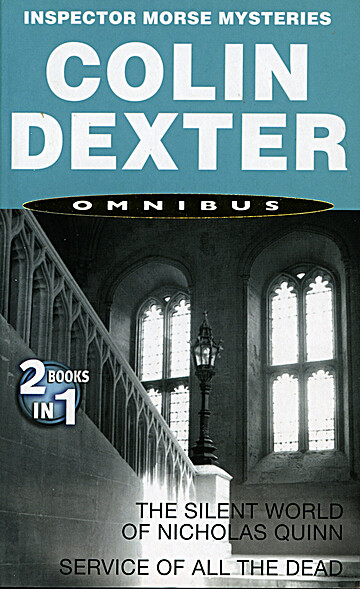
I don’t remember seeing an episode of The Silent World of Nicholas Quinn, so apart from visualising John Thaw and Kevin Whately as Morse and Lewis I was free to see the novel through Colin Dexter’s words. My copy is a secondhand book – an Omnibus containing Service of All the Dead as well as The Silent World of Nicholas Quinn.

Description from the back cover:

Morse had never ceased to wonder why, with the staggering advances in medical science, all pronouncements concerning times of death seemed so disconcertingly vague.

The newly appointed member of the Oxford Examinations Syndicate was deaf, provincial and gifted. Now he is dead . . .

And his murder, in his north Oxford home, proves to be the start of a formidably labyrinthine case for Chief Inspector Morse, as he tries to track down the killer through the insular and bitchy world of the Oxford Colleges . . .

My View

I thoroughly enjoyed reading this book. As the blurb on the back cover indicated the time of Quinn’s death is of prime importance, but then so is the place of his death. His deafness, as I expected is also crucial. Morse and Lewis come across as well defined characters, and so do all the other characters – Quinn’s colleagues and neighbours. The setting, as I expected, is excellent, but then I am familiar with Oxford.

For a long time when reading I had little idea who the culprit was. It has a most complicated plot that kept me guessing right to the end. It’s one of those books that I want to start again as soon as I finished it to see  just which clues I’d missed. Morse, himself, was baffled too but eventually worked it out successfully, whilst Lewis struggled to catch up with his train of thought, as this extract shows:

(Morse speaking first) ‘Remember this, then: Quinn couldn’t hear what he didn’t see.’

Am I supposed to see why all that is important, sir?’

‘Oh, yes. And you will do, Lewis, if only you think back to the Friday when Quinn was murdered.’

‘He was definitely murdered on the Friday, then?’

‘I think if you pushed me I could tell you to within sixty seconds!’  He looked very smug about the whole thing and Lewis felt torn between the wish to satisfy his own curiosity and a reluctance to gratify the chief’s inflated ego even further. Yet he thought he caught  a glimpse of the truth at last … Yes, of course. Noakes had said … He nodded several times, and his curiosity won.

‘What about all the business at the cinema, though? Was that all a red herring?’ (pages 243-4)

Reading the book I realised that Colin Dexter not only knows Oxford very well (which wasn’t news to me!) but also was very familiar with the workings of  an Examination Board and understood the difficulties of lip-reading. The reason for this is that after being a teacher, because of his deafness he became the Senior Assistant Secretary at the University of Oxford Delegacy of Local Examinations (UODLE) in Oxford, just like Quinn.

The Secret Adversary by Agatha Christie: Book Review

The Secret Adversary was first published in 1922. It was Agatha Christie’s second book and the first featuring Tommy and Tuppence. In this book they have just met up after World War One, both in their twenties: ‘an essentially modern-looking couple’. They are both stony broke and decide to set up a joint venture under the name of the Young Adventurers Ltd, initially intending to hire themselves out to commit crimes.

A Mr Whittington overhears their conversation and offers Tuppence their first assignment, but when she tells him her name is ‘Jane Finn’ he acts very strangely and thinks she is blackmailing him. From then on Tommy and Tuppence set out to find Jane Finn, a name Tommy had overheard from a conversation in the street.

Reading it reminded somewhat of Enid Blyton’s adventure books, mixed up with P G Wodehouse’s books. It’s a spy/detective story that is fast and furious with Tommy and Tuppence landing themselves in all sorts of dangerous situations. It’s also full of red herrings and they’re never very sure who they can trust. Tommy and Tuppence advertise for information relating to Jane Finn and have two responses. One is from Mr Carter, from British Intelligence who tells them that Jane Finn, a survivor from the torpedoed Lusitania, was handed a certain document – a secret agreement, with a ‘new and deadly significance’. The second response is from Mr Julius P Hersheimmer, a young American, who says he is Jane’s cousin and wants to find her.

Just who is the mysterious Mr Brown, the secretive mastermind behind a plot to unite all of England’s enemies, overthrow the government and cause anarchy?  There is no clue to his real identity, he remains elusive and always in the background. But it becomes clear that he is one of two people and as I read I swung from believing it to be one character to the other.

One point of interest is the brief mention of Inspector Japp, of Scotland Yard. His role in this is merely incidental.

I enjoyed this book and I liked Tommy and Tuppence, who by the end realise they are in love. Agatha Christie only wrote five books featuring this couple. Unlike Miss Marple and Hercule Poirot, Tommy and Tuppence age as the books were written:

  • Partners in Crime: a book of short stories
  • N or M?
  • By the Pricking of My Thumbs
  • Postern of Fate.

Format: Kindle Edition
File Size: 378 KB
Print Length: 229 pages
Source: Project Gutenberg EBook

Sunday Salon – P G Wodehouse

Years ago I was a Jeeves and Wooster fan and read as many of these books by P G Wodehouse that I could find in my local library. I also liked the excellent TV version with Stephen Fry and Hugh Laurie. So when my book group decided our next book would be any Wodehouse book  I was quite pleased. I’d read the first Blandings Castle book, Something Fresh a couple of years ago and enjoyed it. I don’t own any Wodehouse books so went to the library to see what was on the shelves. I came home with Summer Moonshine, first published in 1938, Jeeves in the Offing, published in 1960 and Stiff Upper Lip, Jeeves, first published in 1963.

So far I’ve read Stiff Upper Lip, Jeeves, which I finished this morning. Bertie Wooster goes to Totleigh Towers, the home of Sir Watkyn Bassett and his daughter Madeline, who is engaged to Gussie Fink-Nottle, but under the impression that Bertie is desperately in love with her – which he isn’t, of course. When Madeline insists that Gussie becomes a vegetarian he rebels and now no longer wants to marry her. Bertie is horrified as that will mean that Madeline will turn to him. He hot foots it to Totleigh Towers, despite her father’s intense dislike of him to bring about a reconciliation.

Thank goodness for Jeeves, who accompanies Bertie and helps him out of seemingly impossible situations. The events all conspire against Bertie who prides himself on his ‘stiff upper lip’:

It’s pretty generally recognised at the Drones Club and elsewhere that Bertram Wooster is a man who knows how to keep the chin up and the upper lip stiff, no matter how rough the going may be. Beneath the bludgeonings of Fate, his head is bloody and unbowed, as the fellow said. In a word, he can take it.

But I must admit that as I crouched in my haven of refuge I found myself chafing not a little. Life at Totleigh Towers, as I mentioned earlier, had got me down. There seemed no way of staying put in the darned house. One was either soaring like an eagle on to the top of chests or whizzing down behind sofas like a diving duck, and apart from the hustle and bustle of it all that sort of thing wounds the spirit and does no good to the trouser crease. And so, as I say, I chafed. (page 152)

It’s a very easy book to read, and the slang is interspersed with many literary and Biblical references, which I enjoyed, but I didn’t find it as riveting or as funny as I thought it would be – as the Jeeves books were in my memory. I suppose the farcical nature of it all eventually wormed its way into my subconscious and by the end of the book I found myself warming to it more than at the beginning and looking forward to reading the other two books.