The Secret Adversary by Agatha Christie: Book Review

The Secret Adversary was first published in 1922. It was Agatha Christie’s second book and the first featuring Tommy and Tuppence. In this book they have just met up after World War One, both in their twenties: ‘an essentially modern-looking couple’. They are both stony broke and decide to set up a joint venture under the name of the Young Adventurers Ltd, initially intending to hire themselves out to commit crimes.

A Mr Whittington overhears their conversation and offers Tuppence their first assignment, but when she tells him her name is ‘Jane Finn’ he acts very strangely and thinks she is blackmailing him. From then on Tommy and Tuppence set out to find Jane Finn, a name Tommy had overheard from a conversation in the street.

Reading it reminded somewhat of Enid Blyton’s adventure books, mixed up with P G Wodehouse’s books. It’s a spy/detective story that is fast and furious with Tommy and Tuppence landing themselves in all sorts of dangerous situations. It’s also full of red herrings and they’re never very sure who they can trust. Tommy and Tuppence advertise for information relating to Jane Finn and have two responses. One is from Mr Carter, from British Intelligence who tells them that Jane Finn, a survivor from the torpedoed Lusitania, was handed a certain document – a secret agreement, with a ‘new and deadly significance’. The second response is from Mr Julius P Hersheimmer, a young American, who says he is Jane’s cousin and wants to find her.

Just who is the mysterious Mr Brown, the secretive mastermind behind a plot to unite all of England’s enemies, overthrow the government and cause anarchy?  There is no clue to his real identity, he remains elusive and always in the background. But it becomes clear that he is one of two people and as I read I swung from believing it to be one character to the other.

One point of interest is the brief mention of Inspector Japp, of Scotland Yard. His role in this is merely incidental.

I enjoyed this book and I liked Tommy and Tuppence, who by the end realise they are in love. Agatha Christie only wrote five books featuring this couple. Unlike Miss Marple and Hercule Poirot, Tommy and Tuppence age as the books were written:

  • Partners in Crime: a book of short stories
  • N or M?
  • By the Pricking of My Thumbs
  • Postern of Fate.

Format: Kindle Edition
File Size: 378 KB
Print Length: 229 pages
Source: Project Gutenberg EBook

Sunday Salon – P G Wodehouse

Years ago I was a Jeeves and Wooster fan and read as many of these books by P G Wodehouse that I could find in my local library. I also liked the excellent TV version with Stephen Fry and Hugh Laurie. So when my book group decided our next book would be any Wodehouse book  I was quite pleased. I’d read the first Blandings Castle book, Something Fresh a couple of years ago and enjoyed it. I don’t own any Wodehouse books so went to the library to see what was on the shelves. I came home with Summer Moonshine, first published in 1938, Jeeves in the Offing, published in 1960 and Stiff Upper Lip, Jeeves, first published in 1963.

So far I’ve read Stiff Upper Lip, Jeeves, which I finished this morning. Bertie Wooster goes to Totleigh Towers, the home of Sir Watkyn Bassett and his daughter Madeline, who is engaged to Gussie Fink-Nottle, but under the impression that Bertie is desperately in love with her – which he isn’t, of course. When Madeline insists that Gussie becomes a vegetarian he rebels and now no longer wants to marry her. Bertie is horrified as that will mean that Madeline will turn to him. He hot foots it to Totleigh Towers, despite her father’s intense dislike of him to bring about a reconciliation.

Thank goodness for Jeeves, who accompanies Bertie and helps him out of seemingly impossible situations. The events all conspire against Bertie who prides himself on his ‘stiff upper lip’:

It’s pretty generally recognised at the Drones Club and elsewhere that Bertram Wooster is a man who knows how to keep the chin up and the upper lip stiff, no matter how rough the going may be. Beneath the bludgeonings of Fate, his head is bloody and unbowed, as the fellow said. In a word, he can take it.

But I must admit that as I crouched in my haven of refuge I found myself chafing not a little. Life at Totleigh Towers, as I mentioned earlier, had got me down. There seemed no way of staying put in the darned house. One was either soaring like an eagle on to the top of chests or whizzing down behind sofas like a diving duck, and apart from the hustle and bustle of it all that sort of thing wounds the spirit and does no good to the trouser crease. And so, as I say, I chafed. (page 152)

It’s a very easy book to read, and the slang is interspersed with many literary and Biblical references, which I enjoyed, but I didn’t find it as riveting or as funny as I thought it would be – as the Jeeves books were in my memory. I suppose the farcical nature of it all eventually wormed its way into my subconscious and by the end of the book I found myself warming to it more than at the beginning and looking forward to reading the other two books.

Payment Deferred by Joyce Holms: Book Review

I like puzzles and that is one of the things I like about crime fiction – solving the puzzle. The problem for crime fiction authors must be judging it correctly – how to drop the clues into the narrative in a subtle way so that the reader doesn’t get the solution too easily. I like being able to work it out for myself – but not too soon. In Payment Deferred, Joyce Holms has managed it well.

Paperback: 288 pages
Publisher: Bywater Books (30 Aug 2007)
Language English
ISBN-10: 1932859314
ISBN-13: 978-1932859317
Source: Gift from the author

This is the first of Joyce Holms’s series of books featuring Tam Buchanan and Fizz Fitzpatrick. Tam is a lawyer who spends Monday mornings giving legal advice at a community centre in Edinburgh. Fizz is soon to be a mature student of Law and much against Tam’s better judgement talks her way into becoming his assistant. She looks like a teenager, but is actually 26, with a talent for getting people to talk to her.

Murray Kingston, an old friend of Tam’s, is released from prison having served three years convicted of molesting his daughter after his wife’s death. When he turns up at the community centre wanting Tam to clear his name and help him get his daughter back it is Fizz who persuades Tam to review the evidence. Murray believes he was set up.

I thought this was a well plotted book,which moves at a good pace, with a good sense of location (Edinburgh and Berwick) and convincing characters, particularly Fizz and Tam – the relationship between the two of them developed from lukewarm to exasperation. Having solved the case they part:

“See you around Buchanan,” she said coldly, as the doors slid shut between them.

Buchanan sagged back against the wall and closed his eyes. He felt utterly depleted.

“See you around, Fizz”, he whispered to the empty landing, and the words blew away like dry leaves into the silence.

But even as he said it, he knew with absolute certainty that he wouldn’t be shot of her so easily.

After a minute or two he started to laugh, and couldn’t stop.

Their partnership was not at an end, as there are eight more books in the series. I’ve already read the most recent – Missing Link.

Details of all Joyce’s books are on her website.

Crime Fiction Alphabet – Letter B – W J Burley

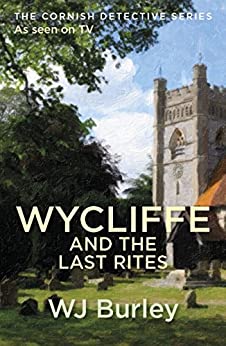
This week I’ve chosen to feature W J Burley to illustrate the letter B for Kerrie’s Crime Fiction Alphabet. I knew of  his Wycliffe novels but had never read any, or watched any of the TV dramatisations, so I came to Wycliffe and the Last Rites with no preconceptions. I really don’t know why I never watched the 1990s TV series starring Jack Shepherd as Wycliffe, but as I didn’t I was able to form my own image of him in my mind directly from the book.

William John Burley was born in Falmouth, Cornwall in 1914. His first book was published in the 1968. All in all he produced 22 more Wycliffe books and 5 others. He died in 2002 whilst he was writing his 23 Wycliffe book. There is more information about him at this website – W J Burley.

Wycliffe and the Last Rites
Paperback: 192 pages
Publisher: Orion; New Ed edition (7 Nov 2002)
Language English
ISBN-10: 075284931X
ISBN-13: 978-0752849317
Source: I bought it

Description from the back cover:

A bizarre murder shakes the Cornish village of Moresk. Arriving at church on Easter morning the vicar discovers the body of a woman sprawled across the chancel steps. To add to the horror, the church is filled with the discordant sound of an organ chord, the notes apparently chosen at random and wedged down.

Has the church been desecrated by a Satanist ritual? Chief Superintendent Wycliffe sees the crime more as an expression of hatred directed at others in the community, besides the dead woman. His investigation, however, is frustrated at every turn, and when another horrific murder is committed Wycliffe thinks he knows who the killer is. But can he prove it?

My thoughts:

This novel has a strong sense of location, with many passages describing the beautiful countryside of Cornwall. The characters are also well defined – a small local community focussing on the twin sisters, Katherine Geach and Jessica Dobell. The relationship between them is strained, with Jessica having a sense of guilt about a hit and run accident she’d witnessed 16 years earlier and admitting that she hadn’t played fair with Katherine.  After their parents’ deaths Jessica had inherited the family farm and lived there with the Vintners and their son, a strange family filled with hatred and resentment over their reduced circumstances. Then there is the Vicar and his sister, who had been forced to move from their previous parish, the houseboat man, Lavin, who is badly disfigured following an accident, and Arnold Paul, the organist and his ‘brother’.

Detective Chief Superintendent Wycliffe is a quiet character who thinks things through before divulging his suspicions to his colleagues. He delegates tasks to his team leaving himself free to concentrate on the victim. To him ‘hope is an ultimate resource’. His evening walks are a necessity for him to ponder what he has discovered and he is calm and collected:

It was characteristic that he should walk rather than drive or be driven; he refused to allow his days to become crowded with events in a frenetic succession of images like a television screen, lacking even commercial breaks to aid digestion. (pages 44 -5)

His problem in finding the murderer is that all the possible leads pointed to a limited range of possible suspects but none of them matched his specification for the criminal. It seemed he had to believe the impossible. It’s a tightly plotted book, concisely and precisely written and I enjoyed it very much. I have one other book of Burley’s to read – Wycliffe and the House of Fear. After that I’ll be looking out for his other books.

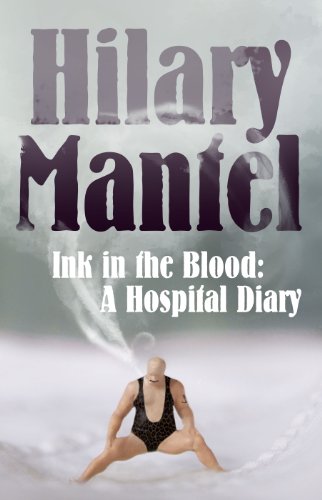
Ink in the Blood: A Hospital Diary by Hilary Mantel

This is a short memoir which I read quickly and easily on my Kindle – it’s only available on Kindle! Quite ironic that the first ebook (ie inkless) I read should be called ‘Ink in the Blood’! I was really pleased to find this because I loved Wolf Hall and had tickets for Hilary Mantel’s talk at the Borders Book Festival at Melrose in the summer.  She had to cancel that because she wasn’t well – I didn’t know just how ill she was. Ink in the Blood reveals all – how she had surgery to remove an intestinal obstruction that ended up in a marathon operation, followed by intense pain, nightmares and hallucinations.

Illness she found knocks down our defences, revealing things we should never see, needing moment by moment concentration on breathing, on not being sick and being dependent on others for your well-being. She read Virginia Woolf’s On Being Ill, which she thought was piffle, describing decorous illnesses such as fainting, fevers and headaches. She wonders what sort of wuss Woolf was, as she obeyed her doctors when they forbade her to write, whereas writing was Hilary Mantel’s lifeline – it was the ink, as she wrote in her diary, that reassured her she was alive.

It’s amazing how much she has managed to pack into this short memoir and one that repays more than one reading.

Product Description  from Amazon

During the summer after Hilary Mantel won the Man Booker Prize for Wolf Hall, she fell very ill. Just how ill is described in her extraordinary diary, Ink in the Blood. Originally published in the London Review of Books, it is one of the most incredible and haunting essays published in a very long time. In the diary she explores in forensic detail her loss of dignity, her determination, the concentration of the senses into an animalistic struggle to get through, and the attendant hallucinations she was plagued by.

  • Format: Kindle Edition
  • File Size: 134 KB
  • Publisher: Fourth Estate (15 Dec 2010)
  • Sold by: Amazon Media EU S.à r.l.
  • ASIN: B004GJXQ0C
  • Source: I bought it

Crime Fiction Alphabet – A is for …

… Agatha Christie

For the first of this year’s Crime Fiction Alphabet hosted by Kerrie I’ve chosen a double A – Agatha Christie – An Autobiography.

I finished reading it at the end of December. I can’t remember exactly when I began reading it. I think it was the end of May because in a Sunday Salon post then I wrote that I was thinking about starting it. I read short sections of it most days since I started it and felt quite sad when I came to the end. It was like having a daily chat with Agatha.


It took her fifteen years to write it. She stopped in 1965 when she was 75 because she thought that it was the ‘right moment to stop’. It seems right that a book that took her so long to write should take me a long time to read. As well as being a record of her life as she remembered it and wanted to relate it, it’s also full of  her thoughts on life and writing. I’ve written about her Autobiography in a few posts as I was reading it:

It struck me as I was reading her Autobiography that  it’s not very easy to work out the dates of many of the events she described. It follows on chronologically but is so interspersed with her thoughts and reflections that I forgot the date, or she hadn’t mentioned it. She wrote about her childhood, teenage years, friends and family, and her marriage to Archibald Christie; but although she wrote about their divorce she didn’t write about her disappearance in 1926. She wrote about her travels around the world, the two world wars, her interest and involvement with archaeology and her marriage to Max Mallowan.

Towards the end of the book she wrote that she had decided not to tidy up her Autobiography too much:

Nothing is more wearying than going over things you have written and trying to arrange them in proper sequence or turn them the other way around. I am perhaps talking to myself – a thing one is apt to do when one is a writer. (page 455)

What she remembered most were things that were most vivid and it was places that remained most clearly in her memory. She never had a good memory for people, apart from her own dear friends:

A sudden thrill of pleasure comes into my mind – a tree, a hill, a white house tucked away somewhere by a canal, the shape of a hill. Sometimes I have to think for a moment to remember where and when. Then the picture comes clearly, and I know. (page 416)

She wrote quite a lot about her writing methods, writing criticism, hearing your own voice, economy in wording, writing detective stories, adapting plays and writing them herself, the right length for a detective story (50,000 words), writing two novels at once, writing books set in historical periods and the joy of creation. The one book that satisfied her completely is not one of her detective books but one she wrote under the name of Mary Westmacott – Absent in Spring – and she wrote it in three days flat (pages 516 -7).

She ended the book with these words:

A child says ‘Thank God for my good dinner’.

What can I say at seventy-five? ‘Thank God for my good life, and for all the love that has been given to me.’ (page 551)