The Long Song by Andrea Levy: Book Review

I thoroughly enjoyed The Long Song by Andrea Levy. I think it may even be the best book I’ve read so far this year.

It’s brutal, savage, and unrelenting in depicting the lives of the slaves in Jamaica just as slavery was coming to an end and both the slaves and their former owners were adjusting to their freedom. The narrator is July, at the beginning a spirited young woman, born in a sugar-cane field, telling her story at her son’s suggestion. She begins by telling of her conception, but then says:

Reader, my son tells me that this is too indelicate a commencement of any tale. Please pardon me, but your storyteller is a woman possessed of a forthright tongue and little ink. Waxing upon the nature of trees when all know they are green and lush upon this island, or birds which are plainly plentiful and raucous, or taking good words to whine upon the cruelly hot sun, is neither prudent nor my fancy. Let me confess this without delay so you might consider whether my tale is one in which you can find an interest. If not, then be on your way, for there are plenty books to satisfy if words flowing free as the droppings from the backside of a mule is your desire. (page8)

It is a tale I found full of interest and one that is beautifully written too. I didn’t want to stop reading it, my only criticism being that I thought towards the end it was too condensed. There was a gap of thirty years, largely unexplained, but too much detail would have taken attention away from the main events of the story.

July lives with Kitty her mother until Caroline Mortimer, the sister of the plantation owner arrives and takes her to live in the big house as her servant and rename her ‘Marguerite’. Caroline is a frivolous, self-obsessed, ignorant woman and soon becomes dependent on July whilst still treating her as less than nothing – a slave. The end of slavery is violent and bloody but July lives on through it with Caroline, eventually helping her to run the plantation even though she is now ‘free’.

The story takes a tragic turn with the introduction of Robert Goodwin, a young Englishman, leading inevitably to heartbreak for July. There are several sub-plots that waylaid me, but I read it quickly eager to find out what happened. It’s shocking, breath-taking and completely absorbing.

Crime Fiction Alphabet – R is for …

… Ruth Rendell is one of my favourite authors, whether she writes under her own name or her pseudonym, Barbara Vine, so her novel, Tigerlily’s Orchids was an easy choice to illustrate the letter R for Kerrie’s Crime Fiction Alphabet.

Ruth Rendell was born on 17 February 1930 in London. She is Fellow of the Royal Society of Literature and has received many awards for her work, including the Crime Writers’ Association Cartier Diamond Dagger (lifetime achievement award), and the Sunday Times Award for Literary Excellence.
She is the author of a series of many novels featuring Detective Chief Inspector Wexford, set in Kingsmarkham, a fictional English town. The first of these, From Doon with Death, is also her first novel and was published in 1964. Books in the series include Kissing the Gunner’s Daughter (1992), Simisola (1994), Road Rage (1997), End in Tears (2005), and Not in the Flesh (2007). Under the pseudonym Barbara Vine her books include A Dark-Adapted Eye (1986), A Fatal Inversion (1987), winner of the Crime Writers’ Association Macallan Gold Dagger for Fiction, Gallowglass (1990), King Solomon’s Carpet (1991), Asta‘s Book (1993) and The Brimstone Wedding (1995). The Blood Doctor (2002) is a psychological novel based on the diaries of Lord Henry of Nanther, Queen Victoria’s physician.

In 1996 she was  awarded a CBE in 1996 and in 1997 became a Life Peer –  Baroness Rendell of Babergh.

Tigerlily’s Orchids, published in 2010, is her 60th published book. It’s one of her stand-alone psychological crime novels, full of decidedly disturbing and disturbed characters.

Summary from the book cover

When Stuart Font decides to throw a house-warming party in his new flat, he invites all the people in his building. After some deliberation, he even includes the unpleasant caretaker and his wife. There are a few other genuine friends on the list, but he definitely does not want to include his girlfriend, Claudia, as that might involve asking her husband.

The party will be one everyone remembers. But not for the right reasons. All the occupants of Lichfield House are about to experience a dramatic change in their lives’¦

Living opposite, in reclusive isolation, is a young, beautiful Asian woman, christened Tigerlily by Stuart. As though from some strange urban fairytale, she emerges to exert a terrible spell. And Mr and Mrs Font, the worried parents, will have even more cause for concern about their handsome but hopelessly naive son.

As I began reading this book which starts by introducing the dysfunctional characters living in the building I had that creepy, ominous feeling  Ruth Rendell creates so easily, generated by the sad and sordid lives of the seemingly ordinary people she describes. Part of me didn’t want to carry on reading, but another part felt compelled to read on. There is Olwen who is determined to drink herself to death, Stuart, who is having an affair with Claudia, whose husband knows about it and who threatens and attacks him; a doctor, who writes dodgy medical reviews, a caretaker who spies on young children and three girls who are flat-sharing. Then there are the people living over the road …

Rendell weaves together a story round the various characters, first concentrating on one then another, in a way that made me want to know more about each one. I read it quickly and it’s one that may benefit from re-reading but I don’t want to. By the end I was happy to finish it and return my copy to the library.

Murder is Easy by Agatha Christie: Book Review

Murder is Easy, Agatha Christie’s 25th book was first published in 1939.

Publisher’s summary:

Luke Fitzwilliam could not believe Miss Pinkerton’s wild allegation that a multiple murderer was at work in the quiet English village of Wychwood — or her speculation that the local doctor was next in line. But within hours, Miss Pinkerton had been killed in a hit-and-run car accident. Mere coincidence? Luke was inclined to think so — until he read in The Times of the unexpected demise of Wychwood’s Dr Humbleby …

My view

This has stood the test of time very well. It’s another one of Agatha Christie’s easily read crime mysteries, with plenty of plot twists and unexpected revelations. This time the detective is Luke Fitzwilliam, a retired policeman recently returned to England from the East. He was wondering what to do with himself when he met Miss Pinkerton quite by chance. She tells him of her suspicions about a number of murders in her village and when he tells her that it’s rather hard to do a lot of murders and get away with it, she replies:

No, no, my dear boy, that’s where you’re quite wrong. It’s very easy to kill – so long as no one suspects you. And you see, the person in question is just the last person anyone would suspect! (page 22)

Wychwood-under-Ashe is a picturesque village with a Manor House, a village green and a duck pond. In other words a quintessentially English village just like Miss Marple’s St Mary Mead. But instead of Miss Marple, the person who helps Luke with his investigations is Bridget Conway, a beautiful young woman who immediately entrances Luke. His cover story is that he is writing a book on folklore and needs to talk to the locals gathering tales and legends.

I had no idea about the killer’s identity and neither really did Luke, until just near the end of the book. Superintendent Battle appears but does nothing towards solving the mystery and denies that he could have done any better than Luke explaining that

… nothing’s impossible in crime.

… Anyone may be a criminal, sir, that’s what I meant. (page 317)

Murder is Easy – one of Agatha Christie’s best mysteries:

  • Paperback: 400 pages
  • Publisher: Harper; Masterpiece edition (Reissue) edition (3 Sep 2007)
  • Language English
  • ISBN-10: 000713682X
  • ISBN-13: 978-0007136827
  • Source: I bought it

Cop Hater by Ed McBain: Book Review

Ed McBain is the pseudonym of Salvatore Lombino (1926 – 2005). He wrote children’s books, science fiction and westerns before writing crime fiction. He also wrote books under the name of Evan Hunter, most notably The Blackboard Jungle, which was later made into a film. He also wrote the screenplay for Alfred Hitchcock’s 1963 film The Birds, (which in turn was loosely based on Daphne du Maurier’s short story of the same name).

Cop hater 001
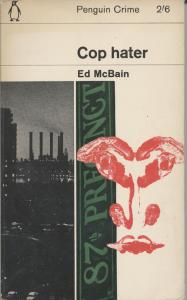
Cop Hater is the first in his series of 87th Precinct books and to my mind is a classic in the police procedural genre with its emphasis on the police routine investigations and on the importance of forensics in detection work. It’s a step back in time to the 1950s. The cover I’ve shown is of my copy reprinted in Penguin’s Crime Series in 1964, the original book was published in 1956.

It’s summer, a heatwave in the city (not named, but suspiciously like New York) and someone is targeting and killing cops, first Mike Reardon, then his partner David Foster. Hank Bush and his partner Steve Carella are struggling to find any clues to identify the murderer. But when Bush is killed with the same weapon, a Colt .45 Carella gets his break. Fortunately Bush managed to wound his attacker and the forensics team are able to piece together a remarkable analysis of the killer:

The killer is a male, white, adult, not over say fifty years of age. He is a mechanic, possibly highly skilled and highly paid. He is dark complexioned, his skin is oily, he has a heavy beard which he tries to disguise with talc. His hair is dark brown and he is approximately six feet tall. Within the past two days he took a haircut and a singe. He is fast, possibly indicating a man who is not overweight. Judging from the hair, he should weigh about 180. He is wounded, most likely above the waist, and not superficially. (page 122)

And all this is drawn from the hair Bush pulled from the attacker’s head, skin and beard hair from scratching his face and from the attacker’s blood that dripped onto Bush’s clothing and his blood stains on the pavement.

The general theory is that the killer is a ‘cop hater’, someone with a grudge against the police, whereas Carella has a different idea and when he talks to Savage, a journalist about it, Savage prints his words, putting Carella’s girlfriend in deadly danger as a result.

This is a great book. I loved McBain’s style, with vivid, precise descriptions of the city, the sizzling, suffocating heat and the characters. The dialogue is terse, tense and to the point and the plot moves quickly as the tension mounts towards a dramatic climax.

McBain is not just good on crime investigation and description. His characters, even the minor ones are real people, like Carella’s girl friend Teddy Franklin for example. I like the way he lets us know that she is deaf by Carella cursing the telephone because ‘it was worthless with a girl like Teddy’ and on then on the next page he clarifies that she’s dumb too – ‘her face was her speaking tool‘.

I love this description of a brief break in the heatwave as a storm hit the city.

It seemed the rain would never come. The lightning was wild in its fury, lashing the tall buildings, arcing over the horizon. The thunder answered the spitting anger of the lightning, booming its own furious epithets.

And then, suddenly, the sky split open and the rain poured down. Huge drops, and they pelted the sidewalks and the gutters and the streets; and the asphalt and concrete sizzled when the first drops fell: and the citizens of the city smiled and watched the rain, watched the huge drops – God, how big the drops were! – splattering against the ground. And the smiles broadened, and people slapped each other on the back, and it looked as if everything was going to be all right again.

Then suddenly the rain stopped.

It had burst from the sky like water that had broken through a dam. It rained for four minutes and thirty seconds. and then, as though someone had suddenly plugged the broken wall of the dam, it stopped.

The lightning still flashed across the sky, and the thunder still growled in response, but there was no rain.

The cool relief the rain had brought lasted no more than ten minutes. At the end of that time, the streets were baking again, and the citizens were swearing and mumbling and sweating.

Nobody likes practical jokes.

Even when God is playing them. (pages 111 – 112)

There are plenty of books in the 87th Precinct series and I hope to read more of them.

Crime Fiction Alphabet: P is for P D James

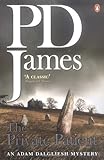
This week’s letter in Kerrie’s Crime Fiction Alphabet is the letter P. My choice is The Private Patient by P D James. I like the fact that not only does the author’s name begin with P (for Phyllis) but the title also has a double ‘P’.

Description from the back cover

When the notorious investigative journalist Rhoda Gradwyn books into Mr Chandler-Powell’s private clinic in Dorset for the removal of a disfiguring and long-standing scar, she has every prospect of a successful operation by a distinguished surgeon, a week’s peaceful convalescence in one of Dorset’s most beautiful manor houses, and the beginning of a new life. She was never to leave Cheverell Manor alive. Dalgliesh and his team, called in to investigate the murder, and later a second death, are confronted with problems even more complicated than the question of innocence or guilt.

My view

This book is not a quick, easy read. It took me several days of slow, careful reading to absorb the details of this complex book. All the characters are described in detail. Rhoda is described as a private person as well as being the private patient. She has a painstakingly probing personality – ideal for an investigative journalist:

Neither dislike nor respect worried her. She had her own private life, an interest in finding out what others kept hidden, in making discoveries. Probing into other people’s secrets became a lifelong obsession, the substratum and direction of her whole career. She became a stalker of minds. (page 8 )

The novel is built up very slowly and methodically and it is only after nearly 100 pages that Rhoda is murdered and Commander Adam Dalgleish and his team are called to the Manor to investigate her death. Dalgleish is preparing for his marriage to Emma Lavenham and his  first thoughts are that maybe he’d had enough of murder. Although it wasn’t the most horrific corpse he’d seen he thought it

… seemed to hold a career’s accumulation of pity, anger and impotence. (page 138)

There are many suspects – a group of seven people in the Manor any of whom could have killed Rhoda – Chandler-Powell, Sister Holland, Helena Cressett, whose family had previously owned the Manor for more than 400 years, Letitia Frensham, Helena’s old governess now working at the Manor as book keeper, the cook and his wife, Dean and Kimberley Bostock and the domestic helper, Sharon Bateman. Marcus Westhall, the surgical assistant and his sister Candace, although they lived in the nearby Stone Cottage, also had access to the Manor and then there was Robin Boyton (the Westhall’s cousin) who was staying at Rose Cottage. He had recommended the Manor to Rhoda.

Dalgleish and his team interview all the suspects and discover many secrets and connections, delving into their lives. The clues are all there, but despite paying close attention as I read, it was only near the end of the book that I worked out who was responsible for the murders. This is a thoughtful book, with precise descriptions of people and places and yet it is tense and dramatic. I enjoyed it.

The Private Patient

  • Paperback: 512 pages
  • Publisher: Penguin (24 Sep 2009)
  • ISBN-10: 014103923X
  • ISBN-13: 978-0141039237
  • Source: I bought it

The Moonstone by Wilkie Collins: Book Review

The Moonstone is one of those books that I thought I’d read because I know the story, but actually I hadn’t. I know it because years ago I watched a TV dramatisation and the images of the Indians, the jewel, the shifting sands and Sergeant Cuff have remained in my mind ever since.

I downloaded the free e-book  to my Kindle.

I was surprised by how easy it is to read, written from several viewpoints and all so individual.  The Moonstone, a large diamond, originally stolen from a statue of an Indian God and said to be cursed is left to Rachel Verinder. She receives it on her 18th birthday and that night it is stolen from her bedroom. Chief suspects are three Indian jugglers, who are Hindu priests dedicated to retrieving the jewel. Suspicion also falls on Rosanna Spearman, one of the maids, who later drowns herself in the quicksands.

I loved the way Collins has written this book from so many different perspectives, giving a rounded picture of the investigations into the Moonstone’s theft. I particularly liked the first narrator Gabriel Betteredge, the house-steward and his reliance on Defoe’s Robinson Crusoe for comfort and enlightenment:

I am not superstitious; I have read a heap of books in my time; I am a scholar in my own way. Though turned seventy, I possess an active memory, and legs to correspond. You are not to take it, if you please, as the saying of an ignorant man, when I express my opinion that such a book as ROBINSON CRUSOE never was written, and never will be written again. I have tried that book for years’”generally in combination with a pipe of tobacco’”and I have found it my friend in need in all the necessities of this mortal life. When my spirits are bad’”ROBINSON CRUSOE. When I want advice’”ROBINSON CRUSOE. In past times when my wife plagued me; in present times when I have had a drop too much’”ROBINSON CRUSOE. I have worn out six stout ROBINSON CRUSOES with hard work in my service.

Then, there is Sergeant Cluff, the detective who loves roses who leaves the mystery unsolved. A year later matters move on, the investigations pick up and eventually the culprit is revealed. There are many red herrings, false trails and plenty of suspense and tension before the denouement. I loved this book for its wealth of vividly drawn characters, its mystery and atmospheric settings and also its humour. Now I want to read more from Wilkie Collins.