The Case of the Lame Canary by Erle Stanley Gardner

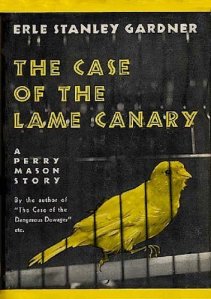
The Case of the Lame Canary was originally published in 1937. My copy is a Penguin green and white reprint of 1961. At that date Erle Stanley Gardner was in his sixties and was one of the world’s best-selling mystery writers. He had given up his career as a lawyer in California in 1935 and had taken a log cabin in the mountains to write his books full-time.

Perry Mason specialises in murder cases so when Rita Swaine arrives at his office with a tale of her sister’s matrimonial problems he isn’t interested. However, he is interested in the caged canary she has carried into his office, because it has a lame foot and he wants to know why it’s lame and why she brought it with her.

Rita tells him a complicated tale, which persuades Perry to represent her sister. Her sister Rosalind is married to Walter Prescott, but is still in love with Jimmy Driscoll, Walter had found out and threatened to kill her and so Rosalind had left and then asked her to get her things and the canary. Walter is later found murdered and the story gets even more complicated, especially as Rita just doesn’t tell Perry the truth. It appears that all three – Rita, Rosalind and Jimmy could have killed Walter.

Perry enlists Paul Drake’s help and together they ferret out yet more information – at times it felt like information overload and no clear way through to discover who killed Walter and why. And yet there is more because towards the end Perry says to his secretary, Della Street

… a solution of any crime which doesn’t account for all of the various factors involved is no solution at all. No, I’ve paid too much attention to the people the district attorney’s office suspect, and not enough to the victim. In the long run, Della, the essence of all successful detective work lies in reconstructing the life of the victim. That gives motivation, and motivation makes murders. (page 185)

There was no way I was able to work it all out, until almost the end and yet all the clues are there just so cleverly concealed within the text – and the lame canary does have a part to play!

Perry Mason acts more as a detective than a lawyer and works independently of the police to protect his clients, but he also has a very human side. Della, is anxious that he has a holiday and has planned a long trip around the world for the two of them. She’s booked their tickets and as the case gets more and more complicated she continues to urge him to start packing his things. In the end they just make it on board and they sail away. The book ends on a romantic scene as the other passengers watch:

… the tall, distinguished man, accompanied by the capable, good-looking young woman, parading around the deck, as though it were a ceremonial march, and, as they walked, whistling Hawaiian Paradise. (page 224)

A satisfying read and one I might read again, if only to see how it was all put together.

Crime Fiction Alphabet: V is for Val McDermid

Until now I’ve steered clear of reading any of Val McDermid‘s books and the reason is that I can’t stand to watch the violence and torture scenes in TV series such as Wire in the Blood. But recently I’ve been thinking that maybe I wasn’t being fair to judge a writer’s work on films based on the books. So I decided to check out a Val Mcdermid book from the library to see for myself.

There are many to choose from but I picked the shortest one, thinking if I didn’t like it I wouldn’t waste much time reading it.

Cleanskin is one of the Quick Reads series, aimed at “adults who’ve stopped reading or find reading tough, and for regular readers who want a short, fast read.” 

Summary (adapted from the back cover where Jack Farrell is erroneously called Jack Farlowe!):

When career criminal, Jack Farrell’s body is found washed-up on a Suffolk shore, it looks to the police like a clear-cut case. Broken-hearted at his daughter’s death, he has drowned himself – good riddance and one less crime to solve, according to CID. Then again, maybe not. For, one by one, Farrell’s enemies are being killed. And the horrific manner of their deaths makes drowning look like a day at the beach!

My thoughts:

Val McDermid’s style in this long short story is clear, straight-forward and chatty. The narrator is DCI Andy Martin. He’s the world expert on Jack Farrell, a criminal known as a ‘cleanskin‘ because he had no criminal record:

Farrell’s crew ran just about every dirty racket you could think of: drugs, guns, hookers, porn. You name it they were into it. They bought and sold human lives like they were bargains on eBay. (page 2)

Martin identifies Farrell’s body from the vivid tattoos still visible on his battered and bloated body. Being a novella the action is fast paced, the characters are briefly sketched and although I had worked out some of the mystery, the final dénouement came as a surprise. And there is a certain amount of  graphic description of the gruesome methods of killing and torture, so I’m still not sure about reading any of Val McDermid’s other books.

Can anyone recommend where I should start – bearing in mind that I am squeamish?

Cleanskin:

  • Paperback: 128 pages
  • Publisher: HarperCollins; World Book Day edition edition (18 May 2006)
  • Language English
  • ISBN-10: 0007216726
  • ISBN-13: 978-0007216727
  • Source: Borrowed from the library

A Crime Fiction Alphabet post – for more posts featuring the letter V see Kerrie’s blog.

Crime Fiction Alphabet: U is for Nicola Upson

This week’s letter in Kerrie’s Crime Fiction Alphabet is letter-u
U.

Nicola Upson has written three novels featuring novelist Josephine Tey (Elizabeth Mackintosh 1896-1952):

  • An Expert in Murder
  • Angel with Two Faces
  • Two for Sorrow

She has also written two books of non-fiction:

  • Mythologies: Sculpture of Helaine Blumenfeld
  • In Good Company: A Snapshot of Theatre and the Arts

I recently read An Expert in Murder, a very detailed and intricate murder mystery. Nicola Upson has a passion for the theatre and it shines through to great advantage in this book, set in the theatrical world of  the 1930s – March, 1934 to be precise, as the final week of Josephine Tey’s play Richard of Bordeaux begins. Josephine is travelling from her home in Inverness to London by steam train when she meets an enthusiastic fan, Elspeth Simmons, who boarded the train at Berwick-upon-Tweed. They chat and Josephine takes a liking to her, feeling protective towards her.

They arrive in London, but then Elspeth is murdered and soon afterwards Bernard Aubrey, the theatre owner is also found dead, poisoned. Detective Inspector Archie Primrose, a friend of Josephine’s investigates. It’s a blend of fact and fiction. I don’t know much about Elizabeth Macintosh and so this representation of her persona as Josephine Tey seemed wholly fictional and actually she is a minor character in the sequence of events and plays little part in discovering the murderer. I think, on the whole, there is too much ‘telling’ and not enough ‘showing’ for my liking.

There is a great amount of family background, back stories and theatrical information that slowed down the action. But I liked the detailed descriptions of people and places and I especially liked the background details of the World War One, that had ended 16 years earlier but still cast its shadow. There are a number of coincidences in the book, but as Josephine tells Archie,

‘Anyway’, she continued wryly, ‘the only people who don’t believe in coincidence are the ones who read detective novels – and policemen. These things happen, Archie, even if we’re not supposed to use them in books. (page 45)

Reading An Expert in Murder made me think about mixing fact and fiction by using real people as characters. I decided that I don’t have a problem with historical fiction so wondered why its use in crime fiction should give me pause for thought. I think maybe it’s a step too far and I would have preferred it if Tey had been wholly a fictional character based on the author in the same way as John Terry, the leading actor in Tey’s play, is a fictionalised version of John Gielgud. Nicola Upson’s Author’s Note at the back of the book is interesting on this point when she explains that Elizabeth Mackintosh

… took a dim view of mixing fact and fiction – but she allowed it if the writer stated where the truth could be found, and if invention did not falsify the general picture. (page 290)

I think she succeeded in this, although, as she then adds

Murder, of course, does rather distort the general picture, but I hope that it won’t entirely eclipse a unique moment of theatrical history and the true beginnings of a remarkable writing career. (page 290)

I think that was a slight stumbling block for me, but I’m glad that it may have advertised Josephine Tey’s work to a wider audience. I haven’t read many of her books, but those I have read are excellent, especially The Daughter of Time.

Since reading An Expert in Murder I am interested in reading more of Nicola Upson’s Tey books and have  Angel with Two Faces lined up to read soon.

  • Paperback: 304 pages
  • Publisher: Faber and Faber; paperback / softback edition (5 Feb 2009)
  • Language English
  • ISBN-10: 0571237711
  • ISBN-13: 978-0571237715
  • Source: I bought the book

Crime Fiction Alphabet: T is for Once a Biker by Peter Turnbull

I’ve chosen Peter Turnbull’s Once a Biker, a Hennessey and Yellich mystery to illustrate the letter T in Kerrie’s Crime Fiction Alphabet. For a full list of his books see Fantastic Fiction.

Synopsis from the book jacket

When a death bed confession leads to the reopening of a murder case, it doesn’t bode well when both victims were members of the same bikers’ gang twenty years ago. As Detective Chief Inspector Hennessey and his team try to investigate, it seems the vow of silence is still as strong as it was all those years ago, and many ex-gang members refuse to discuss those days of dangerous initiation rites and violent dares. But, when an ex-member is suddenly found murdered, it seems that someone is determined to keep old secrets dead and buried…

My view

This is the 16th Hennessey and Yellich mystery, a police procedural set in the city of York. Once again I have jumped into a series that is well advanced in the sequence, but Once a Biker works well as a standalone. Chief Inspector George Hennessey is nearing retirement – ‘His pension was calling his name more and more loudly with each day that passed.’(page 15)  But he is still very much in charge and leads his team, Detective Sergeant Somerled Yellich, Detective Constables Thompson Ventnor and Reginald Webster (new to CID) in uncovering the murderer.

Tony Wells, dying of cancer in a hospice tells Gillian Stoneham, a counsellor, the whereabouts of Terry North’s body, buried in Foxfoot Wood outside York. Both Tony and Terry had been members of a bikers’ gang known as the Dungeon Kings. The post-mortem reveals that Terry had been killed by a blow to the head. There were fractures all over his body but no facial injuries. The pathologist Dr Louise D’Acre describes it as ‘a very dispassionate execution, but somebody wanted to hurt him before they killed him.’ (page 20)

One of the biker chicks had been murdered three weeks before Terry had been reported missing and Harry the ‘Horse’ Turner, a gang member had been convicted of her murder. Released from prison he now maintains that he was innocent and Hennessey believes him, but first he has to penetrate the bikers’ code:

“Don’t grass on your mates”. They are still bikers in their hearts, early middle-aged as they may be. Once a biker, always a biker. (page 62)

I know nothing about bikers and their gangs, but learnt a lot from this book, enough to make me glad that I didn’t – if the initiation ceremony is dangerous, the biker’s chicks’ leaving ‘ceremony’ is very brutal and shocking.

There is a very strong sense of place in this book, as George Hennessey walks to and from his office in Micklegate along the medieval city walls. I liked the chapter headings giving a short preview of the contents, in a similar vein to a Dickens’ novel, such as this for chapter 4 Wednesday, 19 June, 10.10 hours – 13.40 hours in which life in the biker gang is recalled.’ (page 71) In places the dialogue also has an old fashioned feel and the use of words, such as ‘forenoon’ adds to the formality not found in most of today’s crime fiction books. I liked it.

There is an intriguing ending to this book involving George Hennessey which made me realise that I have missed something in not reading the earlier books in the series, something I hope to remedy.

  • Paperback: 201 pages
  • Publisher: Severn House Paperbacks Ltd (Jun 2008)
  • Language English
  • ISBN-10: 9781847510266
  • ISBN-13: 978-1847510266
  • Source: Borrowed from the library

Crime Fiction Alphabet: S is for …

… The Stabbing in the Stables by Simon Brett, the seventh book in the Fethering Mysteries series.

Description from Fantastic Fiction:

Fethering’s favorite sleuths are at it again as Jude and Carole Seddon find themselves in the midst of some horseplay, after stumbling upon the body of ex-equestrian Walter Fleet at Long Bamber Stables.

The police attribute the stabbing death to the mysterious “Horse Ripper,” who’s been mutilating mares across West Sussex-and who Walter obviously caught in the act. But considering Walter’s track record out of the saddle, Jude and Carole find that there are plenty of suspects- including Walter’s put-upon wife and more than a few jealous husbands who wanted Walter put out to pasture.

Jude and Carole are amateur detectives, who live next door to each other in the village of Fethering. Jude (who won’t give her last name) is a healer and takes on a new patient a horse and his owner Sonia Dalrymple, kept in stable owned by Lucinda and Walter Fleet. Carole,  retired from the Home Office, divorced and shy, is very different from Jude, but they work well together.

They make enquiries and discover that Walter was not a popular man, not even his wife mourns his death. The Stables, however, is a source of rivalry and secrets, and suspicion lands on Donal, a drunken ex-jockey and horse healer. Jude and Carole don’t believe he is the murderer even when the police arrest him. Sonia, tense and  verging on hysteria is obviously hiding something and Imogen, a teenager helping out at the Stables, behaves very oddly.

It’s an easy read, a ‘cozy mystery’, enjoyable and not too taxing on the brain, as I did work it out before the denouement.

A Crime Fiction Alphabet post for the letter S.

Cold is the Grave by Peter Robinson: Book Review

There’s quite a lot to think about reading Cold is the Grave by Peter Robinson. First of all are the crimes, the characters, how they interact and so on and then there are  a number of issues raised – including the difficulties of family relationships, the problems arising when professional  and personal lives overlap, and the effects of guilt.

Description from the back cover:

Detective Inspector Banks’s relationship with Chief Constable Riddle has always been strained. So Banks is more than a little surprised when Riddle summons him late one night and begs for his help.

For Riddle, Banks’s new case is terrifyingly close to home. Six months ago his sixteen-year old daughter ran away to London, where she has fallen into a turbulent world of drugs and pornography. With his reputation threatened, Riddle wants Banks to use his unorthodox methods to find her without fuss. But before he knows it, Banks is investigating murder …

My thoughts:

This is the 11th book in the Inspector Banks series and refers back to incidents in previous books. It’s not too difficult to follow if you haven’t read all the others (as I haven’t) but I think it would help and I wish that I had. It’s also a bit too long for my liking – maybe reading older crime fiction has  made me prefer a tighter and shorter book. However, this is still a good read.

Banks quickly finds Emily, living with Barry Clough a dubious character, old enough to be her father and wealthy from the proceeds of bootlegged computer games and software. Sickened by her life with Clough, she returns home with Banks and then one month later she is found dead, murdered by a mixture of cocaine and strychnine. Banks finds it difficult to stand back and be objective. It becomes personal to him and Detective Superintendent Gristhorpe has to warn Banks,

… don’t let anger and a desire for revenge cloud your judgement. Look clearly at the evidence, the facts before you make any moves. Don’t go off half-cocked the way you’ve done in the past. (page 192)

He and his team, including Detective Sergeant Annie Cabot, are also investigating the death of Charlie Courage, a small-time crook. Their investigations take them from their base in Eastvale, Yorkshire down to London, Stony Stratford, and Leicestershire, with links to crime in Northumbria. At first this seems to be unrelated to Emily’s death but Banks begins to suspect that the two cases maybe linked.

More complications follow with blackmail, another death and suicide, but eventually Banks and Annie work their way through the maze of events. Banks, though, has more victims of crime to add to those that bother his sleep with feelings of guilt, thinking that he should have dug deeper, and that he could have prevented the murders. He knew there was ‘something desperately out of kilter with the Riddle family’, and realises that Emily’s death was

… murder from a distance, perhaps even death by proxy, which made it all the more bloody to solve. (page 271)

This is a detailed and comprehensive police procedural as well as a thoughtful look at the problems of modern life. One to ponder.