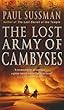
The Lost Army of Cambyses by Paul Sussman

The combination of the legendary ancient mystery about the disappearance of a whole army in Egypt’s western desert in 523 BC, and a modern murder mystery caught my imagination. So I was attracted to reading The Lost Army of Cambyses by Paul Sussman.

The Lost Army of Cambyses is his first book, featuring Inspector Yusuf Khalifa of the Luxor police. It is an action packed adventure story, an easy escapist read, although the ancient mystery element definitely plays second fiddle to the modern murder mystery, with a terrorist plot thrown in the mix.

I enjoyed it. It began well, in Cairo, September 2000, where a mutilated corpse is washed up on the banks of the Nile at Luxor, an antiques dealer is savagely murdered in Cairo, and an eminent British archaeologist is found dead at the ancient necropolis of Saqqara. But as I read on I was less convinced.

Where the book came alive for me was through the character of Yusuf Khalifa, and especially the historical/archaeological aspects of the book highlighted in his meetings with his old teacher and mentor, Professor al-Habibi at Cairo’s Museum of Egyptian Antiquities. Khalifa had wanted to be an archaeologist, but circumstances had meant he’d been unable to complete his studies and he had joined the police force. However he had remained fascinated by the history of his country:

He remembered as a child standing on the roof of their house watching the sunrise over the pyramids. Other children had taken the monuments for granted, but not Khalifa. For him there had always been something magical about them, great triangles looming through the morning mist, doorways to a different time and world. Growing up beside them had given him an insatiable desire to learn more about the past.

… There was something mystical about it, something glittering, a chain of gold stretching all the way back to the dawn of time. (pages 100 – 102)

The other characters were less convincing, becoming stereotypical particularly the ‘bad’ characters, and the violence was a little too violent for my liking. But it still managed to keep me hooked and wanting to know how it would end.

I’d like to read more of Paul Sussman’s books – I much preferred his second book, The Last Secret of the Temple. I’ve yet to read the third book featuring Inspector Khalifa, The Labyrinth of Osiris. More details of his books are on Paul Sussman’s website, which is now being updated by his wife after Paul died very suddenly from a ruptured aneurysm in May 2012.

New-To-Me Books

Just eleven days left to go before the end of March and the end of the TBR Triple Dog DareThe basic idea of the Triple Dog Dare is to spend the first three months of the year cleaning house by reading only books in your TBR stack as of midnight, Dec. 31 and with a few allowed exceptions I’m still on track. But I’ve downloaded books onto Kindle and got some books from Barter Books over these last three months and I’m really looking forward to reading them from April onwards. I wrote about some of them in an earlier post.

Here are some more of the ‘physical’ books I have waiting not-so-patiently to be read:

Sweet Thursday P1090384

  •  Sweet Thursday by John Steinbeck – because I loved Cannery Row and this is the follow-up story. ‘Set in Monterey, on the California Coast, Sweet Thursday is what they call the day after Lousy Wednesday, which is one of those days that’s just naturally bad.’ I was really pleased to find this on the shelves at Barter Books – it just jumped out at me.
  • The Last Girl by Jane Casey – because I’ve read good things about her books, crime fiction of the thrilling kind. It’ll probably be a while before I read this book as I haven’t read the first in the Maeve Kerrigan series and this one is the third.
  • A Medal for a Murderer by Frances Brody – because I enjoyed the first Kate Shackleton mystery, Dying in the Wool. This is the second in the series, set in the 1920s in Harrogate where the leading lady in a play at the theatre is found dead in a doorway.
  • The Day of the Lie by William Brodrick – because I’ve read two of the earlier Father Anselm books and enjoyed them. In this one Anselm investigates events in Eastern Europe in the grip of the Cold War.

The books on Kindle include these:

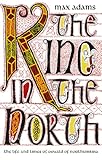
Books on Kindle P1090385The one I’m most interested in is The King in the North: the Life and Times of Oswald of Northumbria by Max Adams – because it’s history of the area where I live, set in the 7th century about Oswald, a prince of the Northumbrian royal house. He reigned briefly, from 634 – 642, but during that time he re-united and re-Christianized the North-East; forged a hybrid culture of Briton, Irish, Scot and Anglo-Saxon; and founded a monastery on Lindisfarne. He was the first British king to die a Christian martyr. Max Adams is a biographer, archaeologist,  traveller and writing coach who lives in North-east England.

I think I’ll be reading this book very soon!

The King's Evil by Edward Marston

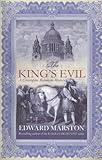
I’m still reading from my own unread books and turned to The King’s Evil for some historical crime fiction. It’s the first in Edward Marston’s Restoration series, featuring Christopher Redmayne, an architect and Jonathan Bale, a parish constable.
The King’s Evil is set in London in September 1666, just as the Great Fire of London has begun, eventually devastating a large part of the old medieval City of London. I liked Marston’s description of the fire, conjuring up the sights and sounds, the fear and panic it caused and the efforts to stop its spread – although I’m sure they didn’t use ‘dynamite’ to blow up houses to create a fire break. Anyway this anachronism didn’t spoil my enjoyment of this book.

Redmayne, a Royalist – a supporter of the Court and King Charles II – has designed a new house for Sir Ambrose Northcott and Bale is a Puritan who views Charles with great disapproval and is wondering if the fire is a consequence of the corruption in society as a result of the Restoration of the Crown:

England was once more ruled by a Stuart king. A monarchy which Jonathan had been pleased to see ended was now emphatically restored. As a result, London was indeed a wicked city and nobody was better placed to see the extent of its depravity than someone who patrolled the streets in the office of constable. Jonathan was a God-fearing man who always sought guidance from above and he was bound to wonder if the conflagration really was a sign of divine anger. There were Biblical precedents of cities being punished for their corruption. (page 26)

The two men are brought together with the discovery of Sir Ambrose’s dead body in the cellars of his partly built new house. It’s a good story with some interesting characters, including Jesus-Died-To-Save-Me Thorpe and Redmayne’s older brother Henry, elegant, fashionable and a dissipated rake, who had introduced Christopher to Sir Ambrose. But it’s the setting in time and place that interested me most – the period when Christopher Wren was the leading architect in rebuilding London – the bustle and energy of the times and the lingering conflict between Royalists and Parliamentarians.

The mystery of who killed Sir Ambrose moves along swiftly, with a few surprises along the way, as you would expect, but nothing too surprising. Redmayne travels to Sir Ambrose’s country house, Priestfield Place in Shipbourne, Kent and crosses the Chanel to Paris following the trail of the killer. It’s the ending of the book that let it down somewhat for me – it’s all a bit rushed and abrupt, but overall I enjoyed it and will read more in the series.

Edward Marston, who also writes under the name of Keith Miles, is a prolific author. He is a former chairman of the Crime Writers’ Association. He has several series of books, listed on his website and also on Fantastic Fiction.

The King’s Evil fits into several challenges I’m doing – The Mount TBR Reading Challenge, TBR Triple Dog Dare,the Historical Fiction Challenge, My Kind of Mystery Challenge and What’s in a Name (royalty category).

Mini Book Reviews

I’ve got a bit behind with writing about the books I’ve read recently, so to catch up I thought I just write some quick reviews. These books are all from my TBRs, two of them good/ excellent books and the third a bit of a disappointment:

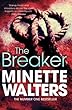
First the good – The Breaker by Minette Walters

From the back cover:

Twelve hours after a woman’s broken body is washed up on a deserted shore, her traumatized three-year-old daughter is discovered twenty miles away wandering the streets of Poole …

But why was Kate killed and her daughter, a witness, allowed to live? And why weren’t they together? More curiously, why had Kate willingly boarded a boat when she had a terror of drowning at sea?

Police suspicion centres on both a young actor, whose sailing boat is moored just yards from where the toddler is found, and the murdered woman’s husband. Was he really in Liverpool the night she died? And why does their daughter scream in terror every time he tries to pick her up … ?

This kept me guessing all the way through and I kept changing my mind about who the murderer was, so I liked this book. It moves between the third person narrative and copies of reports and faxes etc that form part of the police investigation. There are lots of clues, twist and turns and plenty of red herrings. A satisfying book. I’d like to read more of Minette Walters’s books.

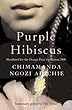
Then the excellent – Purple Hibiscus by Chimamanda Ngozi Adichie.

From the back cover:

Fifteen-year-old Kambili lives in fear of her father, a charismatic yet violent Catholic patriarch who, although generous and well-respected in the community, is repressive and fanatically religious at home. Escape and the discovery of a new way of life come when Nigeria is shaken by a military coup, forcing Kambili and her brother to live in their aunt’s home, a noisy place full of laughter. The visit will lift the silence from her world and, in time, unlock a terrible, bruising secret at the heart of her family life.
This is a fabulous book, one of the best I’ve read this year and it’s even more amazing that this was Adichie’s first book. I read her second book Half of a Yellow Sun a few years ago and was completely taken with that book too. It’s beautifully written – Kambili’s father and aunt are such rounded characters, in other hands they could have just been caricatures. At times I struggled to read the physical abuse scenes, they were so vivid.

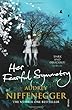
And finally, the disappointment – Her Fearful Symmetry by Audrey Niffenegger. 

From the back cover:

When Elspeth Noblin dies, she leaves her beautiful flat overlooking Highgate Cemetery to her twin nieces, Julia and Valentina Poole, on the condition that their mother is never allowed to cross the threshold.  But until the solicitor’s letter falls through the door of their suburban American home, neither Julia or Valentina knew their aunt existed. The twins hope that in London their own, separate lives can finally begin but they have no idea that they have been summoned into a tangle of fraying lives, from the obsessive-compulsive crossword setter who lives above them to their aunt’s mysterious and elusive lover who lives below them and works in the cemetery itself.

As the twins unravel the secrets of their aunt, who doesn’t seem quite ready to leave her flat, even after death, Niffenegger weaves together a delicious and deadly ghost story about love, loss and identity.

I’d found The Time Traveler’s Wife disappointing and irritating and at first I thought Her Fearful Symmetry was going to be better. It started off well and I liked all the information about Highgate Cemetery, but actually overall this book was disappointing too. I thought it was all rather predictable – I easily guessed the secrets and whilst the ghost elements are interesting at first I found it all became a bit dull and unconvincing. However, the chapters on Martin, the obsessive-compulsive are much more interesting and brought the book a bit more to life. The decision Valentina made was so ridiculous I just couldn’t suspend my disbelief.

In the Woods by Tana French

I have had In the Woods by Tana French on loan from the library since last November – fortunately I was able to keep renewing it, until I got round to reading it. It’s Tana French’s debut novel first published in 2007.

When I began reading I thought this was going to be a really great book. It has all the elements I like – a current murder mystery to solve and a cold case from 20 years earlier, well drawn characters and a writing style that contains enough description to visualise the action easily. It’s set in Ireland mainly around an archaeological dig of a site prior to the construction of a motorway. Most of the wood that covered the land had already been cleared, but a small section remains. A little girl’s body is discovered on the site. Is her death connected to the disappearance of two twelve year-olds 20 years earlier? And it just so happens that the detective, Rob Ryan,  investigating the current murder was the third child who was involved in the disappearance – except he came back and has no memory of what had happened.

I was immediately drawn into the book, enjoying the mystery and wondering how long Ryan can keep his identity hidden and whether he will remember what happened. However, as the story progresses, the descriptive passages get longer and more complicated as the characters’ back stories are revealed, in particular the dead girl’s family and other peripheral characters. And whilst I still think this is a good book, it isn’t a great one. I like the psychological elements and the twists and turns, although I think some of them were predictable. I’ve seen criticism about the way the book ends, but I didn’t find that disappointing at all, in fact I think that is the only credible way that it could end. And I liked it well enough to look out for French’s second book – The Likeness.

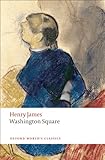
Washington Square by Henry James

When I read  The Turn of the Screw by Henry James I was completely engrossed in the book, even with its long convoluted sentences. It’s a dark and melodramatic story, about good and evil and with hints of sexual relations, reflecting the Victorian society of the time.

So I was expecting to be just as engrossed  with Washington Square – especially as I soon realised that the sentence structure is much simpler. It’s much easier to read, but sadly it just didn’t catch my imagination. I found it rather tedious as Catherine Sloper grew older and older, in conflict with her father over whether she should marry Morris Townsend.

It’s all about will /won’t Catherine and Morris get married. Catherine is an adult, living at home in Washington Square with her father the wealthy Dr Sloper. She has money of her own left to her by her mother. It is her father’s money that she will lose if she marries Morris. At first she is completely obedient to her domineering father and is taken in by the handsome Morris who is clearly after her for her money. I think this description of her sums her up so well and her father’s attitude towards her –

‘She is about as intelligent as the bundle of shawls,’ the Doctor said.’

Spoiler alert – if you don’t want to know how the book ends, don’t read on!

But then she does begin to see through Morris, acknowledges her father’s overbearing manipulation and her aunt’s meddling interference and I began to think this is similar to Jane Austen’s Persuasion, but no, this romance just fizzles out as Morris eventually marries someone else, gets bald and fat and widowed. He returns to see Catherine and she finally rejects his advances. She had forgiven him, but she couldn’t forget the past:

‘I can’t forget – I don’t forget,’ said Catherine. ‘You treated me too badly. I felt it very much; I felt it for years.’ And then she went on, with her wish to show him that he must not come to her in this way, ‘I can’t begin again – I can’t take it up. Everything is dead and buried. It was too serious; it made a great change in my life. I never expected to see you here.’ (page 153)

This was number 10 on my Classics Club Spin list, the number picked as the November/December book – not a success for me.