Green Darkness by Anya Seton

I finished reading Green Darkness a couple of weeks ago and have been wondering what to write about it or whether to write anything at all. I thought I’d read the book years ago, not long after it came out, but as soon as I began what I thought was a re-read I realised that this was completely new to me – I just thought I’d read it because I’d visited Ightham Mote, a beautiful 14th century moated manor house in Kent where part of Green Darkness is set.

A brief synopsis from Goodreads:

This story of troubled love takes place simultaneously during two periods of time: today and 400 years ago. We meet Richard and Celia Marsdon, an attractive young couple, whose family traces its lineage back to medieval England. Richard’s growing depression creates a crisis in Celia, and she falls desperately ill. Lying unconscious and near death, Celia’s spirit journeys backward to a time four centuries earlier when another Celia loved another Marsdon.

I wasn’t enthralled by it and nearly abandoned it after the first few chapters set in 1968, because the characters didn’t come over as real and the writing in accents was awful. But once I got on to the historical part, set in the 16th century it was better, so I read on.

There are some books that are easy to write about – this isn’t one of them so this is a brief post. Green Darkness is written around the premise of reincarnation, so the characters/personalities feature in both time periods. I didn’t think this was successful, but seemed contrived. For me the book would have been better as straight historical fiction.

Reading Challenges: Color Coded Challenge – green (I don’t know why this book is called Green Darkness – if the book explains the title I missed it). What’s In a Name – a book with a colour in its title. Historical Fiction challenge – 16th century England. My Kind of Mystery Challenge.
The Way Through The Woods by Colin Dexter: Mini Review

I really enjoyed reading Colin Dexter’s The Way Through The Woods, the tenth book in his Inspector Morse series. It’s nicely complicated and full of puzzles as Morse aided by Sergeant Lewis investigate the case of a beautiful young Swedish tourist who had disappeared on a hot summer’s day somewhere near Oxford twelve months earlier. After unsuccessfully searching the woods of the nearby Blenheim Estate the case was unsolved, and Karin Eriksson had been recorded as a missing person.
A year later Morse is on holiday at Lyme Regis when The Times published an article on the missing woman together with an anonymous poem that had been sent in that the police thought could help pinpoint the whereabouts of her body. This sets in motion more letters to The Times and ultimately to Morse being assigned to re-open the case.

I was completely engrossed in this book, trying to follow all the possible interpretations of the poem and the witness statements as Morse and Lewis go over the old evidence and turn up new information. This involves a trip to Wales for Morse and one to Sweden for Lewis, Wytham Woods is searched and a body is found – but whose is it? This book sees the first appearance of forensic pathologist, Dr Laura Hobson. But it’s not just the mystery, the crossword type clues, the characterisation and all the twist and turns that make this book so enjoyable, it’s the writing, the descriptions of the scenery and locations bringing them vividly to my mind.

This book has been sitting unread on my shelves for three years and is the last of my to-be-read books of 2014. An excellent book!

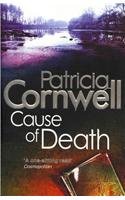
Cause of Death by Patricia Cornwell

Cause for Death is the seventh book in the Dr Kay Scarpetta murder mystery series. It’s a secondhand copy that had been on my TBR shelves for several years and I think I must have started to read it before as the opening chapter seemed very familiar.

It begins well enough when a reported is found dead in the Elizabeth River in Virginia on New Year’s Eve.

From the back cover:

New Year’s Eve and the final murder scene of Virginia’s bloodiest year takes Scarpetta thirty feet below the Elizabeth River’s icy surface. A diver, Ted Eddings, is dead, an investigative reporter who was a favourite at the Medical Examiner’s office. Was Eddings probing the frigid depths of the Inactive Shipyard for a story, or simply diving for sunken trinkets? And why did Scarpetta receive a phone call from someone reporting the death before the police were notified?

The case envelops Scarpetta, her niece Lucy, and police captain Pete Marino in a world where both cutting-edge technology and old-fashioned detective work are critical offensive weapons. Together they follow the trail of death to a well of violence as dark and forbidding as water that swirled over Ted Eddings.

However, although the murder investigation was interesting I wasn’t all interested in the terrorist/FBI/religious fanatics scenes that followed.  I don’t think I’ll bother reading any more of these books.

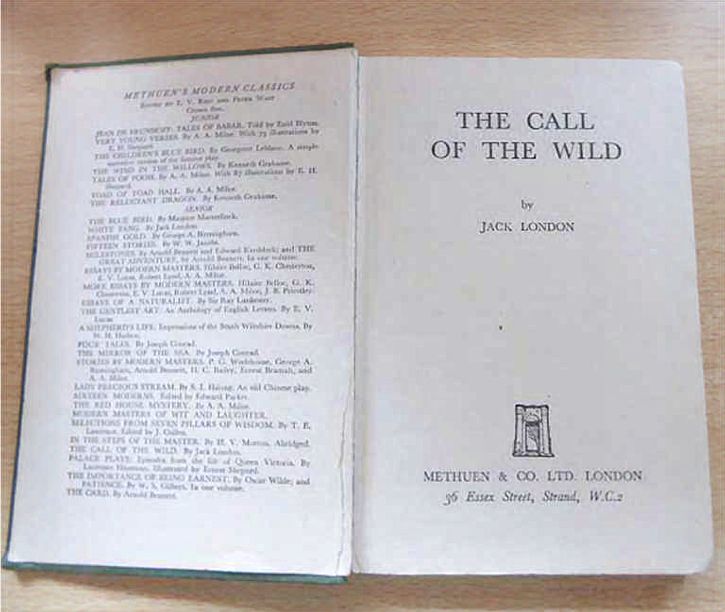
The Call of the Wild by Jack London

The Call of the Wild and White Fang by Jack London are books that I’ve known about as long as I can remember – they were books my parents owned – but I’ve never read them, until now.  So, I was pleased when The Call of the Wild, Jack London’s first book came out as my Classics Club Spin book.  I would have read it one day anyway but the Spin gave me the nudge to read it now. I wasn’t expecting to find it such a beautiful, moving and poignant book, but it is. And it has so much packed into its 106 pages in my little hardback copy.

It begins in 1897 when Buck, a cross between a St Bernard and a Scotch Shepherd (Collie) was stolen from his home in the Santa Clara Valley in California and taken to the Yukon where strong sled dogs were needed during the Klondike Gold Rush. It’s a shock to Buck (what an understatement) as he moves from his pampered life on a California ranch where he had free rein, swimming, hunting and playing to the harsh realities and cruelty of the life of a working dog in the wastes of Alaska, where the ‘law of club and fang‘ predominated. The book is told from Buck’s point of view, but this is no cutesy, sentimental animal story. Buck has to fight for existence and as he learnt by experience, instincts that were long dead came alive in him:

The domesticated generations fell from him. In vague ways he remembered back to the youth of the breed, to the time the wild dogs ranged in packs through the primeval forest and killed their meet as they tracked it down. It was no task for him to learn to fight with cut and slash and the quick wolf snap.

…  And when, on the still cold nights, he pointed his nose at a star and howled long and wolflike, it was his ancestors, dead and dust, pointing nose at star and howling down through the centuries and through him. … the ancient song surged through him and he came into his own again (page 24)

After changing owners several times, each worse than the one before he is eventually saved from death by John Thornton who nurses him back to health and for a while it is the love between man and dog that keeps Buck with him. Eventually however, the call of the wild is too strong!

Apart from the story which kept me turning the pages to find out what happened next it’s the quality of London’s writing, the vivid descriptions and the haunting mystical sense of the wild that captivated me – this passage for example:

There is an ecstasy that marks the summit of life, and beyond which life cannot rise. And such is the paradox of living, this ecstasy comes when one is most alive, and it comes as a complete forgetfulness that one is alive. This ecstasy, this forgetfulness of living, comes to the artist, caught up and out of himself in a sheet of flame; it comes to the soldier, war-mad in a stricken field and refusing quarter; and it came to Buck, leading the pack, sounding the old wolf-cry, straining after the food that was alive and that fled swiftly before him through the moonlight. (pages 37-38)

I’ll be reading White Fang soon.

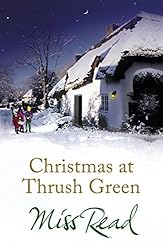
Christmas at Thrush Green by Miss Read

I was in the library a few days ago and Christmas at Thrush Green caught my eye with its sparkly, snowy front cover. Years ago I read as many of Miss Read’s books that I could find in the library, but I didn’t think I’d read this one. ‘Miss Read’ is a pseudonym for Dora Saint (1913 – 2012) who wrote over 40 books for adults and children.
Christmas at Thrush Green was first published in 2009 and the title page reveals that it was written by Miss Read with Jenny Dereham. In the Acknowledgements at the front of the book Miss Read explained that she and Jenny Dereham, her long-time editor had:

… discussed the initial idea, developed the unfolding story-line and then I left her to put that into words, based on the Thrush Green characters. I am more than happy with the result and hope those people who enjoyed all the other Thrush Green books will enjoy this as much.

So, not exactly by Miss Read, but still an enjoyable book and as it was so many years ago that I read some of the Thrush Green books I can’t compare this with the other books. And I’d read more of her Fairacre books than the Thrush Green ones. It’s comfort reading, nearly 350 pages that kept me entertained, with a few memorable characters amongst its many characters. There are so many characters that I began to get confused, as some of them just melded together in my mind. Each character is introduced with a brief biography and history, which helped me sort out some of them.

Preparations for the Christmas Nativity play are under way when some of the children come down with chicken pox. Ella Bembridge is losing her sight and behaving strangely, Nelly Piggott, the owner of The Fucshia Bush Tea Shop is thrilled at winning an award, there are newcomers to Thrush Green who haven’t settled in and have upset some of the locals. I particularly liked the episodes feating the vicar, Charles Henstock and his wife Dimity, affectionately called ‘Dim’. It’s a nostalgic read about village life at Christmas time – snow, parties, and church services.

As a result of reading this I’ve decided I want to re-read/read more of Miss Read’s books, and have started Village Diary.

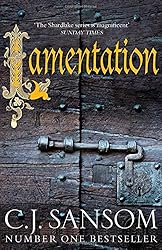
Lamentation by C J Sansom

Once again I am behind myself with writing about the books I’ve read! So here are just a few thoughts about C J Sansom’s historical novel, Lamentation, the sixth Matthew Shardlake book.

I have enjoyed the earlier books in the series so I had great expectations for Lamentation and I wasn’t disappointed. It’s set in 1546, the last year of Henry VIII’s life. Shardlake, a lawyer is asked by Queen Catherine (Parr) for help in discovering who has stolen her confessional book, Lamentation of a Sinner. What I like about these books is their historical setting and the Historical Notes giving yet more background to the period and emphasising that because the sources are ‘very thin’ that inevitably this is Sansom’s own interpretation of events and clarifying that Catherine Parr’s book was not, in the real world, stolen.

The book evokes the people, the sights, smells and atmosphere of Henry’s last year and at the same time it’s an ingenious crime mystery, full of suspense and tension. It begins as Shardlake is ordered to watch the burning at the stake of Anne Askew and other heretics (a real event). I’m not good at reading horrific scenes, but I managed this one without too much mental aversion of my eyes. Along with the mystery of the missing book, Shardlake is working on the Cotterstoke dispute between rival siblings, and has problems at home with his domestic servants.

I was also very taken with Shardlake’s introduction in Lamentation to William Cecil, Mary Tudor and a young Elizabeth I. I hope Sansom has more Shardlake books in mind.