Book Beginnings: The Potter's Hand by A N Wilson

Whilst I’ve been reading from my own book shelves this year so far, I’ve accumulated a pile of library books that are tempting me away from them. One of these books is The Potter’s Hand by A N Wilson.
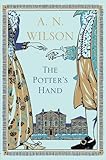
It begins:

The unoiled hinge joined its melancholy whine to the opium-dosed whimper of the patient who st gagged in his chair, and to the swift rasping of the saw. The door creaked ajar in the very moment that the doctor sawed off the leg of Sukey’s pa.

Such a dramatic opening that immediately grabbed my attention, conjuring up such a vivid picture complete with sound effects! The year is 1768. Sukey (Susannah), who later became the mother of Charles Darwin, was the daughter of Josiah Wedgwood,  an English potter and founder of the Wedgwood company.

The Potter’s Hand is a novel about Josiah Wedgwood and his family. Wilson explains in an Afterword that the broad outlines of the story and most of the details are true, but he has altered dates and rearranged historical events and nearly all the letters are invented. It is ‘meant to be read as fiction, even thought it is intended in part, as an act of homage to one of the great men of our history.’

I’ve read the first two chapters and think I’ll have to read on soon, after I’ve finished Death Under Sail by C P Snow, a crime fiction novel, if not sooner.

Every Friday Gilion at Rose City Reader hosts Book Beginnings on Friday, where you can share the first sentence (or so) of the book you are reading, along with your initial thoughts about the sentence, impressions of the book, or anything else the opener inspires.
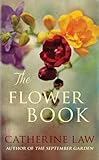
Book Beginnings – The Flower Book

Yesterday I finished reading Purple Hibiscus by Chimamanda Ngozi Adichie, which I thought was an amazing book that kept me captivated even though it’s a challenging book to read because of its subject matter. I’ll write more about that in a later post.

It has left me with the usual problem of deciding what to read next and I’ve picked up and started so many books, none of which seem good enough after Purple Hibiscus. I’ve been reading from my own bookshelves this year, but I’m thinking of having a little break from that and reading a library book. It’s one I picked off the mobile library van, not knowing anything about it or about the author, Catherine Law – The Flower Book. It’s set in 1914 and also in 1936.

It begins in Cornwall in March 1914:

On certain nights if the wind was right, you could hear the sea from Old Trellick. So the legend has it, although Violet had never heard the waves and her parents would not try, due to the fact, she decided, that they had no imagination.

As a child she’d stand at the French windows and implore them to be quiet, to stop what they were doing and to concentrate with her, to catch this magical and elusive sound.

Every Friday Gilion at Rose City Reader hosts Book Beginnings on Friday, where you can share the first sentence (or so) of the book you are reading, along with your initial thoughts about the sentence, impressions of the book, or anything else the opener inspires.

I like the images the beginning of this book conjures and also the sounds. I always like the sight and sound of the waves breaking on the shore; to me too that has a certain magic. So this appealed to me straight away. Couple that with a story set against the backdrop of World War I as Aster Fairling searches for the truth behind her parents’ tragic love through the pages of her mother journal and I want to know more.

The Flower Book is Catherine Law’s third book.

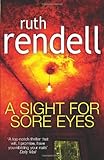
Book Beginning: A Sight for Sore Eyes by Ruth Rendell

The library van came round this week and I borrowed another Ruth Rendell book: A Sight for Sore Eyes, first published in 1998. I don’t really check what the book is about when it’s one by Ruth Rendell, as I usually enjoy her books. This one begins:

They were to hold hands and look at one another. Deeply, into each other’s eyes.

‘It’s not a sitting,’ she said, ‘it’s a standing. Why can’t I sit on his knee?’

He laughed. Everything she said amused him or delighted him, everything about her captivated him from her dark-red curly hair to her small white feet. The painter’s instructions were that he should look at her as if in love and she at him as if enthralled. This was easy, this was to act naturally.

This could be the opening to a love story, but this is a Ruth Rendell book and I’m expecting it to be something darker and more mysterious. Indeed, the information on the back cover warns that this is ‘Masterfully spooky. Don’t read this alone.’

For more Book Beginnings see Gilion’s blog Rose City Reader.

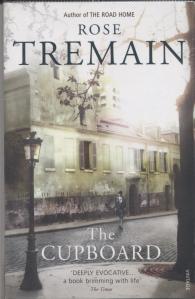
The Cupboard by Rose Tremain

I’ve never read any of Rose Tremain’s books, but when I saw The Cupboard on the library van’s shelves the plainness of the title and the photo on the cover interested me, because they just didn’t seem to match.

The Cupboard 001

I took it off the shelf and read the back cover, where the newspaper critics’ quotations are glowing with praise for Rose Tremain: ‘one of the finest writers in English’ from the Daily Telegraph, ‘Rose Tremain’s fiction is my gold standard’, from The Independent on Sunday’, and ‘Miss Tremain has fashioned the totality of one life – and conveyed the evanescence of all human existence’ from the Sunday Telegraph. So I thought I should have a look inside the book, where I see that Rose Tremain has won many prizes for her books.

But it was the opening paragraph that really caught my attention and is the reason I borrowed the book:

At the age of eighty-seven, Erica March died in a cupboard. She wrapped her body in a chenille tablecloth, laid it out neatly under a few skirts and dresses that still hung on the clothes rail and put it to death very quietly, pill by pill.

Now that makes me want to read on to find out why she did that! Not the accolades or the awards, but the words.

For more Book Beginnings see Gilion’s blog Rose City Reader.

The Steel Bonnets: the opening chapter

A friend has just lent me The Steel Bonnets : the Story of the Anglo-Scottish Border Reivers by George MacDonald Fraser and having looked at the opening chapter I know I just have to read on, rather than waiting for January when Peggy Ann’s Read Scotland 2014 Challenge starts. It’s a long, detailed book so I shall probably still be reading it in January anyway.

The Steel Bonnets 001I live on the English side of the Border with Scotland and the history of the area just fascinates me. The Steel Bonnets covers the period from the building of Hadrian’s Wall to 1603, when James VI of Scotland became James I of England. Four hundred or so years ago it was all very different around here and as the history of the Border Reivers is very complicated I’m hoping this book will guide me through it.

The opening paragraph took me by surprise:

At one moment when President Richard Nixon was taking part in his inauguration ceremony, he appeared flanked by Lyndon Johnson and Billy Graham. To anyone familiar with Border history it was one of those historical coincidences which send a little shudder through the mind: in that moment, thousands of miles and centuries away in time away from the Debateable Land, the threads came together again; the descendants of three notable Anglo-Scottish Border tribes – families who lived and fought within a few miles of each other on the West Marches in Queen Elizabeth’s time – were standing side by side, and it took very little effort of the imagination to replace the custom-made suits with leather jacks or backs-and-breasts. Only a political commentator would be tactless enough to pursue the resemblance to Border reivers beyond the physical, but there the similarity is strong.

In the following paragraphs he goes on to describe their physical features, particularly those of Nixon and Johnson, as ‘excellent specimens of two distinct but common Border types.’ I hadn’t expected this at all.

For more Book Beginnings see Gilion’s blog Rose City Reader.

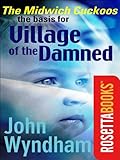
Book Beginnings: The Midwich Cuckoos

Every Friday Gilion at Rose City Reader hosts Book Beginnings on Friday, where you can share the first sentence (or so) of the book you are reading, along with your initial thoughts about the sentence, impressions of the book, or anything else the opener inspires..

I’ve borrowed The Midwich Cuckoos by John Wyndham from the Kindle Lending Library and have only read the opening paragraphs so far. I’ve liked other books by Wyndham, such as Chocky, The Chrysalids, and The Kraken Wakes, so I’m expecting to enjoy this one too.

It begins:

One of the luckiest accidents in my wife’s life is that she happened to marry a man who was born on the 26th of September. But for that, we should both of us undoubtedly have been at home in Midwich on the night of the 26th-27th, with consequences which, I have never ceased to be thankful, she was spared.

According to the reviews on Amazon this Kindle version is full of grammatical errors and typos, so I’m hoping I can overlook them and enjoy this book set in the sleepy English village of Midwich, where a mysterious silver object appears and all the inhabitants fall unconscious.