Book Beginning: A Sight for Sore Eyes by Ruth Rendell

The library van came round this week and I borrowed another Ruth Rendell book: A Sight for Sore Eyes, first published in 1998. I don’t really check what the book is about when it’s one by Ruth Rendell, as I usually enjoy her books. This one begins:

They were to hold hands and look at one another. Deeply, into each other’s eyes.

‘It’s not a sitting,’ she said, ‘it’s a standing. Why can’t I sit on his knee?’

He laughed. Everything she said amused him or delighted him, everything about her captivated him from her dark-red curly hair to her small white feet. The painter’s instructions were that he should look at her as if in love and she at him as if enthralled. This was easy, this was to act naturally.

This could be the opening to a love story, but this is a Ruth Rendell book and I’m expecting it to be something darker and more mysterious. Indeed, the information on the back cover warns that this is ‘Masterfully spooky. Don’t read this alone.’

For more Book Beginnings see Gilion’s blog Rose City Reader.

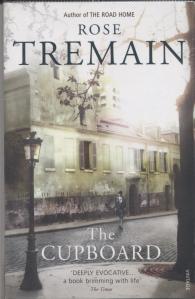
The Cupboard by Rose Tremain

I’ve never read any of Rose Tremain’s books, but when I saw The Cupboard on the library van’s shelves the plainness of the title and the photo on the cover interested me, because they just didn’t seem to match.

The Cupboard 001

I took it off the shelf and read the back cover, where the newspaper critics’ quotations are glowing with praise for Rose Tremain: ‘one of the finest writers in English’ from the Daily Telegraph, ‘Rose Tremain’s fiction is my gold standard’, from The Independent on Sunday’, and ‘Miss Tremain has fashioned the totality of one life – and conveyed the evanescence of all human existence’ from the Sunday Telegraph. So I thought I should have a look inside the book, where I see that Rose Tremain has won many prizes for her books.

But it was the opening paragraph that really caught my attention and is the reason I borrowed the book:

At the age of eighty-seven, Erica March died in a cupboard. She wrapped her body in a chenille tablecloth, laid it out neatly under a few skirts and dresses that still hung on the clothes rail and put it to death very quietly, pill by pill.

Now that makes me want to read on to find out why she did that! Not the accolades or the awards, but the words.

For more Book Beginnings see Gilion’s blog Rose City Reader.

The Steel Bonnets: the opening chapter

A friend has just lent me The Steel Bonnets : the Story of the Anglo-Scottish Border Reivers by George MacDonald Fraser and having looked at the opening chapter I know I just have to read on, rather than waiting for January when Peggy Ann’s Read Scotland 2014 Challenge starts. It’s a long, detailed book so I shall probably still be reading it in January anyway.

The Steel Bonnets 001I live on the English side of the Border with Scotland and the history of the area just fascinates me. The Steel Bonnets covers the period from the building of Hadrian’s Wall to 1603, when James VI of Scotland became James I of England. Four hundred or so years ago it was all very different around here and as the history of the Border Reivers is very complicated I’m hoping this book will guide me through it.

The opening paragraph took me by surprise:

At one moment when President Richard Nixon was taking part in his inauguration ceremony, he appeared flanked by Lyndon Johnson and Billy Graham. To anyone familiar with Border history it was one of those historical coincidences which send a little shudder through the mind: in that moment, thousands of miles and centuries away in time away from the Debateable Land, the threads came together again; the descendants of three notable Anglo-Scottish Border tribes – families who lived and fought within a few miles of each other on the West Marches in Queen Elizabeth’s time – were standing side by side, and it took very little effort of the imagination to replace the custom-made suits with leather jacks or backs-and-breasts. Only a political commentator would be tactless enough to pursue the resemblance to Border reivers beyond the physical, but there the similarity is strong.

In the following paragraphs he goes on to describe their physical features, particularly those of Nixon and Johnson, as ‘excellent specimens of two distinct but common Border types.’ I hadn’t expected this at all.

For more Book Beginnings see Gilion’s blog Rose City Reader.

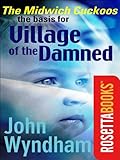
Book Beginnings: The Midwich Cuckoos

Every Friday Gilion at Rose City Reader hosts Book Beginnings on Friday, where you can share the first sentence (or so) of the book you are reading, along with your initial thoughts about the sentence, impressions of the book, or anything else the opener inspires..

I’ve borrowed The Midwich Cuckoos by John Wyndham from the Kindle Lending Library and have only read the opening paragraphs so far. I’ve liked other books by Wyndham, such as Chocky, The Chrysalids, and The Kraken Wakes, so I’m expecting to enjoy this one too.

It begins:

One of the luckiest accidents in my wife’s life is that she happened to marry a man who was born on the 26th of September. But for that, we should both of us undoubtedly have been at home in Midwich on the night of the 26th-27th, with consequences which, I have never ceased to be thankful, she was spared.

According to the reviews on Amazon this Kindle version is full of grammatical errors and typos, so I’m hoping I can overlook them and enjoy this book set in the sleepy English village of Midwich, where a mysterious silver object appears and all the inhabitants fall unconscious.

Book Beginnings

Book Beginnings ButtonGilion at Rose City Reader hosts Book Beginnings on Friday in which you share the first sentence (or so) of the book you are reading, along with your initial thoughts about the sentence, impressions of the book, or anything else the opener inspires.

I was looking at some of my books that I’ve had for a long time and wondering which one to read next and I came across Cloud Atlas by David Mitchell. This was immensely popular when it first came out in 2004 and so I bought a copy and began to read it. Although the opening pages intrigued me after a few more pages I put it down; I just couldn’t get into it. After a while I tried it again, and again and still found it not very interesting and when I looked forward in the book I found it looked very disjointed and I gave up. There were plenty of books to read without struggling to read one that wasn’t interesting me.

Then they made a film and people started enthusing about it again. So, how many times do I try to read this book? It begins:

Thursday, 7th November –

Beyond the Indian hamlet, on a forlorn strand, I happened upon on trail of recent footprints. Through rotting kelp, sea cocoanuts & bamboo, the tracks led me to their maker, a white man, his trowsers & Pea-jacket rolled up, sporting a kempt board & an outsized Beaver, shovelling & sifting the cindery sand with a tea-spoon so intently that he noticed me only after I hailed him from ten yards away. Thus it was, I made the acquaintance of Dr Henry Goose, surgeon to the London nobility. His nationality was no surprise. If there be any eyrie so desolate, or isle so remote that one may resort unchallenged by an Englishman, ’tis not down on any map I ever saw.

From the back cover:

Six interlocking lives – one amazing adventure. In a narrative that circles the globe and reaches from the 19th century to a post-apocalyptic future, David Mitchell erases the boundaries of time, genre and language to offer an enthralling vision of humanity’s will to power, and where it will lead us.

It knits together science fiction, political thriller and historical pastiche with musical virtuosity and linguistic exuberance …

It sounds amazing and extraordinary, but I’m still not sure because when I actually start reading it, the first chapter ends in the middle of a sentence. Is that really meant to make me want to read on when the next chapter seems totally unconnected? It reminds me of Italo Calvino’s If on a Winter’s Night a Traveller, a book I didn’t finish reading, although I loved the beginning of that book.

Is Cloud Atlas really so good! If you have read it, what do you think? Please let me know.
Searching for The Secret River: a Book Beginnings Post

Book Beginnings ButtonGilion at Rose City Reader hosts Book Beginnings on Friday in which you share the first sentence (or so) of the book you are reading, along with your initial thoughts about the sentence, impressions of the book, or anything else the opener inspires.

I’m currently reading Searching for The Secret River by Kate Grenville. It begins:

In the puritan Australia of my childhood, you could only get a drink on a Sunday if you were a ‘bona fide traveller’. That meant you had to have travelled fifty miles or more. Around Sydney a ring of townships at exactly the fifty-mile mark filled with cheerful people every Sunday. One of them was a little place called Wiseman’s Ferry.

I loved Kate Grenville’s book The Secret River, so when I discovered that she had written a book about how she came to write it I just had to get a copy. Her interest began with her great-great-great grandfather, Solomon Wiseman,the original ferryman at Wiseman’s Ferry. Her mother had told her stories about him, but she wanted to know more about, what he was like and what he might have done when he first encountered Aboriginal people … she needed to know.

I haven’t finished the book yet, but it is fascinating – seeing how she went about her research into family history and how she imagined his life from facts gleaned from the records and the places he had lived.