Bleak House by Charles Dickens: Book Beginnings on Friday & The Friday 56

Every Friday Book Beginnings on Friday is hosted by Gillion at Rose City Reader where you can share the first sentence (or so) of the book you are reading. You can also share from a book you want to highlight just because it caught your fancy.

I’m featuring Bleak House, one of the books I’m currently reading.

Chapter 1 In Chancery

London. Michaelmas term lately over, and the Lord Chancellor sitting in Lincoln’s Inn Hall. Implacable November weather. As much mud in the streets as if the waters had but newly retired from the face of the earth, and it would not be wonderful to meet a Megalosaurus, forty feet long or so, waddling like an elephantine lizard up Holborn Hill.

Also every Friday there is The Friday 56, hosted by Freda at Freda’s Voice, but she is taking a break and Anne at My Head is Full of Books has taken on hosting duties in her absence. You grab a book and turn to page 56 (or 56% of an eBook), find one or more interesting sentences (no spoilers), and post them.

I found it a quite delightful place – in front, the pretty avenue and drive by which we had approached (and where, by the by, we had cut up the gravel so terribly with our wheels that I asked the gardener to roll it) at the back, the flower garden, with my darling at her window up there, throwing it open to smile at me, as if she would have kissed me from that distance.

The narrator in this passage is Esther Summerson. She and the two wards in the Jarndyce and Jarndyce case, had arrived at Bleak House and she is describing the scene that she saw from her bedroom window on their first morning at Bleak House.

Description:

Bleak House is the ninth novel by Charles Dickens, published in twenty monthly installments between March 1852 and September 1853. It is held to be one of Dickens’s finest novels, containing one of the most vast, complex and engaging arrays of minor characters and sub-plots in his entire canon. The story is told partly by the novel’s heroine, Esther Summerson, and partly by an omniscient narrator. Memorable characters include the menacing lawyer Tulkinghorn, the friendly but depressive John Jarndyce and the childish Harold Skimpole, as well as the likeable but imprudent Richard Carstone.

At the novel’s core is long-running litigation in England’s Court of Chancery, Jarndyce and Jarndyce, which has far-reaching consequences for all involved. This case revolves around a testator who apparently made several wills, all of them seeking to bequeath money and land surrounding the Manor of Marr in South Yorkshire. The litigation, which already has consumed years and sixty to seventy thousand pounds sterling in court costs, is emblematic of the failure of Chancery. Dickens’s assault on the flaws of the British judiciary system is based in part on his own experiences as a law clerk, and in part on his experiences as a Chancery litigant seeking to enforce his copyright on his earlier books. His harsh characterisation of the slow, arcane Chancery law process gave memorable form to pre-existing widespread frustration with the system. Though Chancery lawyers and judges criticized Dickens’s portrait of Chancery as exaggerated and unmerited, his novel helped to spur an ongoing movement that culminated in enactment of the legal reform in the 1870s. In fact, Dickens was writing just as Chancery was reforming itself, with the Six Clerks and Masters mentioned in Chapter One abolished in 1842 and 1852 the need for further reform was being widely debated.

I first read this book many years ago before I began my blog.

The Daylight Gate by Jeanette Winterson: Book Beginnings on Friday & The Friday 56

Every Friday Book Beginnings on Friday is hosted by Gillion at Rose City Reader where you can share the first sentence (or so) of the book you are reading. You can also share from a book you want to highlight just because it caught your fancy.

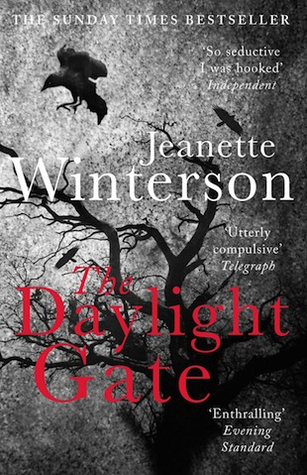
I’m featuring The Daylight Gate by Jeanette Winterson, one of the books I’ve borrowed from the library. It’s a novella, historical fiction set in 1612 in Lancashire, then a wild part of England at a time when the fear of witches and demons was strong, a time of superstition and fear.

The North is a dark place.

It is not safe to be buried on the north side of the Church and the North Door is the way of the Devil.

Also every Friday there is The Friday 56, hosted by Freda at Freda’s Voice, but she is taking a break and Anne at My Head is Full of Books has taken on hosting duties in her absence. You grab a book and turn to page 56 (or 56% of an eBook), find one or more interesting sentences (no spoilers), and post them.

‘You mistake me if you imagine I believe in no dark power. I believe in God and therefore I believe in the Devil.’

‘Who surely has better things to do than help the Demdike dry up cattle and sheep and bewitch pedlars.’

Description:

Good Friday, 1612. Pendle Hill, Lancashire.

A mysterious gathering of thirteen people is interrupted by local magistrate, Roger Nowell. Is this a witches’ Sabbat?

Two notorious Lancashire witches are already in Lancaster Castle waiting trial. Why is the beautiful and wealthy Alice Nutter defending them? And why is she among the group of thirteen on Pendle Hill?

Elsewhere, a starved, abused child lurks. And a Jesuit priest and former Gunpowder plotter, recently returned from France, is widely rumoured to be heading for Lancashire. But who will offer him sanctuary? And how quickly can he be caught?

This is the reign of James I, a Protestant King with an obsession: to rid his realm of twin evils, witchcraft and Catholicism, at any price…

Ever since I read Mist over Pendle by Robert Neill I’ve wanted to know more about the story of the Pendle witch trials, so this book interests me. Does it interest you too?

The Glassmaker: Book Beginnings on Friday & The Friday 56

Every Friday Book Beginnings on Friday is hosted by Gillion at Rose City Reader where you can share the first sentence (or so) of the book you are reading. You can also share from a book you want to highlight just because it caught your fancy.

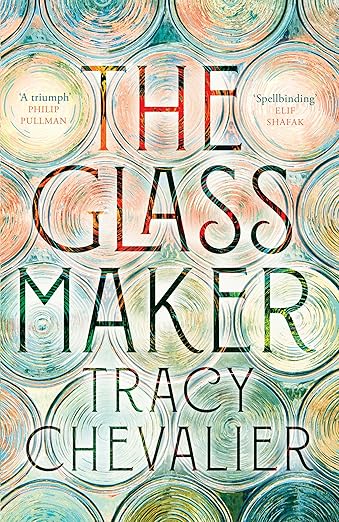
I’m featuring The Glassmaker by Tracy Chevalier. It’s a novel that follows a family of glassmakers from the height of Renaissance-era Italy to the present day. I’ve read several of her books and I’m hoping to enjoy this one as much as the others.

If you skim a flat stone skilfully across water, it will touch down many times, in long or short intervals as it lands.

With that in mind, now replace water with time.

Also every Friday there is The Friday 56, hosted by Freda at Freda’s Voice, but she is taking a break and Anne at My Head is Full of Books has taken on hosting duties in her absence. You grab a book and turn to page 56 (or 56% of an eBook), find one or more interesting sentences (no spoilers), and post them.

‘How dare you come looking for me in Venice,’ he began in a low voice that rapidly grew louder, ‘as if I were a child who needed shepherding. You embarrassed the family name and ruined our relationship with our merchant. If the Rosso business goes under, it will be your fault.

Description:

Tracy Chevalier is a master of her own craft, and The Glassmaker is vivid, inventive, spellbinding: a virtuoso portrait of a woman, a family and a city that are as everlasting as their glass.

Venice, 1486. Across the lagoon lies Murano. Time flows differently here – like the glass the island’s maestros spend their lives learning to handle.

Women are not meant to work with glass, but Orsola Rosso flouts convention to save her family from ruin. She works in secret, knowing her creations must be perfect to be accepted by men. But perfection may take a lifetime.

Skipping like a stone through the centuries, we follow Orsola as she hones her craft through war and plague, tragedy and triumph, love and loss.

The beads she creates will adorn the necks of empresses and courtesans from Paris to Vienna – but will she ever earn the respect of those closest to her?

Wars of the Roses:Book One -Stormbird: Book Beginnings & The Friday 56

Every Friday Book Beginnings on Friday is hosted by Gillion at Rose City Reader where you can share the first sentence (or so) of the book you are reading. You can also share from a book you want to highlight just because it caught your fancy.

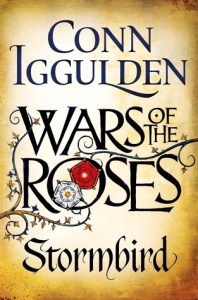
Wars of the Roses: Stormbird by Conn Iggulden is the first episode of The Wars of the Roses series and is one of the books I was given at Christmas.

The book begins with a Prologue set in 1337 as Edward III lay dying.

Prologue:

Anno Domini 1377

Bowls of dark royal blood lay beneath the bed, forgotten by the physician. Alice Perrers rested on a chair, panting from the effort of wrestling the king of England into his armour. The air in the room was sour with sweat and death and Edward lay like his own effigy, pale and white-bearded.

Part One – Chapter One:

Anno Domini 1443

Sixty six years after the death of Edward III

England was cold that month.

Also every Friday there is The Friday 56, hosted by Freda at Freda’s Voice, but she is taking a break and Anne at My Head is Full of Books has taken on hosting duties in her absence. You grab a book and turn to page 56 (or 56% of an eBook), find one or more interesting sentences (no spoilers), and post them.

Page 56

‘They’ve asked for the marriage to take place in the cathedral at Tours, that’s what. Land that will have the French army camped outside, ready to take possession of the price of the truce,that’s what! I’m not letting Henry walk in there, William, not while there’s life in me.’

Description from Goodreads:

King Henry V – the great Lion of England – is long dead.

In 1437, after years of regency, the pious and gentle Henry VI, the Lamb, comes of age and accedes to the English throne. His poor health and frailty of mind render him a weakling king -Henry depends on his closest men, Spymaster Derry Brewer and William de la Pole, Duke of Suffolk, to run his kingdom

Yet there are those, such as the Plantagenet Richard, Duke of York, who believe England must be led by a strong king if she is to survive. With England’s territories in France under threat, and rumours of revolt at home, fears grow that Henry and his advisers will see the country slide into ruin. With a secret deal struck for Henry to marry a young French noblewoman, Margaret of Anjou, those fears become all too real.

As storm clouds gather over England, King Henry and his supporters find themselves besieged abroad and at home. Who, or what can save the kingdom before it is too late?

I’ve read some of Iggulden’s historical fiction novels and loved them, so I’m looking forward to reading this in the new year.

Other books in the Wars of the Roses series are:

  • Stormbird (2013)
  • Trinity (2014) (titled Margaret of Anjou in North America)
  • Bloodline (2015)
  • Ravenspur (2016)

What do you think, does this book appeal to you? What are you currently reading?

The Uncommon Appeal of Clouds: Book Beginnings & The Friday 56

Every Friday Book Beginnings on Friday is hosted by Gillion at Rose City Reader where you can share the first sentence (or so) of the book you are reading. You can also share from a book you want to highlight just because it caught your fancy.

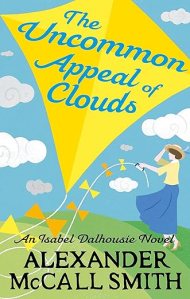
I’m featuring The Uncommon Appeal of Clouds by Alexander McCall Smith, an Isabel Dalhousie book, that I’ve borrowed from my local lbrary.

Chapter One:

‘Mozart’ said, Isabel Dalhousie. And then she added, Stinivasa Ramamjan .

Also every Friday there is The Friday 56, hosted by Freda at Freda’s Voice, but she is taking a break and Anne at My Head is Full of Books has taken on hosting duties in her absence. You grab a book and turn to page 56 (or 56% of an eBook), find one or more interesting sentences (no spoilers), and post them.

But then, we can misjudge each other so easily, she thought; so easily.

Description from Amazon:

As a mother, wife, employer and editor of the Review of Applied Ethics, Isabel Dalhousie is aware that to be human is to be responsible. So when a neighbour brings her a new and potentially dangerous puzzle to solve, once again Isabel feels she has no option but to shoulder the burden.

A masterpiece painting has been stolen from Duncan Munrowe, old-fashioned philanthropist, father to two discontented children, and a very wealthy man. As Isabel enters into negotiations with the shadowy figures who are in search of a ransom, a case where heroes and villains should be clearly defined turns murky: the list of those who desire the painting – or the money – lengthens, and hasty judgement must be avoided at all cost. Morals, it turns out, are like Scottish clouds: complex, changeable and tricky to get a firm grip on; they require a sharp observational eye, a philosophical mindset, and the habit of kindness. Fortunately for those around her, Isabel Dalhousie is in possession of all three.

I’ve read some of his other Isabel Dalhousie books and enjoyed them. So I’m hoping to enjoy this one too. I really like the gentle pace of these books and what I find so fascinating is that whilst not a lot actually happens, a lot goes on in Isabel’s head.

What do you think, does this book appeal to you? What are you currently reading?

Patronage by Maria Edgeworth: Book Beginnings & The Friday 56

Every Friday Book Beginnings on Friday is hosted by Gillion at Rose City Reader where you can share the first sentence (or so) of the book you are reading. You can also share from a book you want to highlight just because it caught your fancy.

I’m featuring Patronage by Maria Edgeworth. This is one of my TBRs and I meant to include it in my Top Ten Tuesday post this week. Maria Edgeworth (1768 – 1849) was a contemporary of Jane Austen, publishing novels at the same time – Patronage was published just 5 months before Mansfield Park in 1814.

From the back cover:

Patronage was one of the most eagerly anticipated novels of Jane Austen’s day. It sold out within hours of publication.… an adventurous soap opera about the trials and fortunes of two neighbouring families in Regency England, both of which had sons and daughters setting out in the world. … a bright and mischievous critique of the way young men gained careers and young women gained husbands.

It begins:

‘How the wind is rising!’ said Rosamond. ‘God help the poor people at sea tonight!’

Also every Friday there is The Friday 56, hosted by Freda at Freda’s Voice, but she is taking a break and Anne at My Head is Full of Books has taken on hosting duties in her absence. You grab a book and turn to page 56 (or 56% of an eBook), find one or more interesting sentences (no spoilers), and post them.

‘I hope, with all my heart, I hope,’ continued Rosamond, that Buckhurst will have some sense and steadfastness to refuse, but I heard his father supporting that foolish Colonel Hauton’s persuasions and urging his poor son to go with those people to Cheltenham.

Description from the publisher:

Meet the Percys and Falconers, neighbouring families, each with three sons and two daughters to launch into Regency society. The hardworking, independently minded and dutiful Percys are happy to work their way up in the world but are undermined by their scheming rivals who use Patronage to grab at instant fame and fortune. With their sons eased into lucrative but ill-suited diplomatic and clerical jobs, and their daughters bankrupting themselves to scale the heights of fashion, the Falconers are heading for a tumble; while the moral steadiness and strong family ties of the Percys allow them to attain both the heights of their chosen professions and a glittering match.