Celebrating Agatha Christie Week

Agatha_ChristieThis week is Agatha Christie Festival Week coordinated by the Torbay Cultural Partnership – lots of activities and events are being held. Agatha Mary Clarissa Miller was born on 15th September 1890 in Torquay.

Here in the blogging world one of my favourite bloggers, Kerrie of MYSTERIES IN PARADISE  has organised a blog tour Celebrating the life and work of Agatha Christie where bloggers have undertaken to put up a special post on their own sites. Before I’d realised it we’re now on to day 5 of the tour and I haven’t posted about it. For all the details of who has posted so far go over to Kerrie’s blog  to see who has posted what so far and what is coming up in the next few days.

My own post is scheduled for 21 September – almost the last post of the tour.

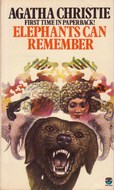
Elephants Can Remember by Agatha Christie: a Book Review

Collingwood Arms books

My posts may be a bit  hit and miss for a while as we have recently sold our house and are busy searching for somewhere to live in Northumberland/Scottish Borders. Whilst we were away over the last few days I did take some of my current books with me to read but as the hotel had two bookcases of books to choose from I picked up Elephants Can Remember to read instead.

It’s not the best Agatha Christie book I’ve read, but I found it entertaining, if rather repetitive and predictable – I worked out the mystery quite easily. Celia’s parents, apparently a happily married couple, were found shot dead on a cliff top – apparently as a result of a suicide pact. Some twelve to fifteen years later Mrs Burton-Cox, concerned that Celia is about to marry her son, approaches Mrs Ariadne Oliver, the mystery novelist, at a literary luncheon and asks the question – who killed whom? As Ariadne is Celia’s godmother she is curious and starts investigating, enlisting the help of Hercule Poirot.

ElephantsThe mystery is unravelled by Poirot and  Ariadne  by talking to the people who knew the couple and comparing their stories. Mrs Oliver interviews several elderly witnesses who she describes as “elephants” because they can remember certain incidents from the past. Much hinges on memory and interpretation of the events, highlighting the unreliable nature of witnesses and their memories, and the brilliance of Poirot in getting to the truth.

In my opinion it would have better if it were shorter and more concise, but then this was Agatha Christie’s last Poirot mystery, published in 1972 when she was in her eighties!

I did like the comments Ariadne makes about the relationship between authors and their readers, but as I put the book back on the hotel’s bookshelf I can’t give any quotes! This is only the second book I’ve read featuring Mrs Oliver, but occurs to me that Agatha Christie was using her to express her own views on writing and her reaction to her readers. Ariadne doesn’t like “literary lunches” and is shy about talking to people about her books, especially disliking those who simply gush and tell her how wonderful her books are. I can see I’ll have to read Agatha Christie’s Secret Notebooks and her autobiography.

AC autobiog


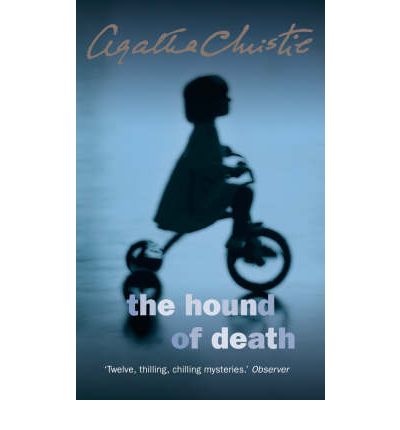
The Hound of Death by Agatha Christie: a Book Review

Hound of deathI borrowed The Hound of Death by Agatha Christie from the library. It’s a collection of twelve short stories, stories of unexplained phenomena, in most cases tales of the supernatural rather than detective stories.

Of the twelve stories I think The Witness for the Prosecution is the best. Agatha Christie later wrote a play based on this story which has subsequently been adapted for film and television. It’s the story of Leonard Vole, a young man who has been arrested for the murder of an elderly lady, Miss Emily French. He befriended this rich lonely old woman who left him everything in her will. He protests his innocence and is astounded when Romaine (who lives with him as his wife) refuses to back up his story at the trial. It is up to his lawyer Mr Mayherne to get to the truth.

I also liked the more supernatural stories – those with no explanation and those where the supernatural either have natural, scientific explanations or are plain con tricks. The narrator in The Hound of Death is unsure of how to view the events during the First World War where a Belgian nun, Sister Marie Angelique is said to have caused her convent to explode when it was invaded by German soldiers. He reflects:

But of course it is all nonsense! Everything can be accounted for quite naturally. That doctor believed in Sister Marie Angelique’s hallucinations merely proves that his mind too, was slightly unbalanced.

Yet sometimes I dream of a continent under the seas where men once lived and attained to a degree of civilization far ahead of ours …

… Nonsense – of course the whole thing was merely hallucination! (p36)

There are stories of premonitions, intuition or a sixth sense, stories of seances, haunted houses, nightmares, amnesia and a very strange tale The Call of Wings in which a millionaire hears a tune, played by man with no legs.

It was a strange tune – strictly speaking, it was not a tune at all, but a single phrase, not unlike the slow turn given out by the violins of Rienzi, repeated again and again, passing from key to key, from harmony to harmony, but always rising and attaining each time to a greater and more boundless freedom. (p269)

The music makes him feel he is being released from all his burdens as he is carried higher and higher. This story, with its mystical overtones reveals the power of music to transport the soul.

Years ago I read as many of Agatha Christie’s books as I could find, but they were all the detective stories – Poirot or Miss Marple. I was unaware that she wrote anything else, so these collections of short stories are a bonus for me. She really was a superb storyteller.

This year’s Agatha Christie Week is being celebrated at The Southbank Centre in September and on the English Riveria too, along with new radio productions and publications of previously unpublished stories – see the Agatha Christie website.

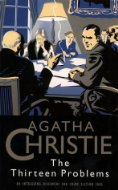
The Thirteen Problems by Agatha Christie

agatha_christie_rcIn The Thirteen Problems by Agatha Christie a group of friends, including Miss Marple meet on a Tuesday night and tell sinister stories of unsolved mysteries. It was first published in the UK in 1933, collecting together short stories previously published in various magazines. The first story The Tuesday Night Club introduces the character of Miss Marple.

The members of the Tuesday Night Club are Miss Marple, her nephew Raymond West a writer, Joyce Lempriere an artist, Sir Henry Clithering the ex-Commissioner of Scotland Yard, Dr Pender a clergyman and Mr Petherick a solicitor. Raymond wonders what type of person succeeds best at unravelling mysteries and puts forward that the ‘art of writing gives one an insight into human nature’, but Miss Marple questions him thinking that ‘so many people seem to me not to be either bad or good, but simply, you know, very silly.’ Mr Petherick thinks imagination is dangerous and that it needs a legal mind to sift through the evidence looking only at facts to arrive at the truth. Whereas Joyce believes it takes a woman’s intuition, such as hers – an artist who has ‘knocked about among all sorts and conditions of people’. She discounts Miss Marple thinking she cannot possibly know about life only having lived in St Mary Mead.thirteen-problems

So they each tell a tale and are amazed when it is Miss Marple, sitting primly, ‘knitting something white and soft’ who comes up with the right solution each time by using her knowledge of human nature gleaned from observing similar cases in St Mary Mead. She sees similarities and makes connections the others overlook.

The second set of stories are told at Colonel and Mrs Bantry’s house, when the guests tell their after-dinner stories. Sir Henry is visiting them and suggests they invite Miss Marple to make a sixth guest at dinner, along with Jane Helier the beautiful and popular actress, and the elderly Dr Lloyd.  Again Miss Marple correctly solves the mysteries, seeing through the red herrings to discover even the crimes that no one even knew had been committed. As she says

a lot of people are stupid. And stupid people get found out, whatever they do. But there are quite a number of people who aren’t stupid, and one shudders to think of what they might accomplish unless they had very strongly rooted principles.

The Thirteen Problems is an easy read and the short stories are ideal for reading quickly and in isolation. They are not complicated and once Miss Marple starts her explanations the crimes are easily solved.

I particularly liked the first description of Miss Marple, sitting erect in a big grandfather chair she

wore a black brocade dress, very much pinched in round the waist. Mechlin lace was arranged in a cascade down the front of her bodice. She had on black lace mittens, and a black lace cap surmounted the piled up masses of her snowy hair.

Kerrie recently ran a poll asking Who is the Best Miss Marple? My answer was Joan Hickson because I liked her portrayal, and the way she spoke and behaved seemed to me to be Miss Marple. But even though she looked nothing like this description I still prefer to ‘see’ Joan Hickson as Miss Marple. A strange case (for me) of a TV portrayal taking precedence over a book.

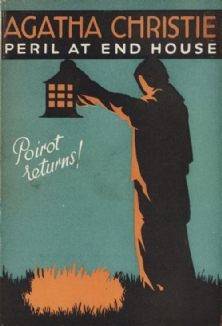
Peril at End House by Agatha Christie: Book Review

peril-at-end-house

Peril at End House by Agatha Christie was first published in 1932.  For once I wasn’t totally bemused and I was doing well, following the clues, or so I thought because I did solve some of the puzzles before Poirot revealed the culprit. But I hadn’t got the final solution!

Poirot is on holiday in Cornwall and boasting of his modesty to Captain Hastings, who is the narrator of this story. In his own words he is happy to be in retirement:

To sit in the sun – what could be more charming? To step from your pinnacle at the zenith of your fame – what could be a grander gesture? They say of me: “That is Hercule Poirot! – The great – the unique! – There was never any one like him, there never will be!” Eh bien – I am satisfied. I ask no more. I am modest.

But when he meets Nick Buckley who tells of her “accidental brushes with death” he just cannot resist investigating who is her would-be killer. Nick treats it all as a joke but Poirot is convinced that she is in grave danger. Indeed it seems as though he is right, especially when her cousin Maggie, wearing Nick’s shawl is shot.

But why would someone want to kill Nick? She lives at End House, badly in need of repair and “mortgaged up to the hilt”. Could it be Ellen, the housekeeper, or one of her friends – the languid, affected and mysterious Frederica known as Freddie, or her cousin Charles, who will inherit the house if she dies. Or maybe it’s the Australian couple renting the lodge house from Nick, who knew her father when he was in Australia. And what is the significance of the secret panel in the house – if it really exists?

There are plenty of twist and turns as usual with an Agatha Christie plot and not everyone is who they seem to be – identity plays a large role in this complicated mystery. I enjoyed it very much, not least because of Captain Hasting’s comments on Poirot’s outrageous vanity, such as this one:

His fame and reputation meant nothing to her – she was of the generation that knows only the great names of the immediate moment. … He was to her only a rather comic elderly foreigner with an amusingly melodramatic mind.

And this attitude baffled Poirot. To begin with, his vanity suffered. It was his constant dictum that all the world knew Hercule Poirot. Here was someone who did not. Very good for him, I could not but feel – but not precisely helpful to the object in view!

agatha_christie_rcHave a look at the Agatha Christie Reading Challenge Carnival for more posts on her books.

The Body in the Library by Agatha Christie: Book Review

body-in-library001

I wrote some initial thoughts about The Body in the Library in my Sunday Salon post.  This is the mystery of who killed Ruby Keene. Ruby was eighteen, a professional dancer employed at the Majestic Hotel Danemouth as a dance hostess. Her body was found  in the Bantrys’ library at Gossington Hall in St Mary Mead. Then the charred body of another girl is found in an abandoned quarry. Who killed these girls and why?

The police are investigating the murder, including Inspector Slack, who is anything but slack, an energetic man, with a bustling manner. The police investigation is reinforced by the retired head of Scotland Yard, Sir Henry Clithering, whilst quietly in the background Miss Marple, at the request of Mrs Bantry, is also looking for the murderer.  I had little idea who it was even though I read the book very carefully. I had my suspicions and was completely wrong.

There are various suspects – Colonel Bantry, because the body was found in his library, Basil Blake who is connected with the film industry, has loud, drunken parties, George Bartlett, a rather dim-witted chap who is a guest at the Majestic, apparently the last person to see Ruby alive, and the Jefferson family – Conway Jefferson confined to a wheelchair, who was proposing adopting Ruby as his daughter, Mark, his son-in-law and Adelaide his daughter-in-law. Ruby was hired by the hotel as a dance hostess to partner Raymond Starr (also the tennis coach) after Josie Turner had sprained her ankle.

This is a satisfying murder mystery in that all the clues are there and when Miss Marple reveals who the killer is it is so clear that I don’t know why I hadn’t realised pages earlier, but that is Agatha Christie’s skill. A quick and enjoyable read.

For more reviews of Agatha Christie’s books have a look at the Agatha Christie Challenge.