Agatha Christie Blog Carnival – June edition

The June 2011 edition of the Agatha Christie Blog Carnival has just been posted.
As ever there is plenty of variety: 16 contributors have posted 22 items.

The number of contributors is slowly growing, although not everybody is able to contribute each month. Some are reading Agatha Christie titles in order, while others (like me) are reading books as they locate them.

This month’s contributions range from reviews of books about Christie, reviews of Christie titles, to novel/film comparisons, book covers over the years, and recipes for cakes and drinks mentioned in Christie books. Something for everybody!

Find out more about the Agatha Christie Reading Challenge and the accompanying Blog Carnival here.

Agatha Christie Reading Challenge Update

The Agatha Christie Reading Challenge is run by Kerrie at Mysteries in Paradise. It’s an open-ended challenge to read all of Agatha Christie’s books. I’m not attempting to read them in order (as Kerrie is doing) but reading them as I find them. So far I have read her Autobiography, 25 of her full length books and 2 of the collections of her short stories:

Progress in publication date order (the links are to my posts on the books):

  1. 1920 The Mysterious Affair At Styles
  2. 1922 The Secret Adversary
  3. 1924 The Man in the Brown Suit
  4. 1926 The Murder of Roger Ackroyd
  5. 1928 The Mystery of the Blue Train
  6. 1929 The Seven Dials Mystery
  7. 1932 Peril At End House
  8. 1934 Why Didn’t They Ask Evans? (Aka The Boomerang Clue)
  9. 1936 The A.B.C. Murders
  10. 1937 Death on the Nile
  11. 1938 Hercule Poirot’s Christmas
  12. 1939 Murder is Easy
  13. 1941 The Body in the Library
  14. 1946 The Hollow
  15. 1949 Crooked House
  16. 1953 A Pocket Full of Rye
  17. 1956 Dead Man’s Folly
  18. 1957 4.50 from Paddington
  19. 1961 The Pale Horse
  20. 1962 The Mirror Crack’d from Side to Side
  21. 1964 A Caribbean Mystery
  22. 1968 By the Pricking of My Thumbs
  23. 1970 Passenger to Frankfurt
  24. 1972 Elephants Can Remember
  25. 1975 Curtain: Poirot’s Last Case (written in the 1940s)

Short Stories:

  1. 1932 The Thirteen Problems
  2. 1933 The Hound of Death

Autobiography/Biography

Agatha Christie: An Autobiography

I own a few more of her books, which I’ll be reading next:

  • Murder on the Orient Express (1934)
  • Dumb Witness (1937)
  • The Moving Finger (1942)
  • Taken at the Flood (1948)
  • They Do It With Mirrors (1952)
  • A Murder is Announced (1950)
  • They Came to Baghdad (1951)
  • The Golden Ball and Other Stories (1971)
  • Nemesis (1971)

I also have:

  • The Complete Parker Pyne: Private Eye,  which brings together the 14 stories featuring Mr Parker Pyne.
  • Miss Marple and Mystery: the Complete Short Stories.

Murder is Easy by Agatha Christie: Book Review

Murder is Easy, Agatha Christie’s 25th book was first published in 1939.

Publisher’s summary:

Luke Fitzwilliam could not believe Miss Pinkerton’s wild allegation that a multiple murderer was at work in the quiet English village of Wychwood — or her speculation that the local doctor was next in line. But within hours, Miss Pinkerton had been killed in a hit-and-run car accident. Mere coincidence? Luke was inclined to think so — until he read in The Times of the unexpected demise of Wychwood’s Dr Humbleby …

My view

This has stood the test of time very well. It’s another one of Agatha Christie’s easily read crime mysteries, with plenty of plot twists and unexpected revelations. This time the detective is Luke Fitzwilliam, a retired policeman recently returned to England from the East. He was wondering what to do with himself when he met Miss Pinkerton quite by chance. She tells him of her suspicions about a number of murders in her village and when he tells her that it’s rather hard to do a lot of murders and get away with it, she replies:

No, no, my dear boy, that’s where you’re quite wrong. It’s very easy to kill – so long as no one suspects you. And you see, the person in question is just the last person anyone would suspect! (page 22)

Wychwood-under-Ashe is a picturesque village with a Manor House, a village green and a duck pond. In other words a quintessentially English village just like Miss Marple’s St Mary Mead. But instead of Miss Marple, the person who helps Luke with his investigations is Bridget Conway, a beautiful young woman who immediately entrances Luke. His cover story is that he is writing a book on folklore and needs to talk to the locals gathering tales and legends.

I had no idea about the killer’s identity and neither really did Luke, until just near the end of the book. Superintendent Battle appears but does nothing towards solving the mystery and denies that he could have done any better than Luke explaining that

… nothing’s impossible in crime.

… Anyone may be a criminal, sir, that’s what I meant. (page 317)

Murder is Easy – one of Agatha Christie’s best mysteries:

  • Paperback: 400 pages
  • Publisher: Harper; Masterpiece edition (Reissue) edition (3 Sep 2007)
  • Language English
  • ISBN-10: 000713682X
  • ISBN-13: 978-0007136827
  • Source: I bought it

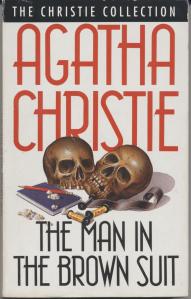
The Man in the Brown Suit by Agatha Christie: Book Review

The Man in the Brown Suit 001Agatha Christie wrote The Man in the Brown Suit whilst on a world tour with Archie Christie, her first husband, in 1922 and it was first published as a serial in The Evening News in 1923 in 50 instalments under the title of Anna the Adventurous. I think that’s an apt title as Anne Beddingfield, one of the two narrators of this book, longs for adventure, enjoying the cinema films of The Perils of Pauline. Agatha Christie, though thought it was ‘as silly a title as I had ever heard‘. But as The Evening News were prepared to pay her £500 for the serial rights she said nothing and bought a Morris Cowley with the proceeds.

She had the idea for the story from Major Belcher, a friend of Archie’s who had invited him to go with him on a grand tour of the British Empire to organise an Empire Exhibition. The Christies dined with Belcher at his house, the Mill House at Dorney and he had urged Agatha to write a detective story about it. He suggested the title The Mystery of the Mill House and wanted her to put him in it.

Agatha sketched the plot whilst she was in South Africa when there was a revolutionary crisis and decided that the book was to be more of a thriller than a detective story, with the heroine as ‘a gay, adventurous, young woman, an orphan, who started out to seek adventure.‘ But she found it hard to make the character she had chosen based on Belcher to come alive, until she hit upon the idea of writing it in the first person and making the Belcher character (Sir Eustace Pedler), Anne’s co-narrator.

I found this information in Agatha Christie’s An Autobiography, but I haven’t added the details she also added that give away who the murderer is (for of course there is a murder) – maybe she thought anyone reading her autobiography would have read all her books.

Anne’s adventure begins when she sees a man fall to his death on the live rails at Hyde Park tube station. He had a terrified look on his face and turning round Anne sees a man in a brown suit, who quickly becomes The Man in the Brown Suit both to her and the newspapers. He announced he was a medical man and that the man was dead, and as he left the station he dropped a piece of paper with some figures and words scrawled on it in pencil, which Anne picked up. A second death follows, this time a young woman is found strangled at Mill House, the home of Sir Eustace Pedler, MP. She was thought to be a foreigner. Anne decides to investigate and the trail takes her on board the Kilmorden Castle sailing to Cape Town.

The action takes place mainly on board ship and in South Africa which Agatha Christie describes so well from her own experiences.  Like Agatha, Anne suffers terribly from sea-sickness; both stayed in their cabins for three days until the ship reached Madeira and like Agatha, Anne just wanted to go ashore and be a parlourmaid. At that point in her life, Agatha had told Archie: ‘I would quite like to be a parlourmaid’. (An Autobiography page 300)

This book features the first appearance of Colonel Race, who appears in three more of Agatha Christie’s books. Anne describes him as ‘one of the strong, silent men of Rhodesia‘ and was very taken with him – ‘easily the best-looking man on board.‘ (page 54)

The novel is a mix of murder mystery and international crime organised by an arch-villain known as ‘the Colonel’, involving violence (but not graphic) and suspense. As usual there are a number of suspects and Anne has to work out who she can trust and who to believe. I found it a bit too drawn out for my liking, too many time lapses and coincidences to convince me of the plot’s credibility, but it held my interest to the end even though I knew the culprit’s identity.

Crime Fiction Alphabet – Letter M

The Murder of Roger Ackroyd by Agatha Christie is my choice to illustrate the letter M in Kerrie’s Crime Fiction Alphabet.

This is Agatha Christie’s 6th book, published in 1926, one of her best known books and possibly one of the most controversial because of its solution to the mystery. I hadn’t read it before, but I knew a bit about it from reading Agatha Christie’s Autobiography, in which she wrote:

Of course, a lot of people say that The Murder of Roger Ackroyd is cheating; but if they read it carefully they will see that they are wrong. Such little lapses of time as there have to be are nicely concealed in an ambiguous sentence … (page 352)

I won’t write any more about the controversy – no spoilers!

Set in the village of King’s Abbot, the story begins with the death of Mrs Ferrars, a wealthy widow and the local doctor, Dr Sheppard suspects it is suicide. The following evening Roger Ackroyd, a wealthy widower who it was rumoured would marry Mrs Ferrars, is found murdered in his study.

Poirot has retired to King’s Abbot, to grow vegetable marrows, not very successfully. He’s missing Captain Hastings who is living in the Argentine, so when he is asked to investigate the murder he enlists Dr Sheppard, who lives next door with his sister Caroline, to help him and it is Dr Sheppard who narrates the story. Caroline is a most interesting character who takes a great interest in other people and likes to know everything that goes on in the village. She is, possibly, a forerunner of Miss Marple as Agatha Christie wrote in her Autobiography:

I think it is possible that Miss Marple arose from the pleasure I had taken in portraying Dr Sheppard’s sister in The Murder of Roger Ackroyd. She had been my favourite character in the book – an acidulated spinster, full of curiosity, knowing everything, hearing everything: the complete detective service in the home. (page 448)

This has to be one of my favourite Agatha Christie books. It’s full of believable characters, suspects aplenty including Major Blunt, an old friend staying with Ackroyd, Flora, Ackroyd’s niece and her mother, his sister-in-law and poor relation, Geoffrey Raymond, his secretary, Ursula Bourne, a parlourmaid who may not be all she appears and Ralph Paton, Ackroyd’s adopted son who has large gambling debts.

The setting is that of the quintessential English village where Poirot appears as an mysterious foreigner. Dr Sheppard’s first impression of him is that he must be a retired hairdresser because of his immense moustaches. He also doubts his ability to solve the mystery and described his as

… ridiculously full of his own importance. It crossed my mind to wonder whether he was really any good as a detective. Had his reputation been built up on a series of lucky chances? (page 80)

Of course, it hadn’t and Poirot meticulously works through the timing of events, and disposes of all the suspects to find the culprit. It was only towards the end of the book that I began to realise who it had to be.

  • Hardcover: 237 pages
  • Publisher: HarperCollins; Facsimile edition (2011)
  • Language English
  • Source: My own copy, part of an issue of The Agatha Christie Book Collection partwork published by Agatha Christie Limited
The Secret Adversary by Agatha Christie: Book Review

The Secret Adversary was first published in 1922. It was Agatha Christie’s second book and the first featuring Tommy and Tuppence. In this book they have just met up after World War One, both in their twenties: ‘an essentially modern-looking couple’. They are both stony broke and decide to set up a joint venture under the name of the Young Adventurers Ltd, initially intending to hire themselves out to commit crimes.

A Mr Whittington overhears their conversation and offers Tuppence their first assignment, but when she tells him her name is ‘Jane Finn’ he acts very strangely and thinks she is blackmailing him. From then on Tommy and Tuppence set out to find Jane Finn, a name Tommy had overheard from a conversation in the street.

Reading it reminded somewhat of Enid Blyton’s adventure books, mixed up with P G Wodehouse’s books. It’s a spy/detective story that is fast and furious with Tommy and Tuppence landing themselves in all sorts of dangerous situations. It’s also full of red herrings and they’re never very sure who they can trust. Tommy and Tuppence advertise for information relating to Jane Finn and have two responses. One is from Mr Carter, from British Intelligence who tells them that Jane Finn, a survivor from the torpedoed Lusitania, was handed a certain document – a secret agreement, with a ‘new and deadly significance’. The second response is from Mr Julius P Hersheimmer, a young American, who says he is Jane’s cousin and wants to find her.

Just who is the mysterious Mr Brown, the secretive mastermind behind a plot to unite all of England’s enemies, overthrow the government and cause anarchy?  There is no clue to his real identity, he remains elusive and always in the background. But it becomes clear that he is one of two people and as I read I swung from believing it to be one character to the other.

One point of interest is the brief mention of Inspector Japp, of Scotland Yard. His role in this is merely incidental.

I enjoyed this book and I liked Tommy and Tuppence, who by the end realise they are in love. Agatha Christie only wrote five books featuring this couple. Unlike Miss Marple and Hercule Poirot, Tommy and Tuppence age as the books were written:

  • Partners in Crime: a book of short stories
  • N or M?
  • By the Pricking of My Thumbs
  • Postern of Fate.

Format: Kindle Edition
File Size: 378 KB
Print Length: 229 pages
Source: Project Gutenberg EBook