Classics Challenge 2012 – July Prompt

This year I am taking part in A Classics Challenge hosted by Katherine of November’s Autumn. The goal is to read at least seven classics in 2012 and every month Katherine is posting a prompt to help us discuss the books we are reading. July’s prompt is about

Lasting Impressions

Choose one of the Classics you’ve read this year or are currently reading.

What is a moment, quote, or character that you feel will stay with you? Years from now, when some of the details have faded, that lasting impression the book has left you with? What is it? –or why did it fail to leave an impression?

I wondered which classic to choose for this post, but I knew the answer as soon as I read the the words ‘lasting impressions’ had to be either Pride and Prejudice or A Tale of Two Cities. Both of these are books I first read when I was a teenager, so I know the lasting impressions they have made on me, both the characters and lots of quotations. How could I ever forget Elizabeth Bennet and Mr Darcy, or Charles Darnay and the wonderful Sydney Carton? And the opening sentences of both are so memorable.

From Pride and Prejudice:

It is a truth universally acknowledged, that a single man in possession of a good fortune, must be in want of a wife.

and from A Tale of Two Cities:

It was the best of times, it was the worst of times, it was the age of wisdom, it was the age of foolishness, it was the epoch of belief, it was the epoch of incredulity, it was the season of Light, it was the season of Darkness, it was the spring of hope, it was the winter of despair, we had everything before us, we had nothing before us, we were all going direct to Heaven, we were all going direct the other way.

Whereas I’ve read  Pride and Prejudice several times I’d only ever read A Tale of Two Cities once before and my memory of it was that it was about the French Revolution and the sacrifice that Sydney Carton made to save Charles Darnay from the Guillotine, with these words, which close the book:

It is a far, far better thing that I do, than I have ever done; it is a far, far better rest that I go to than I have ever known.

Reading the book this time round the character of Sydney Carton is much clearer in my mind, with several vivid images of his slovenly appearance and drunken behaviour. He is in fact a brilliant barrister, but also an alcoholic, lacking self confidence. He is called a ‘jackal‘, who worked for his fellow barrister, Stryver, who then got the credit.

Sydney Carton, idlest and most unpromising of men, was Stryver’s great ally. What the two drank together, between Hilary Term and Michaelmas, might have floated a king’s ship. Stryver never had a case in hand, anywhere, but Carton was there, with his hands in his pockets, staring at the ceiling of the court; they went to the same Circuit, and even there they prolonged their usual orgies late into the night, and Carton was rumoured to be seen at broad day, going home stealthily and unsteadily to his lodgings, like a dissipated cat. At last, it began to get about, among such as were interested in the matter, that although Sydney Carton would never be a lion, he was an amazingly good jackal, and that he rendered suit and service to Stryver in that humble capacity.

To help him overcome his drunkenness he soaked towels in a bowl of cold water and after wringing them out folded them on his head, and whilst working continued drinking wine, brandy and rum with sugar and lemons.

Two or three times, the matter in hand became so knotty, that the jackal found it imperative on him to get up, and steep his towels anew. From these pilgrimages to the jug and basin he returned with such eccentricities of damp headgear as no words can describe; which were made the more ludicrous by his anxious gravity.

He is moody and morose, and when he falls in love with Lucie Manette, he realises he is a wastrel, a ‘drunken, poor creature‘, that she can never return his love and that he can only ever bring her to misery, sorrow and repentance, blight and disgrace her, pulling him down with himself. 

It is Carton’s resemblance to Charles Darnay that enables him to martyr himself in Darnay’s place because of his love for Lucie. It is these two images that will remain with me – that of the dissolute man, who despite his drunkenness, worked though the night with his head wrapped in damp towels, and the man as he approached his death on the Guillotine with:

… the peacefullest man’s face ever beheld there. Many added that he looked sublime and prophetic.

A Classics Challenge – June Prompt

This month’s prompt for the Classics Challenge is to create a visual tour using quotes from the book you are reading; a series of images that closely represents how you see the scene or description. It doesn’t have to absolutely follow the text but it must reflect the mood.

I’ve been reading Charles Dickens’ A Tale of Two Cities and so there are many scenes I could choose from, varying from London to Paris, from calm and peaceful scenes to trial scenes and scenes of violence, revolution and death by guillotine.

But I’ve decide to concentrate on the place described by Dickens as Doctor Manette’s house in London, the house he lived in with his daughter, Lucie after he was released from the Bastille in Paris.

The quiet lodgings of Doctor Manette were in a quiet street corner not far from Soho Square.

Soho Square illustration is South-west Corner of Soho Square in 1816. From an aquatint in John B. Papworth's Select Views of London

I was intrigued by it being described as a quiet street corner – in Soho. But the Soho of 1780 was rather different from what it later became, so I had to alter my mental picture of it. This view of Soho Square is from about 50 years after the events in the book, but it shows the rural nature of London at that time.

I wondered about the location of the Manettes’ lodging house, just where was it? And then I founnd this plan (see illustration below) showing the location of Soho Square, coloured in green. Just below the Square are Greek Street and Rose Street. It has been conjectured that Dr Manette’s house was No.1 Greek Street with its courtyard in Rose Street.  In 1895 Rose Street was changed to Manette Street after Dicken’s character:

Soho Square

However that may or may not been, at that time Soho was very much in the countryside:

A quainter corner than the corner where the doctor lived, was not to be found in London. There was no way through it, and the front windows of the doctor’s lodgings commanded a pleasant little vista of street that has a congenial air of retirement on it. There were few buildings then, north of the Oxford-road, and forest trees flourished, and wild flowers grew, and the hawthorn blossomed, in the now vanished fields.

Hawthorn Blossom
Hawthorn bushes

Somewhat different from the London scene these days!

Doctor Manette occupied two floors of the house, with a courtyard at the back:

where a plane-tree rustled its green leaves

It was where Lucie, Mr Lorry from Tellson’s Bank and Charles Darney sat under the tree talking and drinking wine and where Lucie and her father sat when she told him she was going to marry Darney:

Plane Tree - from Wikimedia © Copyright David Hawgood

I could just imagine the scene:

Never did the sun go down with a brighter glory on the quiet corner in Soho, than one memorable evening when the  Doctor and his daughter sat under the plane-tree together. Never did the moon rise on a milder radiance over great London, than on that night when it found them still seated under the tree, and shone upon their faces through its leaves.

Moonlight

Classics Challenge: May Prompt – Literary Movement

This month’s topic in the Classics Challenge is about literary movement and where the book you’re reading fits within the movement.

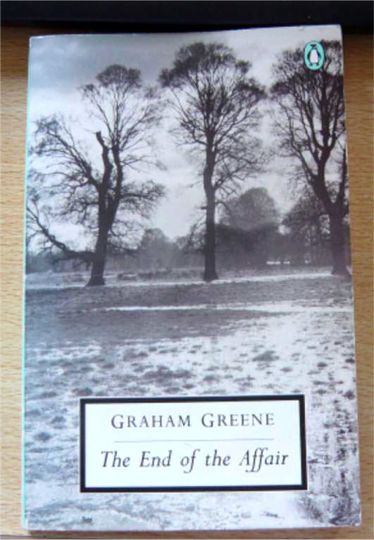
the end of the affair

I’ve recently read Graham Greene’s The End of the Affair, published by Penguin as one of the Twentieth Century Classics. It was originally published in 1951.

It’s very difficult, or at least I think it is, to place this book within a ‘literary movement’. I’m not the only one because William Golding wrote:

Graham Greene was in a class by himself  – He will be read and remembered as the ultimate twentieth-century chronicler of consciousness and anxiety.’ 

So maybe he fits into the ‘stream of conciousness’ movement, because The End of the Affair is full of Maurice Bendrix’s thoughts and feelings, but I don’t think it’s quite that. It moves backwards in time recollecting past events, but it certainly reveals what is going on in Maurice’s mind.

Maurice’s love affair with his friend’s wife, Sarah, had begun in 1944 during the London Blitz. They had met at a party held by Sarah’s husband, Henry. The affair had ended suddenly after his house had been bombed by a V1 and Sarah had not explained why. Two years later Maurice, still obsessed by Sarah employed Parkis, a private detective to find out the truth. So it’s maybe a romantic novel, inspired by Greene’s affair with a married woman ‘C’ (Lady Catherine Walston), but then again, maybe not. The story is narrated by Maurice but includes his reading of Sarah’s diary, which reveals her increasing fascination with religion, specifically with Catholicism. Some describe The End of the Affair as the last of Greene’s Catholic Novels (the others being Brighton Rock, The Power and the Glory and The Heart of the Matter), but Greene didn’t like that label. Nevertheless, The End of the Affair is a study of love and hate, of desire, of jealousy, of pain, of faithfulness, and of the interaction between God and people.

At the beginning Maurice states that: ‘this is a record of hate, far more than of love’. He struggles to believe in God and is full of desperation and anger. He is tormented by his efforts to understand:

But I don’t want Your peace and I don’t want Your love. I wanted something very simple and very easy: I wanted Sarah for a lifetime and You took her away. With Your great schemes You ruin our happiness like a harvester ruins a mouse’s nest: I hate You, God, I hate You as though You existed. (page 191)

It’s a powerful novel that, for me, defies being categorised. Emotional, passionate and intense it’s a  dark and compelling book, with more emphasis on character than on plot. God, whether the characters believe in ‘him’ or not, has a major part. I knew before I read this book that Greene was a convert to Roman Catholicism, but the doubts about belief and the depth of criticism of Christianity both surprised and interested me, more than the question of the affair.

Here’s a selection of passages that I noted as I read:

  • Maurice is in Henry’s study, a room Maurice feels Henry never uses: ‘I doubted whether the set of Gibbon had once been opened, and the set of Scott was only there because it had – probably – belonged to his father, like the bronze copy of the Discus Thrower. And yet he was happier in his unused room simply because it was his: his possession. I thought with bitterness and envy: if one possesses a thing securely, one need never use it.’ (page 13) How true is that I wondered? – to me the unread books on my shelves are less my own than the read books.
  • Maurice is a novelist. Throughout the book he ponders on the nature of writing, characterisation and so on. In this passage he considers his habits of working and he effects outside events have on his ability to write, listing all the obstacles that had never affected him before, concluding that: So long as one is happy one can endure any discipline: it was unhappiness that broke down the habits of work.  (pages 34-5)
  • I wondered how much of this novel is autobiographical – not just the affair, but Maurice’s own character and beliefs seem to be based on Greene’s own life and personality. Maybe that’s an unfair assumption, but I do think it’s true for his passages on writing. Another passage reveals: ‘So much of a novelist’s writing, as I have said, takes place in the unconscious: in those depths the last word is written before the first word appears on paper. We remember the details of our story, we do not invent them.’ (page 35)
  • And on the existence of God/Devil: ‘I have never understood why people who can swallow the enormous improbability of a personal God boggle at a personal Devil. I have known so intimately the way that demon works in my imagination.’ (page 59)

I can’t say that I enjoyed this novel, but it is well written, full of ideas and questions packed within its pages – a tragedy about conflict and doubt.

Agnes Grey by Anne Bronte: a Book Review

Agnes Grey by Anne Bronte, published in 1847, is a deeply moral novel about a young woman, a governess and her experiences working for two families in Victorian England. Agnes is the younger daughter of an impoverished clergyman. Her parents had married against her mother’s family’s wishes and when their fortune was wrecked Agnes determines to help out by working as a governess.

The first family she works for are the Bloomfields. Mrs Bloomfield tells Agnes her children are clever and very apt to learn. In fact they are terrible children, utterly spoilt and cruel. I found their brutality shocking, the more so since Anne was writing from her own experiences. One of the most vivid scenes is where Agnes kills a brood of nestlings to prevent Tom Bloomfield from torturing them.

Agnes is treated like a servant, rather than as a governess. She has no authority over the children and is not allowed to discipline them much as she would like to. Her attempts to improve their wild behaviour by quoting Bible texts and moral instruction have no effect on the children’s behaviour. As Agnes’s mother has told her that people do not like to be told of their children’s faults she kept silent about them and despite her best efforts she failed to make any impression on them:

But either the children were so incorrigible, the parents so unreasonable, or myself so mistaken in my views, or so unable to carry them out, that my best intentions and most strenuous efforts seemed productive of no better result than sport to the children, dissatisfaction to their parents, and torment to myself.

Her second post with the Murrays is little better – her charges are two teenage girls, who are just as spoilt as the younger children, wilful and determined to have their own way and two younger boys who are rough and unruly. Fortunately the boys are soon packed off to school and she only has to cope with sisters.

Both families are portrayed as wealthy, snobbish and totally lacking in any regard for Agnes. The only glimmer of hope comes through her friendship with Edward Weston, but even then Rosalie, the older daughter, is determined to make him fall in love with her. But surely Edward will not be deceived by Rosalie’s scheming ways? Agnes is gentle and self-effacing, never making her feelings known and it seems as though she is destined for a miserable life. Although she loves Edward she is totally unable to give any indication of her feelings towards him. Things seem to get even worse after her father’s death and she has to leave the Murrays – and Edward. However, Snap the dog plays his part in bringing some joy into Agnes’s life.

Agnes Grey vividly portrays the class distinctions of Victorian society, the position of women in that society from both the working and the middle classes through the first-person narrative. Above all it gives a very clear picture of the life of a governess, with all its loneliness, frustrations, insecurities and depressions. The characters, for the most part are well drawn, (the minor characters are one-dimensional) and I liked Agnes’s unspoken thoughts, eg. when told to go to the schoolroom immediately because the young ladies were waiting for her  she thinks, ‘Climax of horror! actually waiting for their governess.!!!’

Reading Agnes Grey has made me keen to re-read Charlotte Bronte’s Jane Eyre, for one thing to compare the two governesses. It’s been years since I read Jane Eyre, and my memory is that it is a much more dramatic novel (certainly it is much longer).

  • Format: Kindle Edition
  • File Size: 449 KB
  • Print Length: 155 pages
  • Page Numbers Source ISBN: 0812967135
  • Publisher: Modern Library (18 Dec 2007)
  • Sold by: Amazon Media EU S.à r.l.
  • Source: My own copy
  • My Rating: 3/5

Classics Challenge – April Prompt: the Book Cover

Katherine at November’s Autumn hosts the Classics Challenge. This month’s focus is the Book Cover. The old and worn adage of never judging a book by its cover is partly true but a book cover tells the reader a lot about what’s inside you can usually tell what genre it is or what time period it takes place in.

What are your first impressions as you look at the cover? Does the book cover have an aspect that reflects the character, setting, or plot of the novel?  If you could have designed the book cover what would you have chosen?

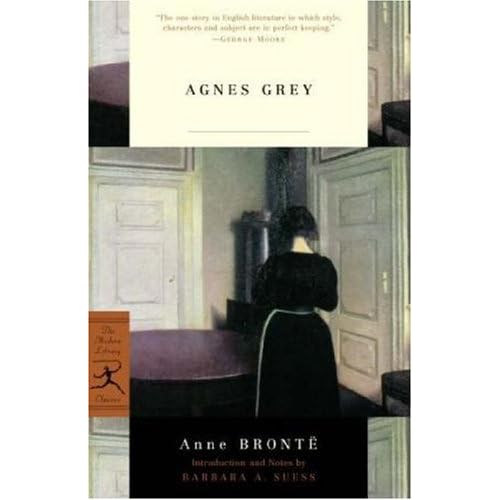
Currently I’m reading Agnes Grey by Anne Bronte on my Kindle. I knew nothing about it before I began reading. There is no information on the Kindle e-book about the cover illustration and I don’t think it gives many clues about the book.

 My first impression on looking at the cover was that the character of Agnes Grey may have been a lady’s maid in a large household. However, I soon discovered that she is the impoverished daughter of a clergyman and she is employed as a governess to the unruly and spoilt children of wealthy families.

The cover does reflect the setting of the novel in Victorian times, although not the position Agnes has in the household – she is not a servant.  But it does reflect Agnes’s character as she is demure, gentle and rather timid. I’ve not finished the book yet, but so far Agnes has been totally unable to control the awful children in her charge and is not given any authority to reprimand them from their parents. The lone figure on the cover reflects the position in which Agnes finds herself – alone and unsupported by her employers.

If I could have designed the book cover I think I would have chosen a similar scene, but would have chosen one showing a governess and the children.

March Prompt – A Classics Challenge

The focus this month in the Classics Challenge is on Setting.

I’ve just finished re-reading (for the umpteenth time) Jane Austen’s Pride and Prejudice. Each time I read it I still enjoy it immensely. I think knowing what happens next adds to the pleasure. I read it this time looking out for information about the settings – something I haven’t done before, although Pemberley always stands out!

There are many locations, but for this post I’ve chosen Longbourn.

Pride and Prejudice is a novel based on character, plot and is a study of society in the late 18th/early 19th centuries, but above all it is a love story. The settings provide an essential backdrop but in most cases leave a lot to the reader’s imagination; dialogue takes precedence over description – place is really unimportant.

The book begins with no indication of its setting, or time of day, with a conversation between two characters – Mr and Mrs Bennet. And it is only in the third chapter that the location is revealed and then all we learn is that that the family lives in the village of Longbourn, where they are the principal inhabitants. More information about Longbourn is scattered throughout the book. It’s one mile from the village of Meryton, in Hertfordshire, where the militia are quartered for a while, and twenty four miles from London.

Longbourn House is the family home of the Bennets. There is little description of the house. It must be quite large, it has land – an estate, including a farm. The family have the use of a carriage and horses, when they are not needed for farm work. There are servants – a butler, housekeeper, cook and maids, a drawing room, dining-parlour, and dressing rooms as well as bedrooms. There are gardens, with gravel walks, a shrubbery, a hermitage, and what Lady Catherine de Burgh called  ‘a prettyish kind of little wilderness on one side of your lawn.’

Reading the book I haven’t formed a definite picture in my mind what Longbourn House looks like, although I like this one from the 1995 TV series.

Luckington Court the 1995 TV location of Longbourn House © Copyright Paul Ashwin and licensed for reuse under this Creative Commons Licence