The Black Loch by Peter May: Book Beginnings on Friday & The Friday 56

Every Friday Book Beginnings on Friday is hosted by Gillion at Rose City Reader where you can share the first sentence (or so) of the book you are reading. You can also share from a book you want to highlight just because it caught your fancy.

The book I’m currently reading is The Black Loch by Peter May, the fourth book in May’s Lewis Trilogy. I’ve read and loved the first three books. So I was keen to read it, and so far (I’ve read 45%) it’s living up to my expectations.

The book begins with a Prologue:

The sun set some time ago. Although it is not yet dark enough, somehow for murder.

Also every Friday there is The Friday 56, hosted by Freda at Freda’s Voice, but she is taking a break and Anne at My Head is Full of Books has taken on hosting duties in her absence. You grab a book and turn to page 56 (or 56% of an eBook), find one or more interesting sentences (no spoilers), and post them.

Page 56:

‘Did I ever tell you about the whaling boy?’

He never had.

‘You know what a whale is, Finn?’

‘Of course!’

‘Well there was a time when we killed them all over the planet. Hundreds and thousands of them.’

Description from Amazon:

A MURDER

The body of eighteen-year-old TV personality Caitlin is found abandoned on a remote beach at the head of An Loch Dubh – the Black Loch – on the west coast of the Isle of Lewis. A swimmer and canoeist, it is inconceivable that she could have drowned.

A SECRET

Fin Macleod left the island ten years earlier to escape its memories. When he learns that his married son Fionnlagh had been having a clandestine affair with the dead girl and is suspected of her murder, he and Marsaili return to try and clear his name.

A RECKONING

But nothing is as it seems, and the truth of the murder lies in a past that Fin would rather forget, and a tragedy at the cages of a salmon farm on East Loch Roag, where the tense climax of the story finds its resolution.
If you have read this book, what did you think?

Top Ten Tuesday: The First 10 Books I Randomly Grabbed from My Shelf

Top Ten Tuesday is a weekly meme created by The Broke and the Bookish and now hosted by Jana at That Artsy Reader Girl. For the rules see her blog

The topic today is The First 10 Books I Randomly Grabbed from My Shelf (Stand in front of your book collection, close your eyes, point to a title, and write it down. If you have shelves, point to your physical books.

This week’s topic is pretty easy. I used the bookcase that’s behind me as I write this post, filled mostly with hardback books, stood in front of it, closed my eyes and touched the books one by one from different shelves. So this is a mixed bunch of books, only some of which I’ve read.

I enjoyed doing this post, but now, of course I want to read those I haven’t read yet – immediately!

The Great Fire by Shirley Hazzard, historical fiction. I haven’t read this one yet. Set in the aftermath of World War II in Asia and Europe.
Tommy Walsh Outdoor DIY, how to make the most of the garden – fences, patios, planters, pergolas and water features galore!

Daemon Voices: On Stories and Storytelling by Philip Pullman. A lovely book. I’ve read some of the stories and Pullman’s reflections in essays and talks on the subject of storytelling.
Cosmopolis by Don Delilo, a novel covering day in the life of Eric Packer, a multi-billionaire. I haven’t read this one yet.

Russia: A Journey to the Heart of a Land and its People by Jonathan Dimbleby, nonfiction first published in 2008. I’ve not read this.

Agatha Christie’s Secret Notebooks: Fifty Years of Mysteries in the Making by Jonathan Curran. It includes two unpublished Poirot Stories . A wonderful book exploring the contents of Agatha Christie’s 73 handwritten notebooks about her plots, titles and characters. I’ve dipped into this several times.

Force of Nature by Jane Harper. I loved this novel set in the fictional Giralang Ranges in Australia, where Aaron Falk is investigating the disappearance of Alice Russell, during a team building exercise in the outback.

Hardy Country by Gordon Beningfield, a book to dip into, not one to read straight through. Paintings and drawings of Wessex accompany a discussion of the portrayal of the region of England in the novels of Thomas Hardy.

Wolf Hall by Hilary Mantel, historical fiction, the first in her fantastic Wolf Hall trilogy. This is the story of Thomas Cromwell, the son of a blacksmith, and his political rise, set against the background of Henry VIII’s England. I loved it.

Completely Unexpected Tales by Roald Dahl. There are 25 short stories in total in this book, some of them are very short. I’ve only read some of these. They all end with an unexpected twist, some are more predictable than others, but others did take me by surprise with a sting in the tail.

Nonfiction November 2025 Week 2

The second week of Nonfiction November is being hosted by Frances at Volatile Rune. The title of this week’s challenge is: Choosing Nonfiction

She wrote: There are many topics to choose from when looking for a nonfiction book.  For example:  Biography, Autobiography, Memoir, Travel, Health, Politics, History, Art, Medicine, Gardening, Food, Business, Education, Music to name but a few.  Maybe use this week to  challenge yourself to pick a genre you wouldn’t normally read?   Or stick to what you usually like is also fine.  If you are a nonfiction genre newbie, did your choice encourage you to read more?

There are many topics I’d like to know more about – Anatomy and Physiology to name but one. Religion is another topic. Over the years I have read many books on Theology, Christianity, the Bible, books about the history of Israel and the creation of the state of Israel, a few books about Buddhism, but next to nothing about Islam or any other religion. Like many other people I’m horrified by what is going on in Israel and Gaza and last year I attempted to find out more. I read a few books – Enemies and Neighbours: Arabs And Jews In Palestine And Israel, 1917-2017 by Ian Black, The Israeli-Palestinian Conflict: What Everyone Needs to Know by Dov Waxman, both of which gave me much to think about.

Now I would like to know more about Islam and I have two books that I’m hoping will enlighten me at least a little. They are Islam: A Very Short Introduction by Malise Ruthven and The Hundred Years’ War on Palestine by Rashid Khalidi. I’ll begin with the first book and hope it will help me understand the basics and that the second will fill in the huge gaps in my knowledge of the history of Palestine.

Are there books you could recommend I read too?

Novellas in November 2025

My Year in Novellas retrospective looking at any novellas you have read since read since the end of last year’s challenge. I haven’t taken part in Novellas in November since 2022, so I’ve looked back to see what I’ve read since then.

I’ve not got back into the swing of writing reviews after my operation in 2023. You can click on the titles to read my review or the Goodreads description – for most of these I’m sorry to say:

  1. Tortilla Flat by John Steinbeck
  2. One Snowy Night Before Christmas by Ava Bradley
  3. Beowulf by Michael Morpurgo
  4. Gladys Aylward: My Missionary Life in China by Gladys Aylward
  5. The Christmas Book Hunt by Jenny Colgan
  6. Ted: a Pawtography: My Adventures in Gone Fishing by Ted the Dog as told to Lisa Clark
  7. The One That Got Away by Mike Gayle
  8. The Curious Case of the Village in the Moonlight by by Steve Wiley
  9. Maigret and the Wine Merchant by Georges Simenon
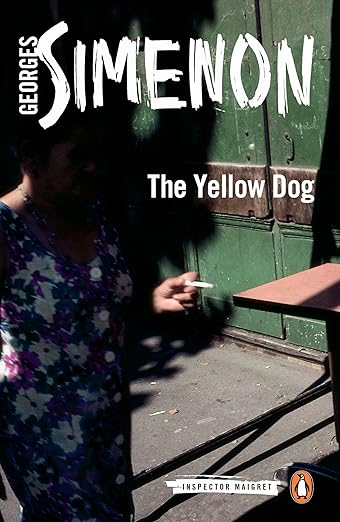
  10. The Yellow Dog by Georges Simenon
  11. Loitering with Intent by Muriel Spark
  12. Appointment in Arezzo by Alan Taylor
  13. The Ghost Cat by Alex Howard

Six Degrees of Separation from We Have Always Lived in the Castle to Ryan’s Christmas

This is a monthly link-up hosted by Kate at Books Are My Favourite and Best. On the first Saturday of every month, a book is chosen as a starting point and linked to six other books to form a chain. Readers and bloggers are invited to join in by creating their own ‘chain’ leading from the selected book.

Books can be linked in obvious ways – for example, books by the same authors, from the same era or genre, or books with similar themes or settings. Or, you may choose to link them in more personal ways: books you read on the same holiday, books given to you by a particular friend, books that remind you of a particular time in your life, or books you read for an online challenge.

A book doesn’t need to be connected to all the other books on the list, only to the ones next to them in the chain.

This month we are starting with We Have Always Lived in the Castle by Shirley Jackson is a fantastic book; a weirdly wonderful book about sisters, Merricat and Constance. They live in a grand house, away from the village, behind locked gates, feared and hated by the villagers. Merricat is an obsessive-compulsive, both she and Constance have rituals that they have to perform in an attempt to control their fears. Merricat is a most unreliable narrator.

I’m starting my chain with The Lottery is a short story also written by Shirley Jackson. It was first published on June 25, 1948, in The New Yorker, (the link takes you to the story.) The lottery is an annual rite, in which a member of a small farming village is selected by chance. This is a creepy story of casual cruelty, which I first read several years ago. The shocking consequence of being selected in the lottery is revealed only at the end.

The Prime of Miss Jean Brodie by Muriel Spark, was first published in The New Yorker magazine on 14th October 1961. It is perhaps Muriel Spark’s most famous novel about the ‘Brodie set’. But which one of them causes her downfall and her loss of pride and self-absorption? What really impresses me about this book is the writing, so compact, so perceptive and so in control of the shifts in time backwards and forwards. It’s a joy to read.

Another book that was a joy to read is Miss Austen by Gill Hornby. This is the untold story of the most important person in Jane’s life – her sister Cassandra. After Jane’s death, Cassandra lived alone and unwed, spending her days visiting friends and relations and quietly, purposefully working to preserve her sister’s reputation. Cassandra is convinced that her own and Jane’s letters to Eliza Fowle, the mother of Cassandra’s long-dead fiancé, are still somewhere in the vicarage. Eventually she finds the letters and confronts the secrets they hold, secrets not only about Jane but about Cassandra herself. Will Cassandra reveal the most private details of Jane’s life to the world, or commit her sister’s legacy to the flames?

My next link is also a book in which letters play a key part. It’s The ABC Murders by Agatha Christie, a Golden Age of Detective Fiction novel first published in 1936. A series of murders are advertised in advance in letters to Poirot, and signed by an anonymous ‘ABC’. An ABC Railway guide is left next to each of the bodies. So the first murder is in Andover, the victim a Mrs Alice Ascher; the second in Bexhill, where Betty Barnard was murdered; and then Sir Carmichael Clarke in Churston is found dead. The police are completely puzzled and Poirot gets the victims’ relatives together to see what links if any can be found. Why did ABC commit the murders and why did he select Poirot as his adversary?

Another Golden Age murder mystery published in 1936 is Death at the President’s Lodging by Michael Innes. This is essentially a ‘locked room’ mystery. Dr Umpleby, the unpopular president of St Anthony’s College (a fictional college similar to an Oxford college)  is found in his study, shot through the head. His head was swathed in a black academic gown, a human skull beside his body and surrounding it, little piles of human bones. Inspector Appleby from Scotland Yard is in charge of the investigation, helped by Inspector Dodd from the local police force. 

Innes’s writing is intellectual, detailed, formal and scattered with frequent literary allusions and quotations. The plot is complex and in the nature of a puzzle. There are plenty of characters, the suspects being the dons of the college. 

And my final link is Ryan’s Christmas by L J Ross, another ‘locked room mystery’. DCI Ryan, and DS Phillips and their wives are stranded in Chillingham Castle when a snowstorm forces their car off the main road and into the remote heart of Northumberland. Cut off from the outside world by the snow, with no transport, mobile signals or phone lines they join the guests who had booked a ‘Candlelit Ghost Hunt’. Then Carole Black, the castle’s housekeeper is found dead lying in the snow, stabbed through the neck. There’s only one set of footpaths in the snow, and those are Carole’s, so who committed the murder?

My chain includes books by the same author, books first published in the same magazine, letters, Golden Age murder mysteries, and ‘locked room’ mysteries.

‘Next month (December 6, 2025), we’ll start with a novella that you may read as part of this year’s Novellas in November – Seascraper by Benjamin Wood.

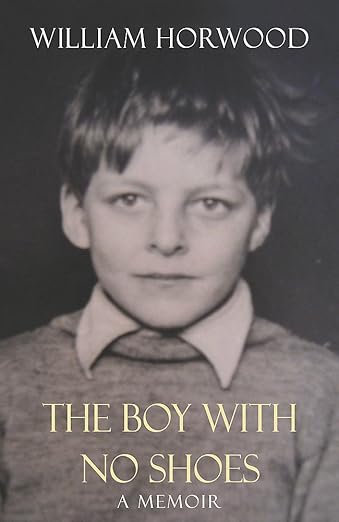
The Boy With No Shoes: a Memoir by William Horwood

Headline Book Publishing| 2004| Hardback edition| 440 pages| 5*

Five-year-old Jimmy Rova is the unwanted child of a mother who rejects him, and whose other children bully him. The one thing he can call his own is a pair of shoes, a present from the only person he feels has ever loved him. When they are cruelly taken away, Jimmy spirals down into a state of loneliness and terrible loss from which there seems no recovery.

This triumphant story of a boy’s struggle with early trauma and his remarkable journey into adulthood is based on William Horwood’s own remarkable childhood in south-east England after the Second World War. Using all the skills that went into the creation of his modern classics, Horwood has written an inspiring story of a journey from a past too painful to imagine to the future every child deserves. (Amazon)

William Horwood is an English novelist. He grew up on the East Kent coast, primarily in Deal. His first novel, Duncton Wood, an allegorical tale about a community of moles, was published in 1980. It was followed by two sequels, forming The Duncton Chronicles, and also a second trilogy, The Book of Silence. William Horwood has also written two stand-alone novels intertwining the lives of humans and of eagles, The Stonor Eagles and Callanish , and The Wolves of Time duology. Skallagrigg, his 1987 novel about disability, love, and trust, was made into a BBC film in 1994. In addition, he has written a number of sequels to The Wind in the Willows by Kenneth Grahame.

When I saw The Boy With No Shoes on the secondhand bookshelves in my local village hall I thought I’d like to read it. It was a great choice as I think it’s one of the best books I’ve read this year. It’s important to read the Author’s Note carefully before you read the book, and not dive straight into it. I had to re-read it after I’d read a few chapters as I was beginning to wonder if this was really fictional. I also wasted time searching on maps to find where he lived growing up.

In his Author’s Note at the front of the book he explained why he wrote about himself as Jimmy Rova:

When I was thirty-four and had been iller than I knew for two long years, my recovery began in the strangest and most magical dream of ways. |I woke one day from dreaming and saw myself when very young, as clearly as in a black and white Kodak photograph. I saw how desperately the little boy I once was had needed someone to talk to in a world where no one wanted to listen. I decided there and then to travel back in time and let myself as adult be listener to the child. This book and my final healing is the result of that imaginative listening, over very many years.

Because the boy seemed other than himself he gave him a different name and changed the name of his home town. By so doing he was able to fill in gaps, paper over the cracks and visit distant places of emotion that he would never have reached.

It is a long and detailed book that took me nearly a month to read. It is beautifully written and as he tells the story of his very early life there are many times when it moved me to tears. His writing is so clear that the places and people he describes spring to life as you read. All the characters have depth and are believable as people.

He is just as good at portraying Jimmy’s feelings and emotions. I could feel his depth of despair, fear and confusion as he describes his first memory about the man in a time long ago who bought him a pair of shoes. That day entered his heart and stayed there forever. He called him The Man Who Was, the man who left him standing in the rain, holding his Ma’s hand, full of fear that he would not be there to keep him safe from Ma, who treated him appallingly, and he would be all alone. All that was left to him were the shoes. So, imagine how awful it was when the shoes disappeared, cruelly taken from him.

But life for Jimmy did eventually get better, especially when Granny came to live with them, but even she could not protect completely from his abusive Ma. I loved all the details of Granny’s time in Africa with ‘The African Gentleman’, who wore a funny hat on his grey and grizzled hair, and his clothes were striped black and yellow. In his hand he carried a wand like a magician. Also unforgettable is his first love, Harriet, and how his mother ended their affair.

There were others too who were kind to him. I loved his description of a new English teacher at the Grammar School, who in contrast to the Head and other teachers believed in the boys. He inspired Jimmy and transformed his life by showing him how to believe he could succeed and how to prepare for his O levels.

There were others too, His Uncle Max who took him hiking in Snowdonia. Moel Saibod was the first mountain he climbed and then others, including Snowdon, the tallest mountain in Wales and England. Then, Mr Boys who taught him to read, Mr Bubbles, a fisherman and his wife, who lived along the shore and taught him all about fishing. I could go on and on, but really if this interests you the best thing is to read the book for yourself. It is a wonderful book, that captures what life was like in the 1950s and even though my childhood was nothing like his, it brought back memories of growing up. I too, as a young woman) climbed Snowdon – Welsh name, Yr Wyddfa (I did not take the Snowdon Mountain Railway either up or down) and also Moel Saibod.