Happy Mother’s Day!

Today really feels like spring has well and truly arrived and it’s Mother’s Day ! My son surprised me with not just one book, but two:

First, a book that was wrapped in brown paper in the bookshop from a pile of ‘mystery’ books – just a brief description, but not giving the author or the title. It’s Present Tense: a Best Defence Mystery by WHS McIntyre. On the cover it’s described as;

Crime with an edge of dark humour. The Best Defence series could only come out of Scotland.’

Blurb:

Criminal lawyer, Robbie Munro, is back home, living with his dad and his new-found daughter. Life as a criminal lawyer isn’t going well, and neither is his love life. While he’s preparing to defend the accused in a rape case, it all becomes suddenly more complicated when one of his more dubious clients leaves a mysterious box for him to look after. What’s in the box is going to change Robbie’s life – forever.

Secondly, a beautiful book, The Crofter and the Laird by John McPhee, described in the Guardian:

McPhee is a grand master of narrative non-fiction.

Blurb:

In 1969, John McPhee moved his family from New Jersey across the Atlantic to live in the land of his forefathers, the island of Colonsay ‘“ seventeen square miles of dew and damp twenty-five miles off the coast of Scotland. They rented a crofthouse, his children enrolled at the local school, and they soon were accepted into this tightly circumscribed community of 138 people.

Intertwining history and legend, McPhee gives us a comprehensive portrait of this remote and misty land. He battles the fierce gales on the outer shoals of the Ardskenish Peninsula, listens to the crofters complain of the laird over drams in the island’s sole pub, and meets perhaps the last of the Great Highland bagpipers.

A blend of anthropology and travelogue, The Crofter and the Laird presents us with a perfect mirror of daily-life in the Highlands. McPhee writes with insight, sensitivity, and fondness for these hardy people ‘“ resulting in an account that’s as honest, humorous, and frank as the locals themselves.

Two very different books, both by authors new-to-me, and I’m looking forward to reading both of them. Thanks, Paul!

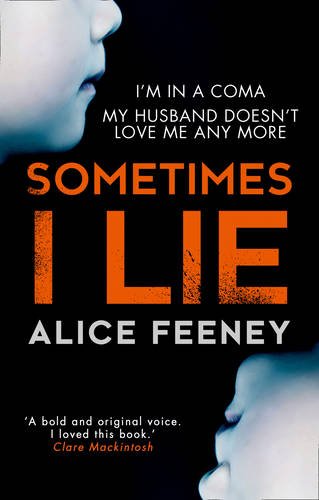
Sometimes I Lie by Alice Feeney

A gripping psychological thriller

Sometimes I Lie is Alice Feeney’s debut thriller. I usually take descriptions of books like this with a bit of scepticism: ‘Unnerving, twisted and utterly compelling, you won’t be able to put this new thriller down.’ But it really is like this – and I did find it utterly compelling.

I like complicated plots with believable characters and with twists and turns to keep me glued to the book. This book has all this and more. I was puzzled, stunned and amazed at the cleverness of the plot structure and how I’d had the wool pulled over my eyes, although I did have a suspicion of what it was all about, I just hadn’t worked out the whole truth.

I’m not going to say much about this book because I think it’s best to read it without knowing very much about it. It’s narrated by Amber Reynolds as she lies in hospital in a coma. She can’t move or speak, but she can hear and gradually she begins to remember who she is and what happened to her. But as the opening sentences reveal sometimes she lies. Actually it’s hard to figure out who is lying, who can be trusted and what really happened. There are flashbacks to what happened immediately before Amber ended up in hospital and there are diary entries from the early 1990s starting when Amber was nearly ten.

I thoroughly enjoyed Sometimes I Lie. It’s a complex, confusing, disturbing and brilliant book. I read it in just two sittings and when I got to the end I immediately had to turn back to the beginning and start reading it again.

Many thanks to the publishers and NetGalley for a review copy .

  • Format: Kindle Edition
  • File Size: 1872 KB
  • Print Length: 279 pages
  • Publisher: HQ (23 Mar. 2017)

Alice Feeney is a writer and journalist. She spent 16 years at the BBC, where she worked as a Reporter, News Editor, Arts and Entertainment Producer and One O’clock News Producer.

The Idea of You by Amanda Prowse

Blurb:

With her fortieth birthday approaching, Lucy Carpenter dares to hope that she finally has it all: a wonderful new husband, Jonah, a successful career and the chance of a precious baby of her own. Life couldn’t be more perfect.

But the reality of becoming parents proves much harder than Lucy and Jonah imagined. Jonah’s love and support is unquestioning, but as Lucy struggles with work and her own failing dreams, the strain on their marriage increases. Suddenly it feels like Lucy is close to losing everything’¦

Heart-wrenching and poignant, this latest work by bestselling author Amanda Prowse asks the question: what does it mean to be a mother in today’s hectic world? And what if it’s asking too much to want it all?

My thoughts:

I like variety in my reading and so when the publishers of Amanda Prowse’ The Idea of You offered me a review copy I thought from the description that it would make a change from the genres I usually read.

Amanda Prowse is a popular author, described by the Daily Mail as the ‘queen of domestic drama‘. And I can see from the numerous 5 and 4 star reviews on Amazon and Goodreads that many readers love her books.

The Idea of You is mainly about relationships motherhood, and it is emotionally charged with the devastating effect of miscarriages, but apart from that I was not convinced that the characters were real. The dialogue seemed to me to be forced and not true to life and so I felt as as though I was on the outside looking in and at times the characters of Lucy and her teenage stepdaughter, Camille, seemed to merge into each other.

The narrative is interspersed with letters Lucy writes and for a while it’s not that clear who she is writing them to. But reading the Prologue along with other clues that Amanda Prowse drops in along the way about Lucy’s past, gave me a good indication of who it was, so it was no surprise when the recipient is finally revealed. I also thought the story of Camille was too predictable given Lucy’s situation. And the ending left me with rather a sickly aftertaste. In fact I found much of the book is too cloying for my liking.

  • Format: Kindle Edition
  • File Size: 2642 KB
  • Print Length: 334 pages
  • Page Numbers Source ISBN: 1503942333
  • Publisher: Lake Union Publishing (21 Mar. 2017)
  • Source: review copy from the publishers via NetGalley

First Chapter, First Paragraph: State of Wonder

First chapterEvery Tuesday Diane at Bibliophile by the Sea hosts First Chapter First Paragraph Tuesday Intros to share the first paragraph sometimes two, of a book that she’s reading or planning to read soon.

This week I’m looking at State of Wonder by Ann Patchett, one of my TBR books on my Kindle and thinking of reading it next.

State of Wonder

It begins:

The news of Anders Eckman’s death came by way of Aerogram, a piece of bright blue airmail paper that served both as the stationery and, when folded over and sealed along the edges, the envelope. Who even knew they still made such things? The single sheet had traveled from Brazil to Minnesota to mark the passing of a man, a breath of tissue so insubstantial that only the stamp seemed to anchor it to this world. Mr Fox had the letter in his hand when he came to the lab to tell Marina the news. When she saw him there at the door she smiled at him and in the light of that smile he faltered.

“What?” she said finally.

He opened his mouth and then closed it. When he tried again all he could say was, “It’s snowing.”

Blurb:

Among the tangled waterways and giant anacondas of the Brazilian Rio Negro, an enigmatic scientist is developing a drug that could alter the lives of women for ever. Dr Annick Swenson’s work is shrouded in mystery; she refuses to report on her progress, especially to her investors, whose patience is fast running out. Anders Eckman, a mild-mannered lab researcher, is sent to investigate.
A curt letter reporting his untimely death is all that returns.

Now Marina Singh, Anders’ colleague and once a student of the mighty Dr Swenson, is their last hope. Compelled by the pleas of Anders’s wife, who refuses to accept that her husband is not coming home, Marina leaves the snowy plains of Minnesota and retraces her friend’s steps into the heart of the South American darkness, determined to track down Dr. Swenson and uncover the secrets being jealously guarded among the remotest tribes of the rainforest.

What Marina does not yet know is that, in this ancient corner of the jungle, where the muddy waters and susurrating grasses hide countless unknown perils and temptations, she will face challenges beyond her wildest imagination.

Marina is no longer the student, but only time will tell if she has learnt enough.

I can see why I bought this book – but why haven’t I read it yet? It looks so good. What do you think – would you keep reading?

The Spirituality of Jane Austen by Paula Hollingsworth

A celebratory book to mark the 200th anniversary of the death of Jane Austen in 2017

Blurb:

2017 marks the 200th anniversary of the death of Jane Austen, whose six completed novels have never been out of print. Best known for her novels, ‘Sense and Sensibility’, ‘Pride and Prejudice’, ‘Mansfield Park’, and ‘Emma’, first published anonymously, Jane commented, critiqued and illuminated the life of the English upper classes.

But did Jane’s writings highlight anything about her own spirituality? In this celebratory book, Paula Hollingsworth explores Jane Austen’s gentle but strong faith and the effect it had both on her life and her writing. Drawing on Jane’s life story, her letters, her friendships, her books and the characters portrayed, Paula shows the depth of Jane Austen’s spirituality.

Jane Austen has long been one of my favourite authors, so when I saw The Spirituality of Jane Austen by Paula Hollingsworth on NetGalley I was keen to read it. It’s a combination of a biography, which complements other biographies that I’ve read, and an analysis of Jane Austen’s works from the point of how they reveal her spirituality.

‘Spirituality‘, in Jane Austen’s day was used in the sense of the word ‘religious‘, but used in a narrower sense than we would today. It would have meant ‘Christian‘ and in particular almost exclusively ‘Protestant Christianity‘. In the Austen family that would mean the beliefs and practices of 18th century Anglicanism – ‘a faith that was tolerant and pragmatic, focusing on self-improvement and right behaviour, with a belief in change that comes not so much from miracles but through self-reflection and inner growth.’

With this definition in mind Paula Hollingsworth then considers Jane Austen’s letters, her early writings and novels, focusing on how they reveal Jane’s spirituality implicitly rather than explicitly, seeing parallels between her life and her writings. I enjoyed this way of looking at her novels in particular.

I think the last chapter in which Paula Hollingsworth considers modern adaptations and dramatisations of Jane Austen’s books is very interesting. Whilst they have brought her work to a wider audience it has meant that character development has been lost, or the values of the times in which the novels are set have been changed to make the story more acceptable to a modern audience.

And given that Jane Austen disliked Bath when she lived there, Paula Hollingsworth believes she would be disappointed by the focus on some of the activities and merchandise rather than on her books. She also considers the recent Austen Project books in which modern authors set the novels in the present day and the problems they have in making them credible to modern readers.

She describes the many ways people today can enjoy Jane Austen’s work, such as watching screen adaptations, dancing at a Regency Ball, reading books about Jane Austen and her world, dressing in Regency costume and parading through Bath and other events, but considers that the best way is to read the novels themselves and to read them slowly. I agree. I really enjoyed reading this book and it has made me want to re-read the novels, particularly those I haven’t re-read recently.

There are comprehensive notes on the chapters, an appendix of Jane Austen’s prayers and a select bibliography.

My copy is an ARC I received from the publishers, Lion Books via NetGalley. The paperback (240 pages) will be published on 24 March 2017.

The Gathering by Anne Enright

The Gathering by Anne Enright is her fourth book. It won the Man Booker Prize in 2007.

The Gathering

Blurb:

The nine surviving children of the Hegarty clan gather in Dublin for the wake of their wayward brother Liam. It wasn’t the drink that killed him ‘“ although that certainly helped ‘“ it was what happened to him as a boy in his grandmother’s house, in the winter of 1968.

The Gathering is a novel about love and disappointment, about thwarted lust and limitless desire, and how our fate is written in the body, not in the stars.

I’m sorry to say that I think The Gathering is one of the most dreary books I’ve read. It’s a dark and disturbing novel about a dysfunctional family. I didn’t enjoy it, which is a shame as it’s a book that’s been on my shelves since 2008 and one I chose to read this month as part of Reading Ireland Month, an event to ‘˜to celebrate the wealth and breadth and general awesomeness of Irish cultural life.’ 

It begins:

I would like to write down what happened in my grandmother’s house the summer I was eight or nine, but I am not sure if it really did happen. I need to bear witness to an uncertain event. I feel it roaring inside me – this thing that may not have taken place. I don’t even know what name to put on it. I think you might call it a crime of the flesh, but the flesh is long fallen away and I am not sure what hurt may linger in the bones.

The narrator is Veronica Hegarty and it is through her eyes that the Hegarty family story is told as they gather at her brother’s wake in Dublin. Liam, an alcoholic, had committed suicide by putting rocks into his pockets and walking into the sea at Brighton. The characterisation is fantastic and I had no difficulty seeing the people in my mind’s eye; the descriptions of their appearance and personalities are strong and detailed.

But how reliable is Veronica’s memory? She mixes up memories of herself and her sister for example and there is quite a lot that you have to read between the lines. There aren’t many certain facts, for example how much truth is there in Veronica’s account of the early years of her grandparents’ married life and of their friend Lambert Nugent? She relates episodes that I’m sure they wouldn’t have told their granddaughter. At one point Veronica does say:

It is time to put an end to the shifting stories and the waking dreams. It is time to call an end to romance and just say what happened in Ada’s house, the year that I was eight and Liam was barely nine.

It takes a long time before Veronica finally gets to say what happened and even then there is ambiguity. Veronica cannot stick to a chronology and describes events haphazardly just as they come to her mind. A stream of thoughts just pour out of her – which is all very well because that is how the mind works.  But I found it made the text disjointed as it moved swiftly backwards and forwards.

As the blurb says it is about ‘thwarted lust and limitless desire‘ and the focus is on the body, on death, on sex and sexual abuse, on alcoholism, on insanity and on secrets and betrayal, but not much about love. At times I found it depressing or boring.

  • Paperback: 272 pages
  • Publisher: Vintage; Reprint edition (20 Mar. 2008)
  • Language: English
  • ISBN-10: 0099501635
  • ISBN-13: 978-0099501633

When I finished The Gathering I wondered about the other books that were listed for the Man Booker Prize in 2007 – were the other books equally as depressing? This is what the judges thought about The Gathering:

Judges applauded The Gathering for its controlled prose, sentence by sentence. They were impressed by its figurative language. They wondered at how unflinching Enright was in the face of what was pretty grim, unappealing material. Would the subject matter deter readers? asked one judge. Was that a literary question? asked another.

So, it was the language they liked and I can see what they found to applaud there.  But I also thought that I had found the unappealing material a deterrent.

They concluded:

Enright’s novel had the support in depth and range other titles were not able to muster. It is, perhaps, a book people admire rather than immediately warm to, and this admiration won the day for her. Admiration for the unflinching ferocity of her vision and her skill with figurative language, admiration for the way in which she conveys feeling in carefully modulated prose which, sentence for sentence, matches anything being written in English today. Together we were happy to award her the prize on that basis. It was a collegiate decision. That is how it should be for the Man Booker.

Again I can see where they are coming from, but I prefer books that I can warm to as well as admire and I’m sorry but I just couldn’t warm to The Gathering, although I can admire its skill.

The other books on the shortlist were:

  • Darkmans by Nicola Barker – a book about love and jealousy and also about invasion, obsession, displacement and possession, about comedy, art, prescription drugs and chiropody.
  • The Reluctant Fundamentalist by Moshin Hamid – it traces the life and love of Changez, an idealistic young Muslim man who leaves Pakistan to pursue his education in the US.
  • Mister Pip by Lloyd Jones – a tale of survival by story set in Bougainville in 1991, a small village on a lush tropical island in the South Pacific where the horror of civil war lurked. Mr Watts introduces the children to Mr Dickens’ Great Expectations.
  • Animal’s People by Indra Sinah – ever since he can remember, Animal has gone on all fours, the catastrophic result of what happened on That Night when, thanks to an American chemical company, the Apocalypse visited his slum.
  • On Chesil Beach by Ian McEwan – It is June 1962. In a hotel on the Dorset coast, overlooking Chesil Beach, Edward and Florence, who got married that morning, are sitting down to dinner in their room. Neither is entirely able to suppress their anxieties about the wedding night to come.

They sound mainly a depressing bunch of books. I read On Chesil Beach,  in 2007 and didn’t blog about it in detail. As I remember it, it is a sad book too, but I loved it. I have Mister Pip waiting to be read.