It’s time again for Six Degrees of Separation, a monthly link-up hosted by Kate at Books Are My Favourite and Best. Each month a book is chosen as a starting point and linked to six other books to form a chain. A book doesn’t need to be connected to all the other books on the list, only to the one next to it in the chain.

This month starts with Orbital by Samantha Harvey, the 2024 Booker winner:
A team of astronauts in the International Space Station collect meteorological data, conduct scientific experiments and test the limits of the human body. But mostly they observe. Together they watch their silent blue planet, circling it sixteen times, spinning past continents and cycling through seasons, taking in glaciers and deserts, the peaks of mountains and the swells of oceans. Endless shows of spectacular beauty witnessed in a single day.
The fragility of human life fills their conversations, their fears, their dreams. So far from earth, they have never felt more part – or protective – of it. They begin to ask, what is life without earth? What is earth without humanity?
Yet although separated from the world they cannot escape its constant pull. News reaches them of the death of a mother, and with it comes thoughts of returning home. They look on as a typhoon gathers over an island and people they love, in awe of its magnificence and fearful of its destruction.
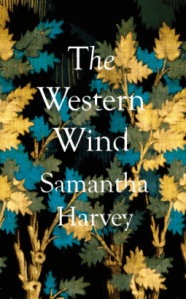
My first link is The Western Wind by Samantha Harvey. I came to the end of this book and immediately wanted to start it again. What seems at first to be a simple tale is actually a multi-layered and complex book. I really enjoyed reading it. It’s set in the late 15th century in a small village in Somerset. A man disappears, presumed drowned – but how and why did he die?
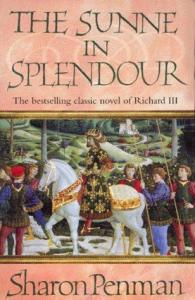
My second link is a book also set in the 15th century, The Sunne in Splendour by Sharon Penman, a fascinating novel about Richard III’s life from his childhood to his death at Bosworth Field in 1485. I think this is one of the best historical novels that I’ve read. It is full of detail, but Sharon Penman’s research sits very lightly in this book, none of it feels like a history lesson, and it all brings Richard’s world to life.

I’m staying in the 15th century for my third link, Red Rose, White Rose by Joanna Hickson, set in 15th century England during the Wars of the Roses when Cecily Neville was torn between both sides. Her father was Richard Neville, the Duke of Westmorland and a staunch Lancastrian and she married Richard Plantagenet of York and became the mother of Edward IV and Richard III. Told through the eyes of Cicely and her half-brother Cuthbert, this is the story of one of the most powerful women in England during one of its most turbulent periods.

For my fourth link I’m using the words ‘white rose‘ in the title and moving from the 15th century to the 20th with White Rose, Black Forest by Eoin Dempsey, a World War 2 novel. It’s told from the perspective of a German who opposed the Nazis and is set in the Black Forest, Germany in 1943, where Franka Gerber is living alone in an isolated cabin, having returned to her home town of Freiburg after serving a prison sentence for anti-Nazi activities.

My fifth link is to another novel set in World War 2 – Checkmate to Murder by E C R Lorac, a Chief Inspector Robert Macdonald murder mystery. What I found fascinating in this book is the insight into what life was like in wartime London, complete with the London fog and the details of the blackout and although the Blitz was over there were still plenty of bangs and noise so that a gunshot wasn’t easily heard.
For my final link I’m moving to London in the 19th century with Bleak House by Charles Dickens about the obscure case in the Court of Chancery of Jarndyce and Jarndyce. Here’s his description of fog in Chapter 1:
Fog everywhere. Fog up the river, where it flows among green aits and meadows; fog down the river, where it rolls defiled among the tiers of shipping and the waterside pollutions of a great (and dirty) city. Fog on the Essex marshes, fog on the Kentish heights. Fog creeping into the cabooses of collier-brigs; fog lying out on the yards and hovering in the rigging of great ships; fog drooping on the gunwales of barges and small boats. Fog in the eyes and throats of ancient Greenwich pensioners, wheezing by the firesides of their wards; fog in the stem and bowl of the afternoon pipe of the wrathful skipper, down in his close cabin; fog cruelly pinching the toes and fingers of his shivering little ‘prentice boy on deck. Chance people on the bridges peeping over the parapets into a nether sky of fog, with fog all round them, as if they were up in a balloon and hanging in the misty clouds.
My chain moves from the International Space Station to London in the 19th century and has travelled through the 15th century with a brief stop in the 20th century. The books are historical and crime fiction
What is in your chain, I wonder?
Next month (February 1, 2025), we’ll start with a classic – Dangerous Liaisons by Pierre Choderlos de Laclos.
 BooksPlease
You have some lovely historical novels here, Margaret. And your chain among the books is clever and interesting. I’ve not read Orbital, but it sounds intriguing.
LikeLiked by 1 person
Hm… you’re another person to link to another Samantha Harvey book, with high praise. I wonder why I never read her. Maybe I should. Lovely chain here.
LikeLiked by 1 person
I also started with The Western Wind this month, although I didn’t enjoy it as much as you did. I loved The Sunne in Splendour, though – it’s one of my favourite historical novels as well.
LikeLiked by 1 person
Fog is an appropriate link for me in Cornwall this morning. We have fog – not snow like most of the country! Great chain, Margaret.
LikeLiked by 1 person
Oh, I like this chain, stuffed full of books I think I’d like to read. Thank you!
LikeLike
Love the books on your chain and so cool about the ‘White Rose’ linking! WWII books are among my favorite type of reads so will be adding those to my TBR..
My post is here
LikeLike