I love doing Six Degrees of Separation, a monthly link-up hosted by Kate at Books Are My Favourite and Best. Each month a book is chosen as a starting point and linked to six other books to form a chain. A book doesn’t need to be connected to all the other books on the list, only to the one next to it in the chain.
This month the chain begins with The Beauty Myth by Naomi Wolf.

This book is described on Goodreads as the bestselling classic that redefined our view of the relationship between beauty and female identity. I haven’t read it and most probably won’t read it. So the first link in my chain is to a book about a mythical woman known for her beauty and for being the cause of the fall of Troy. It is

Helen of Troy by Margaret George, a modern retelling of the ancient myth of Helen, Paris and the Trojan War. Coincidentally we’ve been watching the BBC’s Troy: Fall of a City I’m never sure I really want to watch film or TV adaptations and yet I find myself drawn to them. This leads me on to
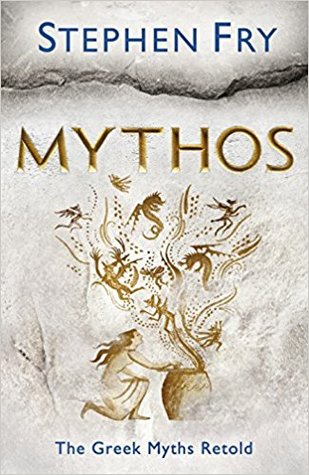
Mythos: The Greek Myths Retold by Stephen Fry, although he hasn’t included the details of the Trojan War – he begins at the beginning where the poets captured the stories told by the Greeks of their gods, monsters and heroes – but doesn’t end at the end.
But Fry does include the story of King Tantalus, who was punished for his crimes by being made to stand in a pool of water beneath a fruit tree with low branches, with the fruit ever eluding his grasp, and the water always receding before he could take a drink. A modern re-working of the story is in my next chain link:
![Tantalus: the sculptor's story by [Westwell, Jane]](https://images-eu.ssl-images-amazon.com/images/I/51PuH4TkwQL.jpg)
Jane Westwell’s novel, Tantalus is the story of two lovers are separated not by barriers of race, class or creed, but by something much more devastating – by time. They can see and can talk to each other but can never touch. Theirs is an impossible love as each is trapped in their own time and space.
Another modern version of one of the Greek myths is that of Penelope and Odysseus in
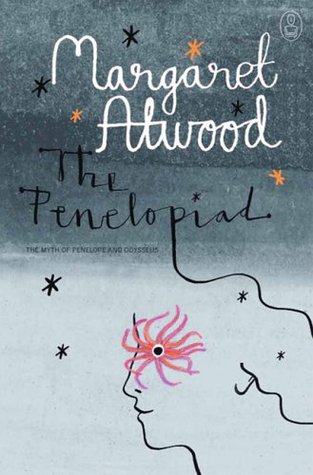
Margaret Atwood’s The Penelopiad: The Myth of Penelope and Odysseus, described by Mary Beard in the Guardian as ‘exploring the very nature of mythic story-telling.’ This is one of the Canongate Myth series of books – retelling Homer’s account in the Odyssey. It also links to Helen of Troy as she is Penelope’s cousin. Atwood’s version explores what Penelope was really up to whilst Odysseus was away for twenty years.
My next link is to another book in the Canongate series:

Weight: the Myth of Atlas and Heracles by Jeanette Winterson. Atlas, the guardian of the Garden of Hesperides and its golden apples, leads a rebellion against the Olympian gods and incurs divine wrath. For this the gods force him to bear the weight of the earth and the heavens for eternity. When Heracles, for one of his twelve labours, seeks to steal the golden apples he offers to shoulder the world temporarily if Atlas will bring him the fruit.
This brings me to yet another re-working of the Greek myths, about another Heracles – also known as Hercules, and his twelve labours:
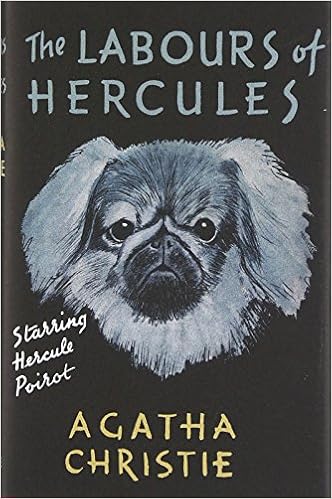
The Labours of Hercules by Agatha Christie is a collection of 12 short stories featuring Hercule Poirot, first published in 1947. The stories were all first published in periodicals between 1939 and 1947.
The labours of Hercules were set for the classical Greek hero by King Eurystheus of Tiryns as a penance. On completing them he was rewarded with immortality. Hercule Poirot is a very different figure from the Greek hero, Hercules, but there is one way in which they are alike – Christie writes: ‘Both of them, undoubtedly, had been instrumental in ridding the world of certain pests … Each of them could be described as a benefactor to the Society he lived in … ‘
Poirot has set himself the task of solving twelve cases corresponding to the Twelve Labours of Hercules, including The Apples of the Hesperides, in which Poirot’s apples are emeralds on a tree around which a dragon is coiled, on a missing Italian renaissance goblet. It seems that Poirot may have to go on a world tour to investigate locations in five different parts of the globe in order to retrieve the goblet.
My chain this month has the same link running through the book – that of myths. From the modern obsession with beauty back to ancient myths and their modern versions and ending with a collection of short stories of crime fiction based on the Greek myths.
Next month (April 7, 2018), we’ll begin with Arthur Golden’s bestseller, Memoirs of A Geisha.

 BooksPlease