It’s not often that I buy a book and start reading it straight away, mainly because I’ll be already reading one or more and also because I have a huge stack of unread books. But Bring Up the Bodies arrived in the post at just the right time, as I’d just finished reading one book and was ready for the next.
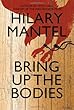 Bring Up the Bodies by Hilary Mantel is the sequel to Wolf Hall, which I read and loved in 2010. I’ve been looking forward to reading it ever since I finished reading Wolf Hall. So, even with a large backlog of books to be read, I just had to start Bring Up the Bodies straight away. It’s like catching up with friends you haven’t seen for a while – it begins in September 1535, just a few days after Wolf Hall finished. Thomas More was executed and now Henry VIII and his retinue are staying at Wolf Hall, the home of the Seymour family. And so, the story continues. This book covers the fall of Anne Boleyn, but like Wolf Hall, it’s about the career of Thomas Cromwell, Secretary to the king, Master of the Rolls, Chancellor of Cambridge University, and deputy to the king as head of the church in England.
I’m now on page 101, a quarter of the book read, and am trying to read it as slowly as possible, soaking up the atmosphere and Hilary Mantel’s richly descriptive words. Interestingly, I’ve noticed that every now and then, she qualifies who ‘he‘ is: ‘he, Cromwell‘, removing the ambiguity found in Wolf Hall. I hadn’t realised until I read the Author’s Note that this is not the end of Thomas Cromwell or the end of Hilary Mantel’s efforts to write about him:
This book is of course not about Anne Boleyn or about Henry VIII, but about the career of Thomas Cromwell, who is still in need of attention from biographers. Meanwhile, Mr Secretary remains sleek, plump and densely inaccessible, like a choice plum in a Christmas pie; but I hope to continue my efforts to dig him out. (page 410)
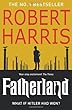 But I’ve also realised that I need to read Fatherland by Robert Harris, because this is the book we’ll be discussing at my face-to-face book group at the end of May and I hadn’t started it yet. So this morning I began to read it.
Whilst Bring Up the Bodies is most definitely historical fiction, Fatherland is more difficult to categorise. It’s set in Germany in 1964, but not the historical Germany of that date, because Hitler is approaching his 75th birthday, and Germany had won the Second World War – it’s historical fiction that never was – an alternative history. And yet many of the characters actually existed, their biographies are correct up to 1942 and Harris quotes from authentic documents in the book. The Berlin of the book is the Berlin that Albert Speer planned to build. What is definite is that this is a murder mystery, beginning with the discovery of the naked body of an old man, lying half in a lake on the outskirts of Berlin. The homicide investigator is Xavier March of the Kriminalpolizei and the victim is a member of the Nazi Party. It promises to be a thrilling page-turner.
I don’t think I’ll have any trouble reading the two books in tandem, as there’s no chance that I’ll mix up the characters or plots. :)
 BooksPlease
Hi Margaret,
I was listening to a very interesting discussion about the Hilary Mantel book, on the ‘Today’ programme on Radio 4, during my commute to work on Friday morning, so I shall be waiting for your review with interest.
I know that both of your books come from completely diverse genres, however, given the individual intensity of each of them, I don’t think that I would have been brave enough to attempt reading them in tandem. I really do prefer to read one book at a time, which I guess is why I don’t seem to post half as many reviews as other people.
Enjoy the rest of your weekend, Yvonne
LikeLike
Thanks, Yvonne. I’ll see if the Today programme discussion is available on iPlayer. I do like to have more than one book on the go, but often find I put the less compelling on one side whilst I finish the other. I wonder which one I’ll finish first.
LikeLike
Both your choices sound thrilling. Can’t wait to hear what you will decide by the end of them. Have a wonderful Sunday.
LikeLike
Thank you, Irene – I hope I’ll write about them soon.
LikeLike
I don’t read more than one book unless I must, but both of these books sound like good reads. I haven’t even read Wolf Hall yet – must get cracking. Like you, I’ve had some medical problems holding up my reading this year but reading is still the best escape. Hope you’re feeling well.
LikeLike
Thank you, Barbara and sorry you’ve had medical problems too. I hope you on the mend. I’m OK – but feeling tired today, and a bit sore.
LikeLike
I really must read Wolf Hall this year. The sheer size always makes me think twice about starting it, but from the things I’ve heard about it, it sounds like most readers still rip right through it. I also have had Fatherland on my pile for longer than I care to admit! :)
LikeLike
Danielle, I hope you do read Wolf Hall. It is long – longer than Bring Up the Bodies, but once I got into it I didn’t want to put it down.
LikeLike
I adored Wolf Hall, loved the length, her writing style, how Cromwell leapt at you off the page – I’d always thought him ruthless but a bit dull before – and can’t wait to get my hands on bring up the bodies, which will have to be when it comes out in paperback. Living in France I have to buy all my books and hardbacks are beyond the budget.
I read Fatherland shortly after it came out in the mid nineties and it’s a terrific read. Hope you enjoy it.
LikeLike