Taken at the Flood by Agatha Christie: a Book Review

I enjoyed Agatha Christie’s Taken at the Flood, on several levels. There is the murder and mystery level, but also a great sense of the times, set in post-war Britain, reflecting the mood of the population, and, on top of all, that the characters stand out for the most part as well-rounded, convincing people. There are plenty of references to the changing social scene, to the attitude towards women and foreigners and to the difficulties  of war heroes adapting to civilian life.

It was published in 1948, when the aftermath of the war is felt by some people as a restless dissatisfaction with life,  feeling ‘rudderless’ just drifting along and by others, who had ‘come into their own’ during the war, benefiting from the need to plan and think and improvise for themselves.

Lynn Marchmont is one of the people feeling ill at ease and nervous; she was aware of ill will, ill feeling:

It’s everywhere. On railways and buses and in shops and amongst workers and clerks and even agricultural labourers. And I suppose worse in mines and factories. Ill will. But here it’s more than that. Here it’s particular. It’s meant! (page 65)

There is certainly ill will in her family after her uncle, Gordon Cloade had died, killed in an air raid, and left the rest of the family ‘out in the cold’. They had all relied on him to help them out financially and expected they would inherit his wealth on his death. But Gordon had married Rosaleen, a young woman, whose brother, David Hunter has no intention of letting any of them have any money. Rosaleen has a chequered past and when a tall, bronzed stranger arrives in the village calling himself Enoch Arden, the question of his identity becomes of great importance. I didn’t know the reference to Enoch Arden, but knew it must be of significance when it stirs some poetical memory in David’s mind, from a poem by Tennyson. Then Enoch Arden is found in his room at the local inn, The Stag:

‘Dead as a doornail,’ said Gladys, and added with a certain relish: ‘ ‘Is ‘ead’s bashed in!’ (page 161)

Poirot is called in to help solve the crime. Was Enoch Arden was Rosaleen’s first husband, Robert Underhay or had Robert died in Africa, as she said? Would the family fortune remain with the Cloades? Is Rosaleen’s life in danger, are the Cloades wishing her dead?

It’s a baffling case and Poirot tells Superintendent Spence that it’s an interesting case, because it’s all wrong – it’s not the ‘right shape.’ Eventually, of course, he works it out and it is complicated as Spence complains, protesting when Poirot quotes Shakespeare. Poirot, however, explains that it is very Shakespearian:

… there are here all the emotions – the human emotions – in which Shakespeare would have revelled – the jealousies, the hates – the swift passionate actions. And here, too, is successful opportunism. “There is a tide in the affairs of men which taken at its flood leads on to fortune …” Someone acted on that, Superintendent. To seize opportunity and turn it to one’s own ends – and that has been triumphantly accomplished – under your nose, so to speak!’ (page 319)

Two New Acquisitions

I was really pleased to find these two books on recent visits to local bookshops.

First is Lilian Nattel’s The River Midnight. I’ve been reading Lilian’s blogs A Writer Reads and A Novelist’s Mind for a while and was interested in reading her books. Lilian also has a website with details of more of her books. Amazon UK has some copies of her first novel, The River Midnight for sale, the new ones at prices from £13.98 up to £40, with secondhand copies too, more reasonably priced (which you can see via my link to the book) and I was thinking about sending off for one. But I was thrilled to find a good paperback copy in The Border Reader Bookshop one of the local secondhand bookshops I visit, so I snapped it up. I love the cover.

It’s set in the tiny, fictional village of Blaska in Russian-occupied Poland at the end of the 19th century and the beginning of the 20th. Pogroms are a recent memory for the Jewish community, yet life in Blaska is rich and the bonds of friendship unbreakable. It’s a place where anything – even magic can happen (taken from the back cover).

The second book I was excited to find was from Barter Books, another favourite secondhand bookshop. I’d recently watched the film, Schindler’s List for a second time and was very moved by it – it had me in tears. So I wanted to find the book on which Steven Spielberg had based his film.  It was there at the top of a very high bookcase in the main body of Barter Books and D got up the step-ladders to retrieve it for me.

Thomas Keneally’s 1982  Booker Prize winning book was first published as Schindler’s Ark. It recreates the story of Oskar Schindler, a member of the Nazi party, who risked his life to protect Jews in Nazi-occupied Poland. He rescued more than a thousand Jews from the death camps.

Both books are based on real historical events, both set in Poland and about Polish Jews. Both have used contemporary sources and are based on historical research. Lilian has included  a selection of the sources she used and Thomas Keneally used a mass of Schindler material including testimonies of survivors, photographs of the period, documents, some of them produced by Oskar himself, copies of SS telegrams, and the famous list of Swangsarbeitslager Brinnlitz, Oskar’s second camp.  I think these two books go together and I’m planning to read them consecutively as soon as I can.

Saturday Snapshot

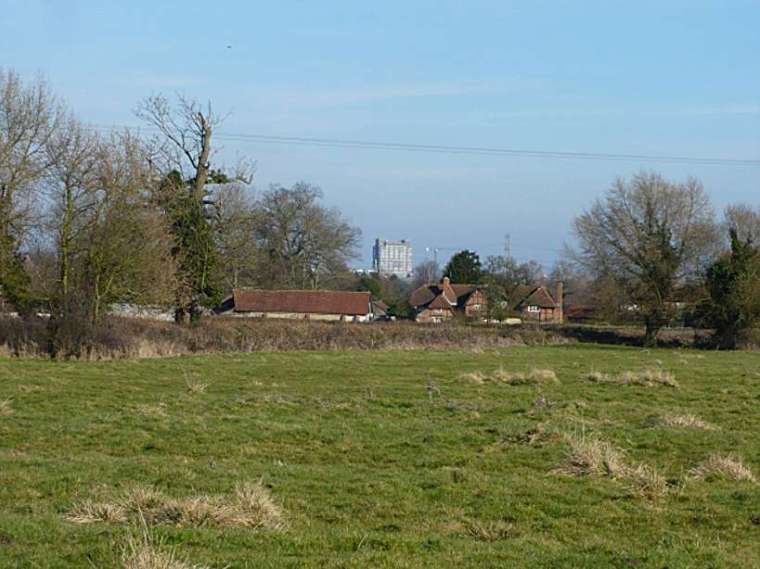
I have a scrolling photo viewer on the computer desktop and this photo greeted me this morning when I switched the computer on. It’s the view from the field near to my previous house looking towards the town of Aylesbury in Buckinghamshire. The grey tower block in the background is where I used to work at the County Council offices – I was on the 8th floor, just over halfway up the building.

I like this photo because it shows the contrast between the old and the new, although the County Hall tower block is not new, completed in 1966, it’s certainly centuries older than the timber-framed house in the foreground.

Believe it or not, the tower block, sometimes called Pooley’s Folly after the architect, is a Grade II Listed Building. It’s constructed out of concrete and glass and whilst I was working there it was discovered that the core of the building was crumbling and it had to be reinforced. We were surrounded by scaffolding for months. It’s also a most inconvenient building to work in, boiling hot in the summer, freezing in the winter, draughty windows and only two lifts serving 13 fours and no service lift. I spent hours in total over the years I worked there just waiting for the lift. Still, that meant I had more time to read whilst waiting.

Saturday Snapshot is hosted by Alyce of At Home with Books.

Book Beginnings: Life Support

Life Support by Tess Gerritsen is the fourth book I’ll be reading in the RIP IV Challenge. According to the back cover this is ‘a quick, delightfully scary read‘, which fits in well with the RIP challenge criteria.

It begins:

A scalpel is a beautiful thing.

Dr Stanley Mackie had never noticed this before, but as he stood with head bowed beneath the OR lamps, he suddenly found himself marveling at how the light reflected with diamondlike brilliance off the blade. It was a work of art, that razor sharp lunula of stainless steel. So beautiful in fact, that he scarcely dared to pick it up for fear he would somehow tarnish its magic. In its surface he saw a rainbow of colors, light fractured to its purest elements. (Page 13)

This will be the first book by Tess Gerritsen that I’ve read. It’s been on my bookshelves for quite a while now and I have been wary of reading it in case it’s too gory for me. I didn’t buy it, it was a free book with the magazine Woman and Home, which I buy now and then. When I read the Introduction I was even less sure this book was for me as Tess Gerritsen wrote that she got the idea for the book whilst at medical school (she is a doctor), when she heard the professor say the words ‘human cannibalism’ in his lecture on Creutzfeld-Jakob disease, a viral infection of the brain.

So I put this book way down on my to-be-read books, but since then I’ve read several favourable reviews of other books by Gerritsen so I thought I’d try this one. I like the style of writing in this first paragraph and it does make me want to read on, so when I’ve finished one of my current reads I’m going to start Life Support. Let me know what you think if you’ve read it?

Book Beginnings on Friday is hosted by Katy at A Few More Pages.

Blood Harvest by S J Bolton: a Book Review

I thoroughly enjoyed Blood Harvest, even though (or maybe because) it’s a dark, scary book and one that I found disturbing, but thoroughly absorbing . Each time I had to stop reading it I was eager to get back to it. I’ve previously read S J Bolton’s earlier books – Sacrifice and Awakening – and think that Blood Harvest surpasses both of those.

It’s set in the fictional town of Heptonclough in Lancashire and there is a very helpful map at the start of the book showing the layout of the town. There are two churches, the ancient ruined Abbey Church and standing next to it the ‘new’ church of St Barnabas. The Fletchers have just moved into a new house built on the land right next to the boundary wall of the churchyard:

The Fletcher family built their big, shiny new house on the crest of the moor, in a town that time seemed to have left to mind it’s own business. They built on a modest-sized plot that the diocese, desperate for cash, needed to get rid of. They built so close to the two churches – one old, the other very old – that they could almost lean out from the bedroom windows and touch the shell of the ancient tower. And on three sides of their garden they had the quietest neighbours they could hope for, which was ten-year-old Tom Fletcher’s favourite joke in those days; because the Fletchers built their new house in the midst of a graveyard. They should have known better, really. (page 17)

Tom has a younger brother, Joe and they’re playing in the graveyard when they catch glimpses of a girl watching them, and hear voices. Their little sister, two-year old Millie sees her too.  Tom is terrified, convinced something terrible will happen and then Millie disappears. Harry is the new vicar, getting to know the locals and their strange rituals and traditions. He too hears voices, in the church but can’t find anyone there. Evi, a psychiatrist has a new patient, Gillian, unemployed, divorced and alcoholic, who can’t accept that her daughter died in the fire that burnt down her home. The Renshaws own most of the land, old Tobias, his son Sinclair and his two daughters, Jenny and Christiana.

Heptonclough is not a good place for little girls, three have died over the past ten years and Christiana asks Harry to tell the Fletchers to leave:

‘So many little girls’, she said. ‘Tell them to go, Vicar. It’s not safe here. Not for little girls.’ (page 353)

It’s not safe at all for the Fletcher family. I was completely convinced not only by the setting but also by the characterisation that this place and these people were real. It’s full of tension, terror and suspense and I was in several minds before the end as to what it was all about. I had an inkling but I hadn’t realised the full and shocking truth.

An excellent book to read for Carl’s RIP IV Challenge.

Agatha Christie’s Birthday – A Celebratory Post

So much has been written about Agatha Christie’s life, her books, her houses, and so on and so forth, that I wasn’t sure what to write about for this post to celebrate the 121st anniversary of her birth.  Last year I wrote an A – Z of facts about her taken from her autobiography and the year before I visited her grave and wrote a bit about that and Winterbrook House, her house at Wallingford.

Looking for inspiration I came across the Agatha Christie: Official Centenary Celebration 1890- 1990, which is a mine of information with articles about Agatha Christie to celebrate her life and work. Along with lists of her books, plays, films and TV adaptations (up to 1990) there are articles about her poetry, life before the First World War, her family life, the actors and actresses playing the roles of Poirot and Miss Marple, including many fascinating facts and photographs.

For example there is this “Confession” reproduced in Michael Parkinson’s Confession Album, 1973 in which famous people filled in a questionnaire about their likes and dislikes. The reproduction in the book is indistinct and I can’t make out some of the words but here are some of Agatha’s favourite things and her greatest misery:

  • My ideal value: Courage
  • My idea of beauty in nature: A Bank of Primroses in Spring
  • My favourite qualities in men: Integrity and Good Manners
  • My favourite qualities in women: Loving and Merry
  • My greatest happiness: Listening to Music
  • My greatest misery: Noise and Long Vehicles on Roads
  • My  favourite authors: Elizabeth Bowen Graham Greene
  • My favourite actors and plays: Alec Guinness  Murder in the Cathedral
  • My favourite quotation: Life is a pure flame and we live by an invisible sun within us – Sir Thomas Browne
  • My favourite state of mind: Peaceful

There is also an article by Mathew Pritchard – Agatha Christie – a Legend for a Grandmother, which reveals that

She was an intensely private kind of person, who listened more than she talked, who saw more that she was seen, and whose perception, humour and enjoyment of living was in many ways the opposite of what you might expect from the nature of her stories. Her family was what she prized most – I think she regarded our summers together as a reward in part for the completion of another Christie for Christmas which had usually taken place by May or June each year and partly as relaxation from the strenuous archaeological tours she undertook with her husband Max Mallowan most springs during the 1950s. We all looked forward to them, I as a schoolboy more than most.

Amongst other memories he  wrote about her plays in the West End, and her house in Wallingford where he took school friends, who were all impressed by her modesty, friendliness and the interest she took in what they were doing. He revealed that her greatest passion apart from reading and writing was music (see her greatest happiness, above) and remembered her singing  and their visits to the opera, visiting Bayreuth together to see a production of Wagner’s Parsifal.

One strand of Agatha Christie’s work that I’m not familiar with is the books she wrote under the pseudonym Mary Westmacott. Her daughter Rosalind Hicks explained how she had chosen the name – Mary was Agatha’s second name and Westmacott the name of some distant relatives. She managed to keep her identity as Mary Westmacott unknown for fifteen years. She wrote six books under this name:

  1. Giant’s Bread, published in 1930, a novel about Vernon Deyre and his obsession with music, in line with her love of the musical world. She had been trained as a singer and a concert pianist.
  2. Unfinished Portrait (1934), based on her own experiences and early life.
  3. Absent in the Spring (1944), which was for Agatha the most satisfying book she wrote, about a woman alone in the desert finally coming to recognise what she was really like.
  4. The Rose and the Yew Tree (1947), which Rosalind described as a favourite of both Agatha and herself.
  5. A Daughter’s a Daughter (1952) about the battle between a widowed woman and her grown-up daughter.
  6. The Burden (1956), the story of the weight of one person’s love on another.

Rosalind didn’t think it was fair to describe them as ‘romantic novels’, nor yet ‘love stories’, but books about ‘love in some of its most powerful and destructive forms.’ Definitely books I’m going to seek out.

See more celebratory birthday posts at the Agatha Christie Blog Challenge Celebration.