Teaser Tuesday – The Tent, the Bucket and Me

I’m reading Emma Kennedy’s The Tent, the Bucket and Me.  As the subtitle explains this is about her ‘Family’s Disastrous Attempts to go Camping in the 70s‘, and that is not an understatement. I wish that I had the same powers of recall as Emma does to remember what I thought, felt and said at the age of 3. Emma is of course, writing comedy. It reminds me of those TV programmes that make you think ‘this just wouldn’t happen in real life’. I’m not saying that what she writes about didn’t happen, but I do suspect it’s been embellished somewhat.

Emma Kennedy would be great on Rob Brydon’s programme Would I Lie to You? All the events she describes would be ideal for the programme because no-one would believe they were true from the way she describes them. Passages in this book both make me laugh out loud and groan at the stupidity that led up to them. Just imagine you’re three, you’re drenched in wee (from a bucket full of the stuff that had tipped over when you tried to sit on it) and your parents told you to run naked round the car in a howling gale to wash off the wee! And that was Emma’s introduction to the joys of life under canvas.

There are more than enough toilet incidents, but these are not the only disasters that befall Emma and her teacher parents Tony and Brenda.  Having put up a frame tent in a howling gale in a field on the side of a cliff they abandon the tent and break into an empty caravan on the campsite, only to find that it went from bad to worse. The caravan was ‘ a stinking hole’, the back window blew out and, fighting against the wind the front end of the  caravan came off its bricks. They managed to jump out just as:

The caravan groaned; a deep crunch shattered out from its underbelly. With one terrifying yaw, the rear cracked up to the verical, tipped over and then rolled end over end, crashing down the field, metallic smashes punching through the howling wind. Then with one sliding finale, the caravan fell off the edge of the cliff.

‘We’re in hell!’ wailed Mam, as she watched it go. ‘Hell!’ (page 37)

They’d been in the eye of a force-ten gale, without realising it. Nothing daunted they carry on camping (holidays, that is) for the next 9 years.

Weekly Geeks – What Makes an Author Last?

This week’s discussion topic is inspired by the fact that on September 15 the world celebrates the 120th anniversary of the birth of Agatha Christie.

Have you read Christie’s books? Recently? What do you think it is about them that has given them such lasting value?
Or perhaps you have another favourite author whose works have outlasted those of their contemporaries? Maybe you’re a fan of Charles Dickens whose work is still widely known and studied while those of his contemporary, Edward Bulwer-Lytton, languish in relative obscurity.
What do you think it is that gives your favourite long-lasting author an edge? Is longevity all to do with quality? Quantity? Style perhaps? Or luck?
Agatha Christie is a great favourite of mine. I read a great many of her books as a teenager when I first came across her books and I’ve been taking part in the Agatha Christie Reading Challenge – my contribution to the current blog tour will be 22 September.

I’ve already written quite a lot about Agatha Christie’s books so for this post I thought I’d I’d write about another favourite author – Jane Austen. I first read Pride and Prejudice even before I knew anything about Agatha Christie. I can’t compare the two because they are so different – Jane only wrote six novels, Agatha over 80, Jane’s are romantic fiction, whereas Agatha wrote crime fiction, and so on.

Jane Austen’s lasting appeal is certainly down to the quality of her writing. Her characters are timeless. She portrays flirts, bores, snobs, the self-centred and foolish people as well as high-principled characters such as Jane Bennet (in Pride and Prejudice), who is determined to see good in everyone.  Her characters are amusing and well drawn, with great depth so that we are convinced of their reality. But her books aren’t sentimental and they are full of wit and humour. She writes about serious subjects treating them with humour and irony. In fact she delighted in a sense of the ridiculous, with such characters as Lady Catherine de Burgh and Mr Collins (Pride and Prejudice). And then there is Mr Darcy, handsome and aloof, a man who has won the heart of many women readers and also TV viewers with Colin Firth’s portrayal in the 1995 TV production.

Jane Austen’s England was at war with both America and France and the French Revolution was being fought across the Channel, but little of this is seen in her novels, just as it didn’t directly affect much of the nation. England was then largely a rural, agricultural society and Jane’s characters live in that world – a world of social inequality, one in which the role of women was very different from that of today. And for me this too is part of her appeal. She takes me into that world as I read her books. And yet because she was more interested in relationships, courtship, love and marriage than in national or international affairs her work has a timeless quality.

Her popularity is widespread from the academic to the popular. Her books are studied in schools and universities and they have been dramatised for the stage, TV and radio, and made into films and musicals. The first stage production was the 1906 play of Pride and Prejudice. In 1940 it was made into a film starring Laurence Olivier as Mr Darcy and Greer Garson as Elizabeth. Later two musicals of Pride and Prejudice were produced called First Impressions, Jane Austen’s first title for the book. Since then numerous TV productions of all her books have been made, and sequels, prequels and adaptations galore. More recently Pride and Prejudice has entered the zombie world with Pride and Prejudice and Zombies, (a book I cannot bear the thought of reading!) and also Bollywood with Bride and Prejudice.

There are numerous biographies, Jane Austen clubs and societies, in the United Kingdom, Australia and North America. The Jane Austen Centre in Bath, the Cobb at Lyme Regis and the house she lived in at Chawton are places of pilgrimage for her fans. And there are several blog sites dedicated to celebrating Jane Austen’s work, including:

Writing this has made me want to re-read her books and read for the first time The Watsons, Lady Susan and Sanditon. I also have Jane Austen’s Letters to read.

Borrowed Books

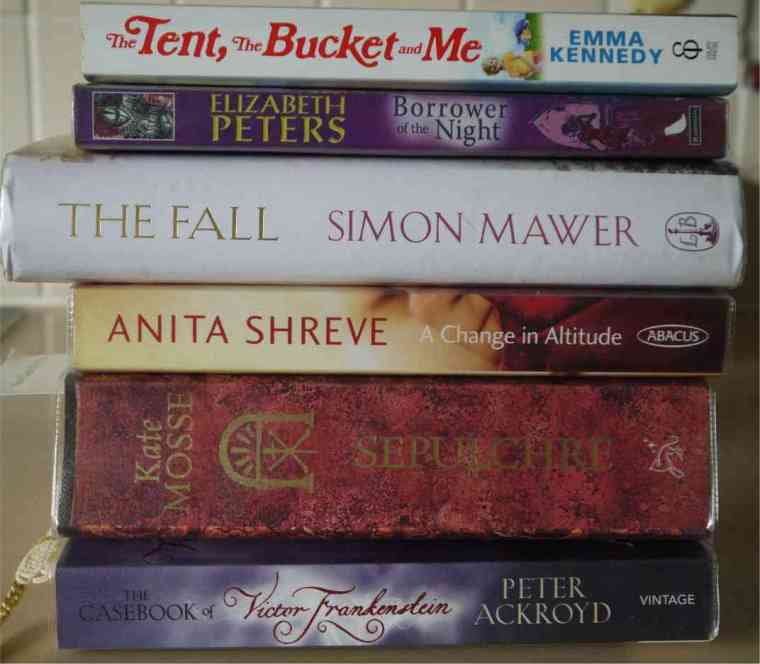
The mobile library came last week. I wasn’t going to borrow many, if any books, but there were some on the shelves that looked interesting and the van isn’t coming again until 21 October so I thought, why not borrow them. Then we went to our granddaughter’s 10th birthday party on Saturday and our son lent me a book too. It’s the top one in the pile shown below. Finally we went into town yesterday and as I returned a book to the library there I had a quick look round and borrowed the book at the bottom of the pile.

Borrowed Books

From top to bottom they are:

  • The Tent, the Bucket and Me: My Family’s Disastrous Attempts to go Camping in the 70s by Emma Kennedy. Apparently (I say this because I haven’t got that far in the book) they go to Carnac where we also went camping (well in a caravan) in the 80s. I checked on Amazon and this book has widely different reviews – some love it and think it very funny and others think it’s dreadful and not at all funny. I wonder which ‘camp’ I’ll be in.
  • Borrower of the Night: a Vicky Bliss Murder Mystery by Elizabeth Peters. I haven’t read anything by Elizabeth Peters, but as I’ve seen some reviews on a few blogs, I thought I’d have a look at this one. I haven’t started it yet. Vicky Bliss is an art historian, beautiful and brainy, according to the back cover. This one is about a search for a missing masterwork in wood by a master carver who died in Germany in the 16th century.
  • The Fall by Simon Mawer. I’ve read one other by by Simon Mawer – The Gospel of Judas, which I’d enjoyed. The Fall is the story of Rob and Jamie, friends from childhood, with a passion for mountaineering and climbing. From just a quick look at it, I see that it begins in Snowdon (another place where went on holiday and have camped and climbed (well D climbed, I just walked). Jamie and Rob take on greater challenges, culminating in the Eiger’s North Face. The jacket description appealed to me: ‘a story that captures nature at its most beautiful and most brutal, and which unlocks the intricacies at the heart of human relationships.’
  • A Change in Altitude by Anita Shreve. I’ve not been too keen on the latest books by Anita Shreve, although I loved her earlier ones, so I thought I’d borrow this one rather than buy it. I have started to read it, but just a few pages in it hasn’t ‘grabbed’ me yet. It’s about two couples on a climbing expedition to Mount Kenya when a horrific accident occurs.
  • Sepulchre by Kate Mosse. I read Labyrinth a few years ago (before I began this blog) and at the time I noted that it was ‘OK but too long’. So this is another book I decided not to buy, but if I saw it in the library I’d borrow it. It is enormously long! So far I’ve read a few chapters, set in 1891 in Paris and I’m not sure whether I’ll ever finish it. It’s a time-split book, divided 1891 and 2007, ‘the story of a tragic love, a missing girl, a unique set of tarot cards and the strange events of a cataclysmic night.’ (from the back cover)
  • The Casebook of Victor Frankenstein by Peter Ackroyd. I’ve always enjoyed Peter Ackroyd’s books and this one looked like a candidate for the RIP Challenge (as does Sepulchre). So far I’ve read about Victor Frankenstein’s love of learning and his desire to know the secrets of nature and the source of life. He has met Shelley at Oxford University, attended lessons at the dissecting room of St Thomas’s Hospital in London and is fascinated by Humphrey Davy’s experiments with electrical experiments. So far, so good. This book also has very mixed reviews on Amazon and in the press – the Guardian, ‘disappointing‘ and the Telegraph, ‘a brilliant jeu d’esprit.’

The links are to Amazon.co.uk (except for the press reviews). The only book to get consistent reviews on Amazon is The Fall. I don’t take much notice of these reviews, unless I know the reviewer, but I find it interesting to read such varying responses.

The Naming of the Dead by Ian Rankin: Book Review

As the police prepare for the G8 Conference at Gleneagles in July 2005, DI Rebus is apparently surplus to requirements, not much more than a year away from retirement. No-one would blame him for coasting, but that’s not his way. The Naming of the Dead begins with a funeral, that of Michael, Rebus’s brother which fills him with remorse and nostalgia. But true to form he puts work before family when DS Siobhan Clarke phones to tell him of progress in the search for Cyril Colliar’s killer.

Colliar had been killed six weeks earlier and his death was the first in a series of killings of convicted rapists who had recently been released from prison. Items of clothing were found at the Clootie Well, leading forensics to identify the victims. The police had not gone overboard in trying to find the killers, but Colliar was one of Big Ger Cafferty’s men, and the gangleader wants his killer found. He leads Rebus and Siobhan to BeastWatch , a website giving details of rapists and their release dates.

Matters are complicated by the death of Ben Webster, a Labour MP at the conference. He fell from the ramparts of Edinburgh Castle. It’s not clear whether his death was an accident, suicide, or murder. Rebus’s investigation is hampered by Steelforth from Special Branch. Siobhan’s attention is diverted when her parents arrive in Edinburgh to take part in the protests and her mother is injured. Siobhan is determined to find the culprit, particularly if it’s one of the police. Then there is the local councillor Gareth Tench, who gets involved and is then killed.

As with all of Ian Rankin’s Rebus books this has a convoluted plot, with several sub-plots and many characters. Rebus as ever, is dogged and determined, cynical and weary, fighting against the odds and wishing for and fearing his retirement – what would he do? Cafferty and Rebus have their usual sparring matches and Siobhan seems to be drawn into Cafferty’s web.

There is an emphasis on family relationships and loyalties, and reflections on power and the effects of the loss of power as both Rebus and Cafferty are feeling their age:

It struck Rebus that what Cafferty feared was a loss of power. Tyrants and politicians alike feared the self-same thing, whether they belonged to the underworld or the overworld. The day would come when no one listened to them any more, their orders ignored, reputation diminished. New challenges, new rivals and predators. Cafferty probably had millions stashed away, but a whole fleet of luxury cars was no substitute for status and respect. (page 257)

For me there is too much in this book about the G8 conference and the political scene and I got restless in the middle of the book because of that. But overall I enjoyed this last but one book before Rebus finally retires.The title comes from the ritual of reading out the names of a thousand victims of warfare in Iraq. Siobhan reflects that this summed up her whole working life.

She named the dead. She recorded their last details, and tried to find who they’d been, why they’d died. She gave voice to the forgotten and the missing. A world filled with victims, waiting for her and other detectives like her. Detectives like Rebus too, who gnawed away at every case, or let it gnaw at them. Never letting go, because that would have been the final insult to those names. (page 135)

Disaster! – Booking Through Thursday

Today’s Booking Through Thursday’s question is:

You’ve dropped your favourite out-of-print book in the bath, ruining it completely … what do you do?

I have done this with a library book. My immediate reaction was to panic and fish the book out of the water, abandon the bath and try to dry the book. Of course, it was useless, the book had been completely submerged. I had to take it back to the library and confess what I’d done. This was not the only library book I had to take back ruined. The second was one our dog had chewed. In both cases I had to pay for replacement books.

So after the bath disaster I’ve never read in the bath again.

It’s so difficult to replace a favourite book because even if I could find a second-hand copy it wouldn’t have the same meaning for me. I lost my copy of Robert Louis Stevenson’s A Child’s Garden of Verses that I had loved as a child. I have bought a replacement copy, but somehow it doesn’t have the same sentimental value for me, although it is better than not having it at all.