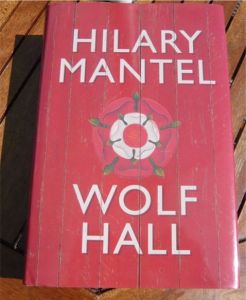
I began reading Wolf Hall last year and at first I found it hard to get interested in it. For one thing it’s written in the present tense and that usually jars with me and then it’s so physically big and heavy. So I put it to one side whilst we moved house, only going back to it recently.
I’ve referred to the book in a few posts including one on a small extract containing the word waffeting and one on my thoughts as I was reading it. Now I’ve finished it I can reflect on it as a whole. Overall, despite being written in the present tense and despite the over-frequent and confusing use of the pronoun ‘he’, I think it’s one of the best books I’ve read this year, if not the best one. It is satisfying in depth and breadth, with a host of characters and detail.
It is, of course the story of Thomas Cromwell, the son of a blacksmith, and his political rise, set against the background of Henry VIII’s England and his struggle with the Pope over his desire to marry Anne Boleyn. It’s a brutal time. What I found most enjoyable was the way this book transported me back to that time, with Mantel’s descriptions of the pageantry, the people, the places and the beliefs and attitudes of the protagonists. My knowledge of the period has been built up over time, from history lessons at school, films, books and TV series and it all seemed secondhand. In this book you are there in the thick of it all. Here, Thomas More is not the saint I thought he was from watching ‘A Man for All Seasons’, Anne Boleyn is a coy, flat-chested, manipulator and schemer and Thomas Cromwell is not the hard hearted, cold and stern character I’d read about before, but is humane, kind and considerate, taking care of his family whilst weaving his way through the intricacies of court life. He is hardworking, generous and cultured. But he is tough and ruthless too. Here Chapuys, the French ambassador is talking to Cromwell after Anne’s coronation:
‘Well, you have succeeded where the cardinal failed, Henry has what he wants at last. I say to my master, who is capable of looking at these things impartially, it’s a pity from Henry’s point of view that he did not take up Cromwell years ago. His affairs would have gone on much better. … When the cardinal came to a closed door he would flatter – oh beautiful yielding door! Then he would try tricking it open. And you are just the same, just the same.’ He pours himself some of the duke’s present. ‘But in the last resort, you just kick it in.’ (page 465)
The descriptions of Cromwell’s house, Austin Friars, and his family brings it all to life, the reality of the daily lives of ordinary people as well as of the court. I wondered about Austin Friars, whether it still exists and found an article by Mantel in the Timesonline where she writes:
Very near the Bank of England, at the foot of the glass cliff of Tower 42, there is a secret city garden that now belongs to Draper’s Hall. A plaque on the wall says: ‘On this site, once part of the Augustinian Priory, Thomas Cromwell built his palace and in 1536 plotted the downfall of Anne Boleyn, second wife of Henry VIII.
“Palace’ is perhaps an inflation. The building at Austin Friars was an opulent merchant’s house, which from 1530 accreted new wings, storerooms, strongrooms, and tighter and tighter security. It was a powerhouse of Tudor politics, and over a decade, its master became one of the richest and most powerful men in England: councillor and secretary to the king, Master of the Rolls, Lord Privy Seal and eventually Earl of Essex. Austin Friars was not a quiet spot. Twice a day, 200 of London’s poor swarmed to the gate to be fed by the great man’s kitchen.
I’m still a bit puzzled about the title – why Wolf Hall, when Wolf Hall, the home of the Seymour family hardly figures at all in the book. It could be that it is symbolic of the times, when ‘man is wolf to man’ (page 572). The Seymour family is a seemingly of little significance, sneered at by Anne as ‘those sinners at Wolf Hall.’ But there are tantalising glimpses of Jane Seymour at the court, ‘ a little pale girl … the sickly milk-faced creeper’ who Anne calls ‘Milksop‘ and thinks no one will ever want, let alone Henry! The future is signalled as the book ends, with Cromwell’s intention to visit Wolf Hall.
As well as being shortlisted for the Orange Prize for Fiction, Wolf Hall is also shortlisted for the Walter Scott Prize for Historical Fiction.
I hope it’s not too long before her second book on Cromwell is published, taking his story up to his execution in 1540 .


 out today with 30 contributions from 11 contributors in a bumper edition. It also includes my post on Christie’s Passenger To Frankfurt. This month’s carnival has a new feature – A Featured Blog kicking off with Margot Kinberg’s remarkable blog
 Revenge Served Cold by Jackie Fullerton was kindly sent to me by the publishers, Thomas House Publishing. It’s her second book featuring Anne Marshall, a part-time court reporter and law student. I think it slots into the “cozy mystery” category, with the crime being solved by amateur sleuths rather than the police, who are always one step behind. If there is a category for “paranormal crime fiction” that applies too. In some respects it reminded me of that TV series – Randall and Hopkirk (Deceased), a remake with Vic Reeves of a 60s TV series about private detectives, one of whom was dead and appearing in a white suit could only be seen by his partner.


 BooksPlease