Sunday Salon – Today’s Reading

Today I’ve been reading Semi-Detached by Griff Rhys Jones (a book I borrowed from the library). This is his memoir of his childhood and adolescence and I’m enjoying reading it. I had a look at what people have written about it on Amazon and found it has some very disparaging comments. I completely disagree – this is not boring or dull, and not at all a ‘celebrity’ memoir. I’ll leave writing about it until I’ve finished it, apart from this little bit about swimming and diving in his local swimming pool. I can identify so much with his account of the diving boards. The diving boards were made up of a lower board and a high dive. And it was scary on the high board. It was best to jump off it first before attempting a dive. Griff describes the experience of his first jump, that ‘sinking, sick-making descent’:
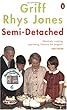
I must have stood there taking counsel and advice for ten minutes before I finally went off for the first time, in a sudden fit of bravado: still talking, without anybody having the chance to advise me, I stepped straight off the edge and fell … arrgh: my internal organs apparently losing their adhesion to my lower abdomen.

I bobbed up quickly and swam frantically, over-energised, to the side and went straight back up. (page 80)

That was me too! I loved it, but how times have changed. My last experience in a swimming pool last year at Center Parcs in Nottingham was terrifying when I went down the flume. It was a rapid descent and I was pushed along by people behind me, ending up underwater, certain that I was going to be drowned and hating the whole thing.

My other reading this morning was The Widow’s Tale by Mick Jackson, a book I received from the publishers via LibraryThing’s Early Reviewers’ Program. This a gentle account of a newly-widowed woman who is coming to terms with her husband’s death after 40 years of marriage. It’s about her thoughts and feelings as she flees  from her London home to rent a cottage in a small Norfolk village.  I have my doubts about the narrator’s voice – at times it comes across as male rather than female, but I’m waiting until I’ve finished it to pass judgement.


Weekend Cooking

Weekend Cooking is open to anyone who has any kind of food-related post to share: Book (novel, nonfiction) reviews, cookbook reviews, movie reviews, recipes, random thoughts, gadgets, fabulous quotations, photographs.

As it’s Easter my contribution this week is Simnel Cake. This recipe is from Marguerite Patten’s Everyday Cook Book in Colour, which was first published in 1968. It was the first cookery book I bought and I’ve used it extensively ever since.

The ingredients are the same as a Rich Dundee Cake (fruit cake). You put half the cake mixture into an 8 inch round cake tin, put a layer of marzipan on top of that and then add the remaining cake mixture. Bake for 2 to 2½ hours at 160°C or Gas 3. When cold brush the top with egg white or apricot jam and cover with a round of marzipan. Traditionally this is decorated with eleven marzipan balls, representing the eleven disciples (leaving out Judas), or sugared eggs, or chicks.

Originally Simnel Cake was made for Mothering Sunday, but it has now become an Easter Cake. Nigella Lawson’s beautiful book Feast: Food that Celebrates Life also has a recipe for Simnel Cake and she uses a light fruit cake mixture and after decorating the cake with marzipan she paints it all with egg white and blow-torches it to give it a burnished look. I haven’t tried that.

Cozy Mystery Challenge

The Crime Fiction Alphabet has just two more letters to go and I was wondering whether there would be another crime fiction challenge I could join and today I found this one on Margot’s blog Joyfully Retired.

It’s the Cozy Mystery Challenge, which is run by Kris from  Not Enough Books. She describes a cozy mystery as

 a mystery that doesn’t normally have any rough language, sex scenes, or gruesome details about the killing, and the main character is normally an amateur detective.

It sounds good to me. The challenge is to read at least  least 6 cozy mysteries between April 1st, 2010 and September 30, 2010. I think I can manage that.

April Fool – Booking Through Thursday

btt   button

Deb has asked a variety of questions for today.

  • Who’s your favorite ‘fool’ of a character, and why?
  • What authors have fooled you? By a trick plot twist? By making you think their book was any good when it wasn’t?
  • What covers have fooled you into reading books you hated €¦ even though the covers were wonderful?
  • What’s the best April Fool’s Day trick you’ve ever seen/heard about/done?

Choose the one you like best. Or answer all of them! Or make up your own.

I was fooled by Margaret Forster’s book, Diary of an Ordinary Woman, or rather I fooled my self.

Even though it is clear from the front cover that this is a novel I started reading it thinking it really was the diary of Millicent King, a woman born in 1901 who had kept a diary from the age of 13 until she was 94. I think the fact that it has an ‘Introduction’ was partly to blame where the narrator explained how she had come across the diaries and was intrigued enough by them to ‘make something of them’ and how she had met Millicent just before her death. The ‘diary’ records the events of the Great War as it touched her family, on through the 20s and 30s in London and then to the Second World War where Millicent drove an ambulance through the bombed streets of London.

It’s written in diary format with added information from the ‘editor’. It was only when I came to read the later part of Millicent’s ‘life’ that I began to wonder if this woman could possibly be real and have been involved in so many of the great social upheavals and dramas of the times and I began to suspect that this was fiction.  That should teach me to read book titles more closely and look at the front covers properly!

Nevertheless this is very good book and I enjoyed it enormously, although I did feel a little sad that Millicent wasn’t a real person.

As for covers I don’t think I’ve ever been fooled by one – as I don’t really look at them very carefully.

Raven Black by Ann Cleeves: Book Review

Raven Black is the first book I’ve read by Ann Cleeves. It’s set in Shetland and begins on New Year’s Eve with Magnus Tait seeing the new year in on his own. Magnus, a simple elderly man lives by himself, shunned by most of the other islanders.  To his delight two teenage girls knock on his door to wish him a Happy New Year. One of the girls is Sally, the daughter of the primary schoolteacher and the other is Catherine, an English girl whose father is the Head Teacher at Anderson High School.  A few days later Catherine is found dead in the snow not far from Magnus’s house, strangled with her own scarf.

Eight years earlier a young girl, Catriona, had gone missing and had never been found. At the time, although he had never been charged with anything, everyone was convinced that Magnus had killed her. When Catherine’s body is discovered the police and the locals immediately suspect that Magnus must have killed her.

Inspector Jimmy Perez, originally from Fair Isle, is in charge of the investigation until the arrival of a team from Inverness headed up by DI Roy Taylor. Whilst everyone else is convinced of Magnus’s guilt Perez doesn’t want to jump to conclusions and and feels pity for him. Perez is a fascinating character, descended from a seaman from the Spanish Armada, shipwrecked on Fair Isle. Coming from Fair Isle to Shetland he understands how it must have been for Catherine as an outsider. Catherine, though had not worried what others thought of her and had been making a film of the island, interviewing people getting them to reveal themselves to her camera.  As everyone who knew Catherine is questioned it becomes clear that several people could easily be her killer and I completely failed to identify the culprit. Thinking back over the book I could see that all the clues were there, but so skillfully planted that I failed to see them.

The tension between the islanders and the incomers is evident and also the loneliness of outsiders. Family ties, heredity and personal relationships are important themes running through the narrative.  There is also a strong sense of location and terrific atmosphere – the landscape, the sea, the weather, the circling ravens and the spectacle of Up Helly Aa (the Fire Festival), all anchor the story and bring the book to life.

Often the colours on the islands were subtle, olive green, mud brown, sea grey and all softened by mist. In the full sunlight of early morning, this picture was stark and vibrant. The harsh white of the snow. Three shapes silhouetted. Ravens. (page 28)

There are three more books set in Shetland, featuring Perez – White Nights, Red Bones and Blue Lightning. I’m looking forward to reading them all. I’m also  going to look out for her other novels set in Northumberland.