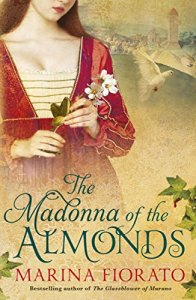
The Madonna of the Almonds

I’ve just finished reading Marina Fiorato’s new novel, The Madonna of the Almonds, which will be out on 14 May. It is a love story above all, but there is so much more as well. It’s set in Italy in the 16th century, about a young widow, Simonetta di Saronno, struggling to save her home, who meets the artist Bernadino, a protege of Leonardo da Vinci. 
 I was fascinated most of all by the artist Bernardino Luini who is employed to paint frescos in the church of Santa Maria dei Miracoli in Saronno, just at the time when Simonetta is trying to cope with the death of her husband at the Battle of Pavia. Little is known of Bernardino’s life. He was born around 1480/82 and died in 1532 and I enjoyed how Marina wove descriptions of his paintings into her story. Now I want to go to Saronna to see the actual paintings and to the Monastery of San Maurizio in Milan where his frescos adorn the church walls.

Bernardino was so captivated by Simonetta’s beauty that her face is the face of every female Saint, every Magdalene and every Madonna that he painted. Simonetta at first resists Bernardino’s advances but of course eventually falls in love with him, causing scandal in the local community. Bernardino has to leave Saronna for Milan, leaving Simonetta to fend for herself. With the help of a Jew, known as Manodorata (because of the golden hand replacing his own hand that had been chopped off by the Spanish Inquisition) she discovers how to make a delicious liqueur, Amaretto, from the almond trees, the only crop growing on her estate. The persecution of the Jews  forms a chilling strand in this book as Manodorato flees from his burning house with his two young sons, unable to rescue his wife from the flames.

Interwined within the story of Bernardino and Simonetta’s story are many tales of the Saints which inspire him to paint the frescos, seeing them in his mind’s eye as he listens to their stories told to him by the Abbess, Sister Bianca. Eventually he returns to Saronna determined to marry Simonetta if she is still free. But there are yet more obstacles to be overcome …

I love the story-telling aspects of this book, its rich descriptions of art and the detailed history of the period. I love Italy, history, art history and almonds, especially Amaretto, so this book just could not fail to delight me.

Collectibles

 btt button

  • Hardcover? Or paperback?
  • Illustrations? Or just text?
  • First editions? Or you don’t care?
  • Signed by the author? Or not?

I don’t have a preference for either hardbacks (hardcovers) or paperbacks, although I buy mainly paperbacks  because they are cheaper. Hardbacks can be a problem because of their weight and size, particularly when reading in bed, although paperbacks can also be huge and unwieldy and some are so difficult to hold open because they’re so tightly bound.  Another reason for buying paperbacks is that most paperbacks are much easier to carry around than hadbacks and I like to take a book with me just in case there’s an opportunity to read.

I don’t really like illustrations in novels, but I think they’re essential in non-fiction. Can you imagine an art or travel book with illustrations? Biographies too are much better with photographs or drawings.

I’m not a book collector in the sense of wanting to buy first editions. I can’t really see the attraction or why they are desirable.  It’s the contents of a book that interests me not whether it formed part of the first printing of the first edition and anyway there seems to be so much interpretation of what exactly is a first edition.

I have just a few books signed by the author and that does always seem to make the book that little bit more special, more personal and more valuable to me. 

Georges Simenon’s The Man On The Boulevard

I borrowed The Man on the Boulevard by Georges Simenon, translated by EileenEllenbogen, from my local library. It is the third Maigret book I’ve read in the past few months and all the way through I was thinking this was the best of the three, until the end that is. It has a puzzling murder to solve – Louis Thouret is found stabbed in a little alleyway. Seemingly a perfectly ordinary man of regular habits who leaves his home in the suburbs to go to his job as a storekeeper in Paris for the past twenty five years. His wife is surprised to find he was wearing light brown shoes because he always wore black, a flamboyant tie unlike the one he normally wore and that there were two cinema tickets in his pocket as well as more money in his wallet than he normally carried with him.

So it turns out that Louis has a double life that his wife knows nothing about. It appears he has been having an affair and for the past three years he has not had a job, so how has he managed to bring home his monthly salary? Where does he change his shoes every day and why?   It’s the shoes that set Maigret on the right track to solving the mystery. The book was originally called Maigret et l’homme du banc or Maigret and the man on the bench – it just so happened that Louis spent part of the day sitting on a bench talking to an unknown man, ‘the sort of person who sits on benches’ and that forms another important clue.

man-on-the-b

There were lots of things I liked in this book – the attention to detail, the descriptions of the weather (cold and wet), and the characters themselves.  It’s set in Paris and without knowing the location of the various boulevards I could still get a good impression of the city and its suburbs.  I liked the theme of a man following a double life and the way Louis resolves his problem of keeping up appearances with his wife and family although I thought his method of maintaining his income was rather implausible.

Maigret and his colleagues gradually discover Louis’s secrets and I was beginning to wonder just where this was taking me as I couldn’t work out who had killed him. I really had no idea who it could be.  And then the book was spoiled for me by the abrupt and unsatisfactory ending. The culprit was someone who hadn’t been mentioned at all. It was such an anti-climax as though Simenon just ran out of inspiration.

It’s Tuesday – Where Are You?/Teaser Tuesday

tuesdaywhereareyou

Today I’m in Paris in the 1860s with the Impressionists. Paris is overrun with art students  wanting to exhibit their paintings in the annual exhibition in the Salon des Beaux Arts. Today it’s 17 May 1863 and everyone is crowded into the exhibition of rejected works called the Salon des Refuses, where people are shocked by the paintings, jeering and hooting with laughter. But the painting that has completely stolen the show is Edouart Manet’s Le Dejeuner sur l’herbe.

It’s Tuesday – where are you? is hosted by raidergirl3.

Now the teaser (tteaser-tuesdayo see more teasers click on the button). The ‘official rules’ are to select a page at random in the book you’re currently reading and pick two sentences between lines 7 and 12. My teaser is a bit longer than two sentences, not random and not from lines 7 – 12. It’s from page 28 of Sue Roe’s The Private Lives of the Impressionists. 

Edouard Manet, who had exhibited at the Salon before, was this year exhibiting a monstrosity. Everyone stared in horror at Le Dejeuner sur l’herbe, an outrageous depiction of a naked woman, brazen and unashamed, staring straight out at the viewer and seated on a riverbank between two clothed men. Behind her, a second, lightly draped woman, up to her ankles in water, stoops in the distance. This bold display was shocking enough in itself, but what really astounded the public was the modernity of the scene. The men were grouped casually, in modern dress: the painting seemed to be about the present day.

It wasn’t the nudity that was shocking, but the casual style and the fact that the painting looks so real. It was seen as “an obscene, provacative taunt, doubly shocking by virtue of its ordinariness.” The critics complained that Manet appeared to have no sense of harmony, light or shade and thought that the colours were brash and harsh – garish and jarring!

I don’t think so – what do you think?

le-dejeuner-sur-lherbe-manet

Library Matters

 I started to write Library Loot posts a couple of weeks ago and thought I’d combine this one with the today’s Musing Mondays post as that is about the library …

How often do you visit the library? Do you have a scheduled library day/time, or do you go whenever? Do you go alone, or take people with you?

I don’t have a scheduled day to visit the library, but I do go frequently.  Actually I borrow books from two libraries – a little branch library, which I visit the most and the main County library. I either go on my own or with my husband.

Sometimes I go specifically to the library but often I combine my visit with shopping trips.  I prefer the branch library because even though there are less books on the shelves to choose from there is a really friendly atmosphere there – the staff know me. In any case if I want a particular book I can reserve it. They have several displays, that I always check first such as new books and first books before browsing the shelves or looking for specific books/authors. It’s a lot easier to park here as well. I usually borrow far too many books. At the moment I’m up to the limit on my ticket – 15 books, but I can always use my husband’s as he doesn’t borrow as many. We often borrow a DVD and have recently been taking out an audiobook as well.

I haven’t been to the library this week, maybe going tomorrow, so my Library Loot post is about some of the books I’ve got out already. Of the 15 books I have out there are four books that I haven’t started to read. They are (the summaries are from the library catalogue, except for the Wodehouse book):

  • The Crowded Bed by Mary Cavanagh – Joe Fortune, a Jewish GP, has been married to Anna, his Aryan beauty, for 20 years, in a relationship that is sustained with great passion and happiness. But in the shadows of their lives, dark secrets are hidden.
  • An Imaginative Experience by Mary Wesley – Mary Wesley draws out on a plot of unforgettable impact: of loss, of release, of a necessarily comic acceptance of fate, of love the ‘imaginative experience’. Rich in character and wit, and powerfully moving, this is a novel of the heart’s pain and deliverance.
  • Aunts Aren’t Gentlemen by P G Wodehouse – extract from the back cover – When the doctor advises Bertie to live the quiet life he and Jeeves head for the pure air and peace of Maiden Eggesford. However they hadn’t reckoned on Aunt Dahlia, aound whom an imbroglio develops involving the Cat which Kept Popping Up When Least Expected.
  • The Mirror Cracked from Side To Side by Agatha Christie – One minute, Heather had been gabbling on at her movie idol, Marina Gregg – the next, Heather suffered a massive seizure. But for whom was the poison really intended? This is one in a new-look series of Miss Marple books for the 21st century.

Writing about them now makes me want to read them all at once, but since I’m in the middle of other books they’ll have to wait.

Sunday Salon – Selections

tssbadge1The idea of The Sunday Salon is to imagine we’re in a large reading room discussing the books we’re reading. 

Today is a good day for reading. Yesterday the sun was shining drawing me outside. But today the sky is grey, the light is dull and I’m content to stay indoors and read. So far, however, I haven’t done much reading. I’ve watched Countryfile, tidied up a bit, made soup and done an Alphapuzzle or two. Countryfile was good – John Craven visited Kew Gardens to celebrate its 250th anniversary, there was a fascinating film of salmon migrating to their spawning grounds in the River Severn and what was to me a truly terrifying look at a mountain bike trail in the Lake District, plus lots more.

Back to books, this morning I continued reading two of the books I have on the go – The View from Castle Rock by Alice Munro and The Madonna of the Almonds by Marina Fiorato. Both are proving to be absorbing reads. For links to these books see the sidebar.

My Tuesday Teaser this week was from Alice Munro’s book, with a brief description of the lower Ettrick Valley where her ancestors came from. The Laidlaws emigrated to Canada in 1818 and the account of their voyage across the Atlantic is made more vivid by entries from Walter Laidlaw’s journal. He had brought with him a book to write in and a vial of ink held in a leather pouch strapped to his chest under his shirt. He had the idea from his cousin, James Hogg, the poet and shepherd. It doesn’t sound an easy crossing:

On the afternoon of the 14th a wind came from the North and the ship began to shake as if every board that was in it would fly loose from every other. The buckets overflowed from the people that were sick and vomiting and there was the contents of them slipping all over the deck. All the people were ordered below but many of them crumpled up against the rail and did not care if they were washed over.

Inevitably reading this book has raised more questions for me – just who was James Hogg for one? My own resources are a bit limited but I do have A Book of Scotland, edited by G F Maine. This is an anthology of Scottish prose and verse and comments on Scottish life and character. It contains several poems by James Hogg who was born in 1770 and died in 1835. I also have Scotland: the Blue Guide, which tells me that he was known as the “Ettrick Shepherd” and was a protege of Sir Walter Scott. There is a monument marking his birthplace and his grave is in the churchyard. He and other men of letters including Scott, Carlyle and Stevenson used to meet in Tibbie Shiels inn. This led me on to look at various websites and well away from Munro’s book, but it’s fascinating how one thing in a book leads on to more and yet more. I found this website about Tibbie Shiels Inn – the inn is in the Scottish Borders 48 miles south of Edinburgh overlooking St Mary’s Loch, on the isthmus between St. Mary’s Loch and Loch of the Lowes about halfway between Selkirk and Moffat. Now I’m wondering if it’s possible for us to stop and have a look at it on our way to see my son and family next time we visit them.

electric-shepherdI also found another helpful website Books from Scotland where I came across a book on James Hogg called The Electric Shepherd by Karl Miller. This looks absolutely fascinating. James Hogg taught himself to play the violin as well as writing poetry and the novel The Private Memoirs and Confessions of a Justified Sinner and was a friend of Wordsworth and Coleridge.

I don’t want to write about The Madonna of the Almonds today because I’m enjoying it so much I just want to get on with reading it. But I have to mention my reaction to the title. I associate it with paintings of the Madonna and Child, most notably The Madonna of the Rocks by Leonardo Da Vinci and in a frivolous vein with”The Fallen Madonna of the Big Boobies” by the fictional painter Van Klomp from ‘Allo, ‘Allo!

And so now after looking at what others are reading in the Sunday Salon it’s back to books before cooking dinner.