Catching Up With My Reading

Once more I’ve been reading books and moving on without writing about them. Here are just two of the books I’ve read recently:
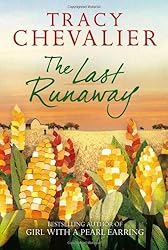
The Last Runaway by Tracy Chevalier – I really liked this book, historical fiction about the life of Honor Bright after she emigrated from Dorset to America in 1850 where she joined a Quaker community in Ohio. It intertwines her story with that of the ‘Underground Railroad’, helping the runaway slaves from the southern states to escape to Canada.

Honor is a quilter, but finds that American quilts are not the same as English ones, just as America is very different from England, both in landscape, temperature and culture. She struggles to fit in, finding it hard to adjust. I thought this was well handled and the sense of period and place is impressive, with a wealth of detail about the land and the struggles of the settlers. She can’t face the journey back across the Atlantic and marries Jack Haymaker, a young farmer whose mother and sister disapprove of her.

The slavery question caused Honor a real dilemma, as she became involved in the Underground Railroad, a network of safe houses and people willing to provide food and shelter for the runaways. Should she abide by the law, or follow her Quaker beliefs about equality, thus putting the rest of her family at risk as well as herself? This is compounded by her relationship with Belle Mills and her disreputable brother Donovan who has taken a liking to Honor, but is also a slave-catcher, ruthless in his pursuit.

I think it’s a very entertaining book, full of colourful characters, although some, like Jack are not as well developed as others. I liked the detail about quilting, even though I have never done any! But it was the account of life on the frontier and the Underground Railroad that made the book for me. Here are Honor’s thoughts about slavery:

She had begun with a clear principle born of a lifetime of sitting in silent expectation: that all people are equal in God’s eyes, and so should not be enslaved to one another. Any system of slavery must be abolished. It had seemed simple in England; yet in Ohio that principle was chipped away at, by economic arguments, by personal circumstances, by deep-seated prejudice that Honor sensed even in Quakers. …

When an abstract principle became entangled in in daily life, it lost its clarity and became compromised and weakened. (page 259)

I borrowed this book from the library.
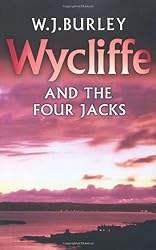
In complete contrast I moved on from The Last Runaway to Wycliffe and the Four Jacks by W J Burley, crime fiction set in Cornwall, featuring Chief Superintendent Wycliffe, who is on holiday but still gets drawn into a murder investigation.

Author David Cleeve, who writes under the pseudonym Peter Stride asks for Wycliffe’s advice about a series of sinister warnings he has received in the form of a playing card – the Jack of Diamonds. Then, a young woman is found dead, an apparently motiveless crime, but, as Wycliffe discovers, it follows a series of crimes, the clues all seeming to centre on an archaeological dig on Cleeve’s land. A further murder helps to pinpoint the culprit.

This is a quick read, with plenty of red herrings, but not too difficult to unravel. I liked it and I liked the personal touches that make Wycliffe a real person, a somewhat irritable man who likes his food, and gets on well with his wife. He is a thoughtful detective:

He was in a strange mood, suddenly everything had become unreal: the bare schoolroom with its peeling green walls, the battered tables, the scratched filing cabinets, his colleagues bending over their reports … He had known such experiences since childhood when, suddenly, everything seemed remarkable, nothing was ordinary any more. His mother would say: ‘Why aren’t you playing with your toys, Charles?’ Later, at school, it was ‘Day-dreaming again, Wycliffe!’ Now DS Lane was watching him and probably thinking, ‘Why dies he just sit there?’ (page 165)

It’s periods like this, however, that help Wycliffe focus his thoughts.

Wycliffe and the Four Jacks was first published in 1985. It’s the 12th in Burley’s series of 22 Wycliffe books.
Crime Fiction Alphabet: W is for Wycliffe …

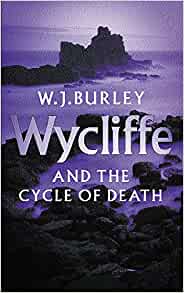
… Wycliffe and the Cycle of Death by W J Burley.

From the back cover:

When Matthew Glynn, a respectable bookseller is found bludgeoned and strangled, Chief Superintendent Wycliffe is mystified. Why would anyone want to kill him, and in such a brutal manner?

But a look at Glynn’s background reveals tension within the family. Alfred Glynn, an eccentric recluse, has held a grudge against his brother for years and the older brother, Maurice, argued bitterly with Matthew over the sale of family land. Add to this a discontented son, valuable documents in the bookseller’s safe, and the mysterious, still unexplained disappearance of Matthew’s wife years earlier, and Wycliffe faces one of his most impenetrable cases yet.

Then another Glynn dies and the murderer’s identity seems obvious. But Wycliffe is not convinced – and soon uncovers some very murky secrets, and the possibility of another murder …

My view:

The story is set in Penzance and its immediate neighbourhood, so Burley, who knew the area well (he lived near Newquay), sets the scene well. The three Glynn brothers didn’t get on, with a long-standing quarrel between Matthew and Alfred, which was connected to their mother, and a more recent row between Matthew and his other brother, Maurice, who objected to Matthew’s proposal to build houses near to Maurice’s pottery. And as Trice, the local DI,  tells Wycliffe, the locals are suspicious of outsiders – he’s talking not just about Cornwall, but about the local area, Penwith, which in Cornish means ‘ … “the extreme end”. The people here feel different – they are different.’

And this is a murder mystery with a difference, because all is not clear by the end. There are plenty of suspects, not just the brothers but also their sister and grown-up children. The reader is left to work out the puzzle, indeed Wycliffe struggles to come to terms with his suspicions and his mind is in turmoil:

With something approaching desperation, Wycliffe was trying to see the events in perspective, to relate them one to another and to imagine the repressed tensions and accumulated bitterness which had finally surfaced. But what troubled him most was the thought that he was being pushed beyond his role as an investigating officer into decisions which were either moral or judicial or both. (page 185)

I liked the book very much, with its complex plot, convincing characters, and in particular the way Wycliffe’s humane and thoughtful character is portrayed. The ending certainly makes you think.

  • Paperback: 320 pages
  • Publisher: Orion; New Ed edition (2 Aug 2001)
  • Language: English
  • ISBN-10: 0752844458
  • ISBN-13: 978-0752844459
  • Source: I bought the book
  • My Rating: 4/5

A Crime Fiction Alphabet post for the letter W.

May’s Reading & Crime Fiction Pick of the Month

I read a lot in May – well I read and listened, because three of the books were audiobooks, which was quite a novelty for me. In total I ‘read’ 11 books and 9 of them were crime fiction. So far I’ve only reviewed 4 of them.

This is what I read –  the links are to my posts on the books and * indicates crime fiction:

  1. Wycliffe and the Cycle of Death by W J Burley* 4/5
  2. The End of the Affair by Graham Greene 3/5
  3. Murder in Mesopotamia by Agatha Christie* 3.5/5
  4. The Redeemed by M R Hall* 4.5/5
  5. Blue Lightning by Ann Cleeves* 4/5
  6. The Hanging in the Hotel by Simon Brett * (library audiobook) 2/5
  7. Fatherland by Robert Harris* 5/5
  8. Bring Up the Bodies by Hilary Mantel 4/5
  9. The Sign of Four by Arthur Conan Doyle* 3/5 (library audiobook)
  10. The Coroner by M R Hall* (library book) 4/5
  11. Dandy Gilver and an Unsuitable Day for a Murder by Catriona McPherson* 3/5 (advanced reading copy)

I’m aiming to review the rest of the books, but for now here are notes on them.

Wycliffe and the Cycle of Death by W J Burley is set in Penzance in Cornwall. Matthew Glynn, a bookseller,is found bludgeoned and strangled, which sets Chief Superintendent Wycliffe a difficult mystery to solve. The answer lies in the past and in the Glynn family’s background. I enjoyed this book, which I read quickly, eager to know the outcome, but the ending was a let down.

Murder in Mesopotamia by Agatha Christie. I always like Agatha Christie’s books and although I don’t think this is one her better books, it was a satisfying read. It’s a closed room type mystery. Who killed Louise, the wife of the celebrated archaeologist leading the Hassanieh dig? Only the people at the dig could have done it, but which one – they’re all under suspicion? Poirot doesn’t appear until quite late on in the book, but, of course, works it all out.

The Hanging in the Hotel by Simon Brett (audiobook). This is the fifth of the Fethering Mysteries, in which Jude and her friend Carole investigate the death of one of the guests at the local country house hotel, following the dinner attended by the all-male members of the Pillars of Sussex the night before. It looks like suicide but Jude thinks it can’t be. I got rather tired listening to this book as Jude and Carole endlessly (or so it seemed) went over and over the events and questioned the suspects.

Bring Up the Bodies by Hilary Mantel is the sequel to Wolf Hall. This book certainly deserves a post of its own. Here I’ll just comment that this chronicles the fall of Anne Boleyn, Henry VIII’s second wife and Cromwell’s part in satisfying Henry’s wishes. I don’t think it’s quite as captivating as Wolf Hall, but it does show just how devious Cromwell could be.

My Crime Fiction Book of the Month is a close call between  Fatherland by Robert Harris  and The Redeemed by MR Hall, both of which had me engrossed.

Fatherland is a fast paced thriller, set in a fictional Germany in 1964, a Germany that had been victorious in the Second World War. It begins with the discovery of the body of one of the former leading members of the Nazi party, who had been instrumental in devising ‘the final solution’. It’s a complex book and leads police detective Xavier March into a very dangerous situation as he discovers the truth.

The Redeemed by MR Hall is by contrast not about a police investigation but is the third book in which Jenny Cooper, a coroner investigates the death of a man discovered in a church yard, the sign of the cross carved into his abdomen. At first it looks like a horrific suicide, but as Jenny delves deeper during her inquest she finds links to yet more deaths. This is the third book in M R Hall’s Jenny Cooper series and I enjoyed it so much that I immediately borrowed the first book, The Coroner, from the library. They do stand well on their own but I think it helps to read them in sequence. In The Coroner Jenny begins her career, having been a solicitor for fifteen years. She obviously has devastating events in her personal life that she has to deal with.

May’s reading has been exclusively fiction, so I’m looking forward to reading some nonfiction in June. I’m feeling like reading a biography or two.

See the round-up post at Mysteries in Paradise for other bloggers’ choices of book of the month for May ‘“ and add your favourite May read to the collection.

Sunday Selection, or what to read next?

This morning I finally finished reading A Place of Greater Safety by Hilary Mantel. I enjoyed it, but it was with a sense of release that I read the final pages, because at 872 pages it’s taken me over a month to read it and I’m looking forward to reading something shorter, snappier and more succinct. I’ll write my thoughts about this mammoth book on the French Revolution later on.

So, I picked up Wycliffe and the Cycle of Death by W J Burley, which is much shorter at 192 pages and easier to read – and to handle. It’s a murder mystery about the death of Matthew Glynn a respectable bookseller.

But I’m also thinking ahead about what to read next. I have started The Meaning of Night by Michael Cox, but I’m thinking of leaving it for now as it too is another long book. So, the possibilities are:

Fresh from the Country by Miss Read, (219 pages) about Anna Lacey plunged into her first teaching job in London. I’ve read most of Miss Read’s Thrush Green and Fairacre novels, but this one is new to me. Dora Jessie Saint, who wrote under the pen-name Miss Read, died earlier this month at the age of 98. She wrote over 30 books, gentle and unsentimental observations of English country and village life and I’ve loved each one I’ve read.

The End of the Affair by Graham Greene. This was my face-to-face book group choice this month, but I missed the meeting because it was the same day as our grandson’s birthday, and I hadn’t read the book anyway. I’d like to read it, though, because the group disagreed about the book – with some people disliking it and others who thought it was good. Maurice and Sarah had begun a love affair during the London Blitz and then Sarah had broken off the relationship. Maurice, driven by obsessive jealousy and grief sends a private detective to find out the truth. It would also be good to read it as it fits into the Classics Challenge.

And looking further ahead, I’ve been trying to decide whether or not to get any of the ‘free’ books offered in newbooks magazine, which arrived recently. I’ve narrowed my choice down to two books:

The Somnambulist by Essie Fox. This is set in Victorian England. Seventeen year old Phoebe takes a job as companion to Mr Samuel’s wife and encounters betrayal, loss and regret as she tries to adjust to life away from home.

The Thoughts and Happenings of Wilfred Price, a debut novel by Wendy Jones. In 1924 Wilfred lives in rural Pembrokeshire where he runs the local funeral parlour. He fantasises about Grace, the daughter of the local doctor and on the spur of the moment he proposes to her. But then he realises that this is a mistake and tries to undo it.

Another book that has caught my eye recently is:

The Unlikely Pilgrimage of Harold Fry, a debut novel by Rachel Joyce. I saw this in a local bookshop and nearly bought it then. It’s about Harold who walks from his home in Devon to Berwick-upon-Tweed in Northumberland to see a dying friend. It’s the idea of a journey along the length of England that I find appealing, but the thought of the friend dying from cancer may be too close to home.

One thing is certain, I’ll never run out of books I’d like to read.

Crime Fiction Alphabet – Letter B – W J Burley

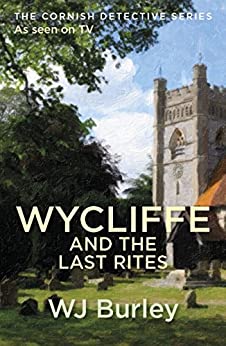
This week I’ve chosen to feature W J Burley to illustrate the letter B for Kerrie’s Crime Fiction Alphabet. I knew of  his Wycliffe novels but had never read any, or watched any of the TV dramatisations, so I came to Wycliffe and the Last Rites with no preconceptions. I really don’t know why I never watched the 1990s TV series starring Jack Shepherd as Wycliffe, but as I didn’t I was able to form my own image of him in my mind directly from the book.

William John Burley was born in Falmouth, Cornwall in 1914. His first book was published in the 1968. All in all he produced 22 more Wycliffe books and 5 others. He died in 2002 whilst he was writing his 23 Wycliffe book. There is more information about him at this website – W J Burley.

Wycliffe and the Last Rites
Paperback: 192 pages
Publisher: Orion; New Ed edition (7 Nov 2002)
Language English
ISBN-10: 075284931X
ISBN-13: 978-0752849317
Source: I bought it

Description from the back cover:

A bizarre murder shakes the Cornish village of Moresk. Arriving at church on Easter morning the vicar discovers the body of a woman sprawled across the chancel steps. To add to the horror, the church is filled with the discordant sound of an organ chord, the notes apparently chosen at random and wedged down.

Has the church been desecrated by a Satanist ritual? Chief Superintendent Wycliffe sees the crime more as an expression of hatred directed at others in the community, besides the dead woman. His investigation, however, is frustrated at every turn, and when another horrific murder is committed Wycliffe thinks he knows who the killer is. But can he prove it?

My thoughts:

This novel has a strong sense of location, with many passages describing the beautiful countryside of Cornwall. The characters are also well defined – a small local community focussing on the twin sisters, Katherine Geach and Jessica Dobell. The relationship between them is strained, with Jessica having a sense of guilt about a hit and run accident she’d witnessed 16 years earlier and admitting that she hadn’t played fair with Katherine.  After their parents’ deaths Jessica had inherited the family farm and lived there with the Vintners and their son, a strange family filled with hatred and resentment over their reduced circumstances. Then there is the Vicar and his sister, who had been forced to move from their previous parish, the houseboat man, Lavin, who is badly disfigured following an accident, and Arnold Paul, the organist and his ‘brother’.

Detective Chief Superintendent Wycliffe is a quiet character who thinks things through before divulging his suspicions to his colleagues. He delegates tasks to his team leaving himself free to concentrate on the victim. To him ‘hope is an ultimate resource’. His evening walks are a necessity for him to ponder what he has discovered and he is calm and collected:

It was characteristic that he should walk rather than drive or be driven; he refused to allow his days to become crowded with events in a frenetic succession of images like a television screen, lacking even commercial breaks to aid digestion. (pages 44 -5)

His problem in finding the murderer is that all the possible leads pointed to a limited range of possible suspects but none of them matched his specification for the criminal. It seemed he had to believe the impossible. It’s a tightly plotted book, concisely and precisely written and I enjoyed it very much. I have one other book of Burley’s to read – Wycliffe and the House of Fear. After that I’ll be looking out for his other books.