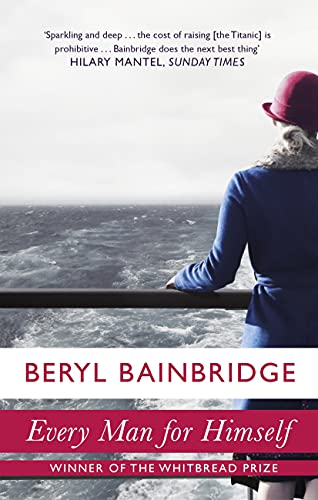
Every Man For Himself by Beryl Bainbridge

Rating: 3 out of 5.

Every Man For Himself was the winner of the 1996 Whitbread Novel Award and was shortlisted for the Booker Prize in that year.

For the four fraught, mysterious days of her doomed maiden voyage in 1912, the Titanic sails towards New York, glittering with luxury, freighted with millionaires and hopefuls. In her labyrinthine passageways the last, secret hours of a small group of passengers are played out, their fate sealed in prose of startling, sublime beauty, as Beryl Bainbridge’s haunting masterpiece moves inexorably to its known and terrible end.

This is one of her historical novels, so it’s no surprise that this is a disaster novel. It’s the story of Morgan’s voyage divided into four days as he tells it. It’s mainly the story of the young rich people as they drink and party their way across the Atlantic. Morgan is part of the crowd but he is not rich, and although he has connections, he’s a young American who has to earn his living. We only see a glimpse into his background and I found it confusing for quite a way into the book. But eventually we learn more about him and things became clearer,

By the time he writes about day 4, the sinking itself, the pace speeds up, and the story came to life for me. I think Bainbridge conveys what it must have been like –

There was such a dearth of information, of confirmation or denial of rumours – the racquet court was under water but not the Turkish baths; a spur of the iceberg had ripped the ship from one end to the other but the crew was fully equipped to make good the damage and were even now putting it to rights – and such an absence of persons in authority to whom one might turn that it was possible to imagine the man in the golfing jacket had spoken no more than the truth when presupposing we were victims of a hoax. (page 179)

I could easily imagine what it was like to be a passenger, people rushing about the boat, trying to get on the lifeboats and being separated from friends and family. And the final scenes bring home the reality that it really was a case of every man for himself with the callous attitude towards the steerage passengers, the lack of lifeboats and the disregard of the ice warnings. And so the boat described as unsinkable, sank.

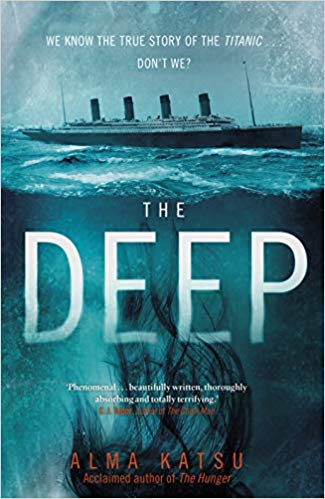
The Deep by Alma Katsu

Random House Bantam Press| 5 March 2020| 391 pages|e-book| Review copy| 3*

About the Book

Deaths and disappearances have plagued the vast liner from the moment she began her maiden voyage on 10 April 1912. Four days later, caught in what feels like an eerie, unsettling twilight zone, some passengers – including millionaire Madeleine Astor and maid Annie Hebbley – are convinced that something sinister is afoot. And then disaster strikes.

Four years later and the world is at war. Having survived that fateful night, Annie is now a nurse on board the Titanic’s sister ship, the Britannic, refitted as a hospital ship. And she is about to realise that those demons from her past and the terrors of that doomed voyage have not finished with her yet . . .

Bringing together Faustian pacts, the occult, tales of sirens and selkies, guilt and revenge, desire and destiny, The Deep offers a thrilling, tantalizing twist on one of the world’s most famous tragedies.

My thoughts

I loved The Hunger by Alma Katsu, so I was looking forward to reading The Deep. It began really well and it’s beautifully written. It’s a mix of fact and fiction. It moves between 1912 as the Titanic sets sail on its maiden voyage and 1916, as its sister ship the Britannic, converted to a hospital picks up soldiers injured in the battlefields to take them back to England. There is a large cast of characters, some are real people and others are fictional; the stories on the two ships are told from their different perspectives.

The story revolves around Annie Hebbley, a stewardess on the Titanic and a nurse on the Britannic. It begins in 1916 when she is in an asylum and receives a letter from a friend, Violet Jessop (a real person) who had been on the Titanic with her, asking her to join her as nurse on the Britannic. Annie, however, has a dark secret in her past, which is slowly revealed – most of the time I was reading I couldn’t decide how much was real and how much imaginary. She grew up in Ireland and her mind is full of the fairy stories and superstitions her grandmother had told her. And things start to go wrong as soon as she boards the Titanic.

It didn’t grip me as much as The Hunger, although it’s a very atmospheric novel and I loved the way Alma Katsu has combined fact and fiction. The scenes on the Titanic convey the splendour of the ship, the wealth of the passengers and the contrasting conditions between the different classes of passengers, and the crew. Similarly, the stark conditions on The Britannic and the suffering of its passengers are vividly portrayed. Some of the passengers are convinced that the ship is haunted and there is a genuine sense of menace, of something sinister and supernatural waiting to strike them all. However, I didn’t think the supernatural elements were as convincing later on in the novel and I found the ending confusing.

It’s not a quick read, beginning slowly and, although at first I thought this was going to be a really engrossing novel, my interest began to flag later on. I was actually relieved when I finished it. That maybe because I knew the fate of the Titanic and I didn’t empathise with Annie, the main character. As historical fiction I think it works quite well, but the main focus of the book is not the sinking of the Titanic or of the Britannic – it’s the story of the passengers and crew of both ships. The supernatural elements just confused me – especially the ending, which is so ambiguous – just who was Annie Hebbley? It’s surreal and I suppose you just have to make your own mind up. It’s been in my mind ever since I finished reading.

My thanks to the publishers and NetGalley for providing me with a review copy.

This is my first book for Cathy’s 20 Books of Summer, and my eighth book for the Historical Fiction Challenge.