
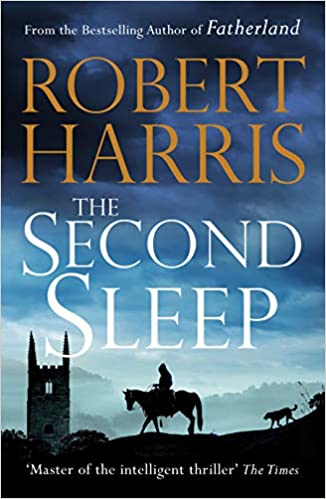
I decided to read The Second Sleep because I enjoy Robert Harris’ books and when I saw him on a TV programme talking about this book I thought it sounded interesting and a bit different. I’m glad I did because I thoroughly enjoyed most of it – it was the ending that I felt was rather flat.
I read it at the end of June and I wish I’d written about it straight away – but I didn’t, it got left because I’ve been finding it difficult to concentrate on writing reviews. So, this is one of my catching up posts that can’t do justice to the books. But, I really do think that you should go into reading this book with an open mind, without knowing too much about it.
The blurb certainly made me want to read it:
Dusk is gathering as a young priest, Christopher Fairfax, rides across a silent land.
It’s a crime to be out after dark, and Fairfax knows he must arrive at his destination – a remote village in the wilds of Exmoor – before night falls and curfew is imposed.
He’s lost and he’s becoming anxious as he slowly picks his way across a countryside strewn with the ancient artefacts of a civilisation that seems to have ended in cataclysm.
What Fairfax cannot know is that, in the days and weeks to come, everything he believes in will be tested to destruction, as he uncovers a secret that is as dangerous as it is terrifying …
As I began reading I had that feeling that this is a book I was going to enjoy – historical fiction, with a mystery to it as well. There is something not quite right about Faifax’s mission as he approaches that remote village in the dark, something menacing and dangerous. The signs are all there – a cataclysmic disaster and a terrifying secret await him when he reaches that village.
But then – all is not as it first appears and I wondered if all this is a smoke screen – what is really going on, is this really the medieval England I’ve read about in history books? And here it is – the nub of the matter – what is going on, where and when are these events taking place? This is an imagined world, a piece of speculative fiction, a bleak and brutal world under a strict authoritarian rule. It’s about progress, or lack of it, about the rule of law, and the power of knowledge.
As I expect in Harris’ novels, apart from that abrupt ending, it is paced well, as more and more information about this strange time and place are revealed the tension rises and rises. The characters became real to me and I could easily visualise all the scenes – in other words I was gripped and involved in the story. So, it was with a sense of an anti-climax that I reached the ending – was that it? I wanted to know more. Even so, I can say that this is a book I thoroughly enjoyed and I think I’d like to re-read it sometime, prepared for the ending.
I was interested in the title, the second sleep, referring to the characters’ sleep pattern of having a period of wakefulness of a couple of hours in the middle of the night and then returning to bed for a second period of sleep. I wondered if that was historical fact – these days it’s not considered to be good to have a broken sleep pattern. It was – I found this BBC article, which explains there is a wealth of historical evidence that humans used to sleep in two distinct chunks and that during the waking period people were quite active – as they are in this book. They often got up, went to the toilet or smoked tobacco and some even visited neighbours. Most people stayed in bed, read, wrote and often prayed. Countless prayer manuals from the late 15th Century offered special prayers for the hours in between sleeps.
- Format: Kindle Edition
- File Size: 2384 KB
- Print Length: 330 pages
- Publisher: Cornerstone Digital (5 Sept. 2019)
- Source: I bought it

 BooksPlease