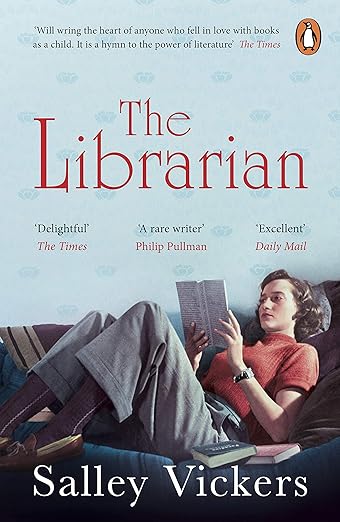
Penguin |26 April 2018 | 388 pages| paperback| 3*
Description from Amazon:
In 1958, Sylvia Blackwell, fresh from one of the new post-war Library Schools, takes up a job as children’s librarian in a run down library in the market town of East Mole.
Her mission is to fire the enthusiasm of the children of East Mole for reading. But her love affair with the local married GP, and her befriending of his precious daughter, her neighbour’s son and her landlady’s neglected grandchild, ignite the prejudices of the town, threatening her job and the very existence of the library with dramatic consequences for them all.
The Librarian is a moving testament to the joy of reading and the power of books to change and inspire us all.
‘Underneath the delightful patina of nostalgia for post-War England, there are stern and spiky questions about why we are allowing our children to be robbed of their heritage of story.’ Frank Cottrell Boyce
‘Vickers has a formidable knack for laying open the human heart’ Sunday Times
The Librarian is one of my TBRs (a paperback I bought four years ago) and also one of the books I decided to read as one of my 20 Books of Summer 2025. Frances @ Volatile Rule also identified it as one of her 10 Books of Summer and suggested we could do a buddy read. I am really looking forward to reading what she thinks about it.
I wanted to read The Librarian because I’ve enjoyed some of Salley Vickers’ books – especially Miss Garnet’s Angel and Mr Golightly’s Holiday (both of which I read pre-blogging). But I have to say that I was rather underwhelmed. It seems a bit shallow as I was expecting something that dug deeper beneath the surface, exploring the characters’personalities in more depth. I found the writing style naïve. Nevertheless I did enjoy it. It’s a simple story, simply told, a light read.
Having said that it does reflect life in the 1950s, a time when memories of the Second World War and Hiroshima still lingered. It’s strong on family relationships, and attitudes towards marriage, sex, and morals and shows the class divisions and the social inequality that existed, one in which the role of women was very different from that of today. It also looks at education and the nature of the 11+ exam and its divisive effects on children in deciding whether they went to a grammar or secondary modern or technical school.
In 1958 Sylvia Blackwell moves to East Mole, a fictional town, to become the Children’s Librarian. The town is described as ‘one of those small, middle-English country towns whose reputation rests on an understanding that it has known better days.’ The library is in a redbrick Victorian building that has been neglected over the years and the Children’s Library has suffered from a lack of adequate funding. It contained an outdated collection of books by mainly once fashionable Victorian authors, most of which could ‘hardly pass for children’s reading in the twentieth century.’ Sylvia is keen to update it and to introduce new books to encourage the children to use the library.
Sylvia is renting one of the cottages in Field Row on the outskirts of East Mole, a redbrick terrace, originally a two up, two down building with no inside WC, no bathroom or running hot water. It’s a damp cottage that her landlady, Mrs Bird, had modernised by adding a toilet next to the kitchen and had squeezed in a bathroom upstairs with a chipped bath and water-stained basin. Sylvia thinks it’s rustic and picturesque with its tiled roof greened over with moss.
Sylvia’s neighbours in the terrace of five houses are June and Ray Hedges, and Sam, their son and his little twin sisters, and Mr Collins, a councillor who is a member of the library committee. She gets on well with the Hedges, particularly so with the children. However, Mr Collins is not so friendly, almost antagonistic towards her. She has an affair with Hugh the local doctor, an older married man, putting her job in jeopardy and indeed threatening the closure of the Children’s Library. It causes problems between Hugh’s daughter and Sam. Sylvia’s work life and personal life become entangled, which has both negative and positive consequences for everyone involved.
I think the most interesting part for me is that it is about libraries in 1958, as I was also a librarian, although not a Children’s Librarian, like Sylvia. And I was a child in the 1950s and and used the local town library from the age of 4, so reading this has brought back many memories of using and working in libraries.
I was less enthusiastic about the ending set some sixty years later, when the library was threatened once again with closure. One of the children returned, now a famous author, to speak at an event which they hope might help to keep the library open, thus giving an update on the lives of some of the characters. However, I think it’s too long and neatly ties up all the loose ends. The book doesn’t need it.
In her Author’s Note at the end of the book, Salley Vickers writes:
The years I have spent as a novelist have taught me that there is no knowing how people will take one’s books. And I really believe that a book is finally made by its readers. Books should not be ‘about’ anything but if this book expresses any special interest it is the interest I acquired as a child in reading. The Librarian grew out of my experience as a young girl with a superb local library and a remarkable Children’s Librarian, Miss Blackwell, whose surname I have stolen (I never knew her first name) for my protagonist.
There’s also a list of children’s books from East Mole Library ‘Recommended reading from East Mole Library’, including some of my favourite books I read as a child and some I missed.
What I have taken from this book is Salley Vickers’ love of reading and enthusiasm for opening the children’s eyes to the joy of reading. It centres on Sylvia and her experiences not only as a Children’s Librarian but as a rather naive young woman in her second job away from her parents and her home. And it is that side of the story that I found less engaging. Salley’s inexperience makes her easy prey for Hugh and I thought the outcome was so predictable.
Salley Vickers
Salley Vickers was born in Liverpool, the home of her mother, and grew up as the child of parents in the British Communist Party. She won a state scholarship to St Paul’s Girl’s School and went on to read English at Newnham College Cambridge.
She has worked, variously, as a cleaner, a dancer, an artist’s model, a teacher of children with special needs, a university teacher of literature, and a psychoanalyst. Her first novel, ‘Miss Garnet’s Angel’, became an international word-of-mouth bestseller. She now writes full time and lectures widely on many subjects, particularly the connections between, art, literature, psychology and religion.
Her principal interests are opera, bird watching, dancing, and poetry. One of her father’s favourite poets, W.B.Yeats, was responsible for her name Salley, (the Irish for ‘willow’) which comes from Yeats’s poem set to music by Benjamin Britten ‘Down by the salley gardens’.(Goodreads)
 BooksPlease