
The 1952 Club hosted this week by Karen at Kaggsy’s Bookish Ramblings and Simon from Stuck in a Book blogs ends today. The idea is simply to read and review books published in 1952.
The Singing Sands: An Inspector Alan Grant Mystery by Scottish author Josephine Tey is the second book I’ve read for this event. It was the last book she wrote whilst she was terminally ill and was found among her papers when she died. It was published posthumously a few months after her death in 1952. Josephine Tey was a pseudonym of Elizabeth Mackintosh. Josephine was her mother’s first name and Tey the surname of an English Grandmother.
My copy is an e-book, published in 2023 by Evergreen Publishers.
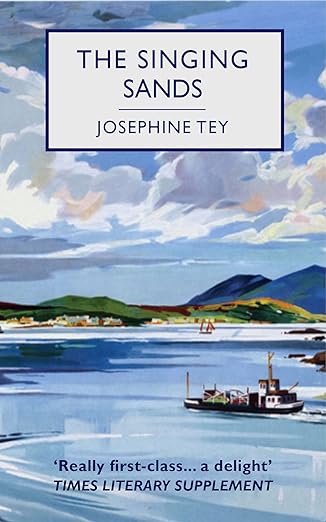
This is the 6th and last Alan Grant Mystery. It’s a book you have to read slowly to fully take in all the details. Although the mystery is interesting and puzzling, what I enjoyed the most about this book is Tey’s descriptive writing, her observations, and her characterisation, particularly that of Alan Grant and the analysis of his mind. Her characters are believable, well developed and unforgettable.
It begins as Grant is travelling on an overnight train to the Scottish Highlands on sick leave from Scotland Yard. He planned to spend his time fishing whilst staying with his cousin, Laura who is married to his old school friend Tommy. He is suffering from claustrophobia and it seems as though he has had some sort of mental breakdown. His journey was fraught with anxiety:
Alan Grant, watching the lights of the yard float past beyond the steamed-up window and listening to the gentle sound of the wheels clicking over the points, was glad because the end of the journey was the end of a night’s suffering. Grant has spent the night trying not to open the door into the corridor. Wide awake, he had lain on his expensive pallet and sweated by the hour. He had sweated not because the compartment was too hot – the air-conditioning worked to a marvel – but because (O Misery! O Shame! O Mortification!) the compartment represented A Small Enclosed Space. … But to the initiate, the sad and haunted initiate, it was A Small Enclosed Space.
Overwork, the doctor called it. (pages 1 – 2)
As he left the train at the terminus he passed compartment B7 and saw the sleeping car attendant shaking the passenger trying to rouse him, assuming he was drunk. Although the compartment reeked of whisky, Grant realised he was dead and left the attendant to deal with it, thinking he’d had enough of dead men – they were not his responsibility. But automatically, he had picked up a newspaper and added it to the other papers he had under his arm. And later on he realised it had belonged to the dead man, on which he had scribbled a cryptic poem:
The beasts that talk,
The streams that stand,
The stones that walk,
The singing sand,
That guard the way
To Paradise.
From then on Grant’s state of mind was in turmoil and he was intrigued by this poem and wondered what it meant. Surely he thought there were actually some singing sands somewhere. It totally occupied his mind and a large part of the book is about his thoughts as he became obsessed with finding out who the man was, why he was travelling to Scotland, what was his state of mind that he had ended up drunk on the train. He had a curious feeling of identification with the man in B7 in the sense of having an identity of interests. He wondered if B7 was also ‘wrestling with demons.’
The inquest concluded that the man’s death was an accidental death. He hadn’t been drunk just tipsy. He had a skull injury that was consistent with a backwards fall against the wash basin. But Grant still wanted to know more and continued to investigate.
He visited various places trying to find the singing sands and advertised in newspapers asking anyone who recognised the words of the verse to contact him. He visited Cladda (a fictional place) after Wee Archie, told him there were singing sands there. The singing sands do actually exist – they’re in the Isle of Eigg. I found this description and a photograph on the Walkhighlands website: In dry weather the grains of quartzite make a rasping or singing sound as you walk on them or when the wind scuffs them.
It’s definitely a book of its time and Tey has used a lot of slang and idioms that aren’t so recognisable today. One of her observations I found interesting was the subject of Scottish nationalism and the relationship between Scotland and England and I wondered if maybe she was expressing her own thoughts on the subject, but bearing in mind that this book is fiction, I can’t be sure. Referring to the 1707 Act of Union between England and Scotland Grant says: Scotland stepped thankfully on to England’s band-wagon and fell heir to all its benefits. Colonies, Shakespeare, soap, solvency and so forth.
Wee Archie, was supposedly a Scottish nationalist but was in fact an Englishman who called himself Gilleasbuig Mac- a’-Bruithainn and wielded a shepherd’s crook two feet taller than himself that ‘no shepherd would be found dead with’, and wore a kilt that ‘no Highlander would dream of being found alive in‘. Talking to Grant Archie spoke of ‘England’s iniquities to a captive and helpless Scotland. Anything less captive or helpless than the Scotland he (ie Grant) had known would be difficult to imagine.) Laura told Grant Archie didn’t have ‘a drop of Scottish blood in him. his father came from Liverpool and his mother was an O’Hanrahan.’ Grant remarked ‘Odd how all the most bigoted patriots are Auslanders,’ adding ‘I don’t think he’ll get far with those xenophobes, the Gaels.’ (page 23)
The Singing Sands is not a typical Agatha Christie puzzle type of crime fiction, but more an analysis of the characters’ emotional and psychological obsessions to be found in novels such as those of Ruth Rendell and Patricia Highsmith. I really enjoyed it.
I now want to know more about her and her life and I’ve found this biography that I’d like to read – Josephine Tey: A Life by Jennifer Morag Henderson.



 BooksPlease