Throughout the month of November, bloggers Liz, Frances, Heather, Rebekah and Deb invite you to celebrate Nonfiction November with us.
Week 3 (11/11-11/15) Book Pairings: This week, pair up a nonfiction book with a fiction title. Maybe it’s a historical novel and the real history in a nonfiction version, or a memoir and a novel, or a fiction book you’ve read and you would like recommendations for background reading. Or two books on two different areas have chimed and have a link. You can be as creative as you like! (Liz)
Liz further clarifies in her Pairings post: ‘I offer a mix of fiction/nonfiction pairs, fiction/nonfiction/memoir sets and nonfiction/nonfiction.’
After the Hamas-led attack on Israel on October 7, 2023 I decided I needed to know more about what had led up to it. And I found lots of books, including these:
Nonfiction/Fiction – I’m aiming to write more about these books in due course.
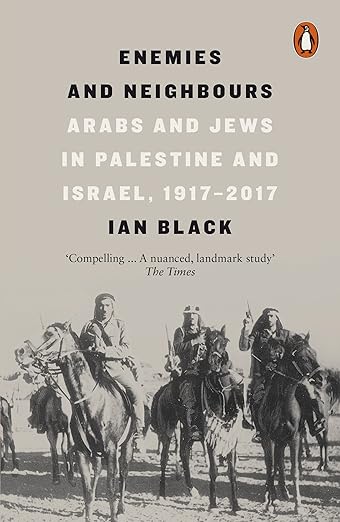
Enemies and Neighbours: Arabs And Jews In Palestine And Israel, 1917-2017 by Ian Black (nonfiction)
This is an extremely detailed chronological account of events in this conflict from the years from 1882 preceding the Balfour Declaration in 1917 to 2017. Ian Black was a British journalist who worked for The Guardian holding the posts of diplomatic editor and Europe editor as well as Middle East editor. I’m quoting from his obituary in January 2023: ‘he embodied the correspondent’s duty to show fairness to both parties. That refusal to reinforce the narrative of one side alone informed his writing on the Israel-Palestine conflict from the start.’ So I thought this could be a good place to start. And as far as I can tell it is an unbiased and factual account,with many references to Black’s sources, and it took me a long time to read it. In the Preface Black states:
It tries to tell the story of, and from both sides, and of the fateful interactions between them. … This book is intended for the general reader … It is based on a synthesis of existing scholarship and secondary sources: primary research covering the entire 135-year history is far beyond the capability of any one author. Specialised publications like the Journal of Palestine Studies, Israel Studies, and the Jerusalem Quarterly are vital resources.
I learnt a lot that I hadn’t known before, but I decided I still needed to know more and next I bought:
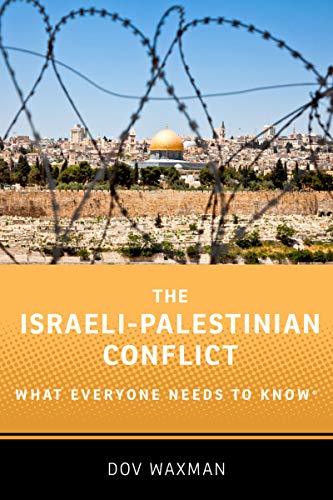
The Israeli-Palestinian Conflict: What Everyone Needs to Know by Dov Waxman (nonfiction), which I’m still reading.
Dov Waxman is the Rosalinde and Arthur Gilbert Foundation Chair of Israel Studies at the University of California Los Angeles (UCLA) and the director of the UCLA Y&S Nazarian Center for Israel Studies. His research focuses on the conflict over Israel-Palestine, Israeli politics and foreign policy, U.S.-Israel relations, American Jewry’s relationship with Israel, Jewish politics, and contemporary antisemitism. He frequently gives media interviews and public talks on these topics. (Taken from his website).
This book is more readable than Black’s and is written as a series of questions and answers covering the conflict from its nineteenth-century origins up to the present day (2019). It explains the key events, examines the core issues, and presents the competing claims and narratives of both sides. In the Preface Waxman states he has tried
to present the different perspectives and narratives of Israelis and Palestinians and avoid ‘playing the blame game’. … Neither side is wholly innocent or completely guilty, and both have legitimate rights and needs.
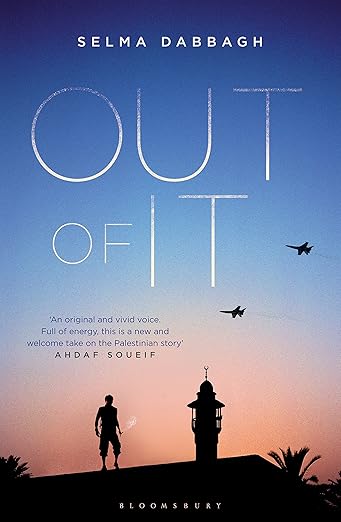
Out of It: a novel about Israel, Palestine and Family by Selma Dabbagh, fiction.
Selma Dabbagh is a British-Palestinian writer and lawyer. Her 2011 debut novel, Out of It was nominated for a Guardian Book of the Year award in 2011 and 2012 and is one of The Guardian’s list of five best books to explain the Israel-Palestine conflict.
I haven’t read this. I saw it reviewed in The Guardian. It’s set in Gaza City during the Second Intifada in the 2000s. It’s about the Mujahed family, chronicling their hopes and dreams as well as their suffering.
Blurb from Amazon:
Gaza is being bombed. Rashid – an unemployed twenty-seven year
old who has stayed up smoking grass watching it happen – wakes to hear that he’s got the escape route he’s been waiting for: a scholarship to London. His twin sister, Iman – frustrated by the atrocities and inaction around her – has also been up all night, in a meeting that offers her nothing but more disappointment. Grabbing recklessly at an opportunity to make a difference, she finds herself being followed by an unknown fighter.
Meanwhile Sabri, the oldest brother of this disparate family, works on a history of Palestine from his wheelchair as their mother pickles vegetables and feuds with the neighbours.
Written with extraordinary humanity and humour, and moving between Gaza, London and the Gulf, Out of It is a tale that redefines Palestine and its people. It follows the lives of Rashid and Iman as they try to forge paths for themselves in the midst of occupation, religious fundamentalism and the divisions between Palestinian factions. It tells of family secrets, unlikely love stories and unburied tragedies as it captures the frustrations and energies of the modern Arab world.
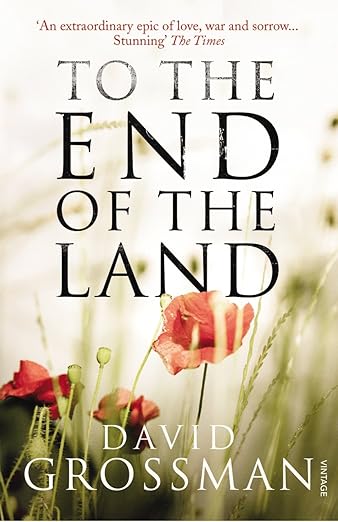
To the End of the Land by David Grossman, translated by Jessica Cohen (fiction) – another book I haven’t read.
David Grossman is one of the leading Israeli writers of his generation, and the author of numerous works of fiction, non-fiction, and children’s literature. His work has appeared in The New Yorker, and been translated into twenty-five languages around the world. He lives on the outskirts of Jerusalem.
Description from Fantastic Fiction:
Ora is about to celebrate her son Ofer’s release from Israeli army service when he voluntarily rejoins. In a fit of magical thinking, she takes off to hike in the Galilee, leaving no forwarding information for the ‘notifiers’ who might deliver the worst news a parent can hear. Recently estranged from her husband, she drags along an unlikely companion: their once best friend Avram, who was tortured as a POW during the Yom Kippur War and, in his brokenness, refused to ever know the boy or even to keep in touch with them.
Now, as they hike, Ora unfurls the story of her motherhood and initiates the lonely Avram in the drama of the human family – a telling that keeps Ofer alive for both his mother and the reader. Her story places the most hideous trials of war alongside the daily joys and anguish of raising children: never have we seen so clearly the reality and surreality of daily life in Israel, the currents of ambivalence about war within one household, the burdens that fall on each generation anew.
Grossman’s rich imagining of a family in love and crisis makes for one of the great antiwar novels of our time.
 BooksPlease