Recent Additions: Christmas Presents

I’ve always loved books and whenever anyone asked me what I’d like for my birthday or Christmas the answer was always ‘books, please’ . So l was delighted this last Christmas to receive four books!
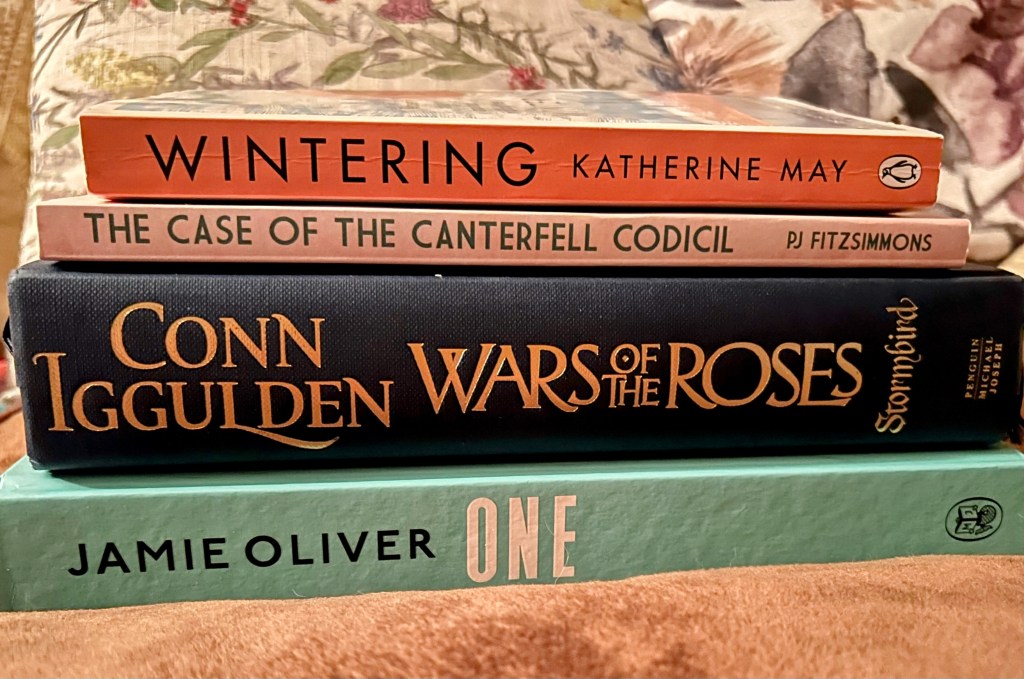
Two of them are books that were on my wish list and the other two were complete surprises.

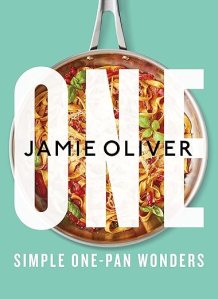
One: Simple One-Pan Wonders by Jamie Oliver (from my wish list)

I’ve got some of Jamie’s books, and this one looks like a good addition. In his introduction he writes ‘With a twinkle in my eye I want to position this book as one that is absolutely dedicated to the art of minimal washing up – you cook each recipe in just one pan or tray … it’s about making your life easier.’ I like the idea of minimal washing up and will be cooking quite a lot of these recipes.

It has over 120 recipes for tasty, fuss-free and satisfying dishes cooked in just one pan. What’s better: each recipe has just eight ingredients or fewer, meaning minimal prep (and washing up) and offering maximum convenience. With chapters including Veggie Delights, Celebrating Chicken, Frying Pan Pasta, Batch Cooking, Puds & Cakes, it all looks simply delicious.

Wars of the Roses: Stormbird Book One by Conn Iggulden (from my wish list)

Historical fiction has long been a great favourite of mine. I absolutely loved Sharon Penman’s The Sunne in Splendour that made me want to know more about the Wars of the Roses.So, when I found Iggulden had written a trilogy about the civil war I was keen to read it. I’ve read some of Iggulden’s other historical fiction novels and loved them, so I’m looking forward to reading this.

King Henry V – the great Lion of England – is long dead. In 1437, after years of regency, the pious and gentle Henry VI, the Lamb, comes of age and accedes to the English throne. His poor health and frailty of mind render him a weakling king -Henry depends on his closest men, Spymaster Derry Brewer and William de la Pole, Duke of Suffolk, to run his kingdom.

Yet there are those, such as the Plantagenet Richard, Duke of York, who believe England must be led by a strong king if she is to survive. With England’s territories in France under threat, and rumours of revolt at home, fears grow that Henry and his advisers will see the country slide into ruin. With a secret deal struck for Henry to marry a young French noblewoman, Margaret of Anjou, those fears become all too real.

As storm clouds gather over England, King Henry and his supporters find themselves besieged abroad and at home. Who, or what can save the kingdom before it is too late?

The Case of the Canterfell Codicil (Anty Boisjoly Mysteries Book 1) by PJ Fitzsimmons (not on my wish list). This was a complete surprise for me as I don’t know anything about this book, or the author. It’ll be good reading a new-to-me author and I do like locked room mysteries.

1920s gadabout Anty Boisjoly takes on his first case when his Oxford chum is facing the gallows, accused of the murder of his wealthy uncle.


Not one but two locked-room murders later, Boisjoly’s pitting his wits and witticisms against a subversive butler, a senile footman, a single-minded detective-inspector, an errant goat, and the eccentric conventions of the pastoral Sussex countryside to untangle a multi-layered mystery of secret bequests, ancient writs, love triangles, revenge, and a teasing twist in the final paragraph.


The Case of the Canterfell Codicil is a classic, cosy, locked-room mystery with an improbable plot inspired by Agatha Christie and prose in the style of an homage to PG Wodehouse.

Wintering: The power of rest and retreat in difficult times by Katherine May (a surprise, not on my wish list). It’s a memoir covering quite a wide range of topics, not just about winter, or rest and retreat. I’ve seen this book is one people either praise it or criticise it, so I’m keen to know what I think of it.

Wintering is a poignant and comforting meditation on the fallow periods of life, times when we must retreat to care for and repair ourselves. Katherine May thoughtfully shows us how to come through these times with the wisdom of knowing that, like the seasons, our winters and summers are the ebb and flow of life.

A moving personal narrative interwoven with lessons from literature, mythology and the natural world, May’s story offers instruction on the transformative power of rest and retreat. Illumination emerges from many sources: solstice celebrations and dormice hibernation, C.S. Lewis and Sylvia Plath, swimming in icy waters and sailing arctic seas.

Ultimately, Wintering invites us to change how we relate to our own fallow times. May models an active acceptance of sadness and finds nourishment in deep retreat, joy in the hushed beauty of winter, and encouragement in understanding life as cyclical, not linear. A secular mystic, May forms a guiding philosophy for transforming the hardships that arise before the ushering in of a new season.

Spell the Month in Books – November 2024

Spell the Month in Books is a linkup hosted by Jana on Reviews From the Stacks on the first Saturday of each month. The goal is to spell the current month with the first letter of book titles, excluding articles such as ‘the’ and ‘a’ as needed. That’s all there is to it! Some months there are optional theme challenges, such as “books with an orange cover” or books of a particular genre, but for the most part, any book you want to use is fair game!

The optional theme this month is Food or Autumn Decorations on the Cover. I’ve focused on books with Food on the covers and these are cookery books that in some instances I’ve been using for many years.

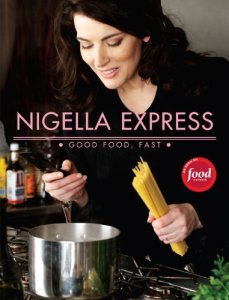
N is for Nigella Express: Good Food, Fast by Nigella Lawson. This is for everyone who loves good food, but just doesn’t have time or patience at the end of the day for a long, drawn-out cooking session. I’ve made several of the recipes in this book – for example Broccoli and Stilton Soup, using frozen broccoli. It cooks in minutes and is very tasty. There are chapters – Super Speedy Suppers, Get Up Go Breakfasts, Packed Lunches and Picnics, Instant Italian, Christmas Quickies and Store Cupboard SOS.

O is for One: Simple One-Pan Wonders by Jamie Oliver. It has over 120 recipes for tasty, fuss-free and satisfying dishes cooked in just one pan. What’s better: each recipe has just eight ingredients or fewer, meaning minimal prep (and washing up) and offering maximum convenience. With chapters including Veggie Delights, Celebrating Chicken, Frying Pan Pasta, Batch Cooking, Puds & Cakes, it all looks simply delicious.

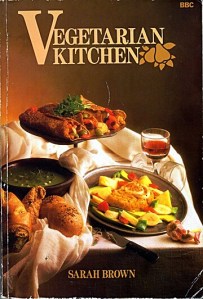
V is for Vegetarian Kitchen by Sarah Brown, a book I’ve had for years, after watching the BBC Vegetarian Kitchen series first broadcast in the late 1980s. I’ve made lots of these recipes – lasagne, casseroles, pasta dishes, flans, tarts and quiches, moussaka, vegetable dishes, and lovely cakes.

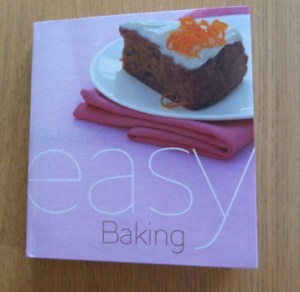
E is for Easy Baking by Marks and Spencer, 208 edition, recipes for Cakes, Slices & Bars, Cookies and Small Bakes, and Desserts. I’ve made the recipe for Sticky Toffee Cake, one of my favourite cakes. There are lots more recipes I’ll try making – including Jewel-topped Madeira Cake, which is topped with sliced glacé fruits glazed with honey, Chocolate Chip and Walnut Slices, Viennese Chocolate Fingers and Manhatton Cheesecake, which looks amazing with a digestive biscuit base and topped with a blueberry sauce.

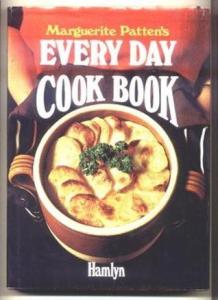
M is for Marguerite Patten’s Every Day Cook Book in colour. This was a wedding present gift in 1969. For many years it was my go-to cookery book, although I also used The Pennywise Cookbook by Lorna Walker, published by the Milk Marketing Board of England and Wales in 1974 – my mum bought it for me from her milkman. The Every Day Cook Book is much more comprehensive and has lots of recipes and colour photographs, including ‘meals for all occasions from family snacks to meals when you entertain’.

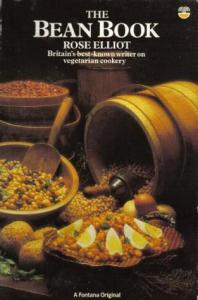
B is for The Bean Book by Rose Elliot, a paperback book. This is packed with recipes for cooking with beans and also pulses, described as ‘rich in protein, low in fat, high in fibre, an excellent source of iron, phosphorus and B vitamins‘. There are no photographs. Flicking through it now I don’t think I’ve tried many of the recipes, but the book falls open at the recipe for Haricot Bean and Vegetable Pie which I’ve ticked. I don’t remember making it. It looks time consuming, from soaking the beans, then simmering them with onions, garlic, and stock for an hour, then adding tomato puree and seasoning. Meanwhile you cook potatoes carrots and leeks. Put the leeks and carrots in the base of a casserole dish, top with the bean mixture, sprinkle with grated cheese, and top with mashed potato, sprinkle with more grated cheese, before baking for 30-40 minutes. So different from Nigella’s Express book!

Version 1.0.0

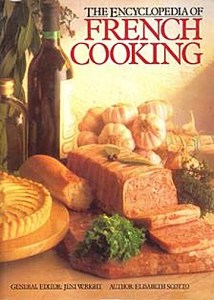
E is for The Encyclopedia of French Cooking by Elizabeth Scotto, a present from my sister. It has sections on the History of French cooking dividing it into la haute cuisine, the finest food by the great French chefs and la cuisine regionale, which is the simple cooking of the provinces or regions of France, cooked by French housewives. There are over 250 recipes, including delicious local specialities. The introduction includes information about French cheeses and other special ingredients, wine and cooking equipment. There is also a detailed glossary of French cooking terms and a map showing the different regions. After that the book is divided into the usual sections – Soups, Hors d’oeuvre & Salads, Fish and so on.

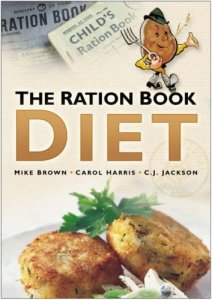
R is for The Ration Book Diet by Mike Brown, Carol Harris and C J Jackson This uses the wartime diet as a model and includes sixty recipes, some taken straight from cookery books of the time, with only minor adjustments, but most are new dishes created using the ingredients that were available during the war. Some of the recipes are taken straight from cookery books of the time, with some minor adjustments, but most are new recipes created using the range of ingredients available during the war. And there is also a chapter on Rationing, which was still in operation when I was a small child, although I didn’t know that at the time. It continued until 1954. This is a very interesting book. Throughout the book there are many illustrations and photographs from the war years. One good thing to come out of the war was that at the end of the war in 1945 as a nation we were healthier than we had ever been before or have been since.

The next link up will be on December 7, 2024 when the theme will be: Christmas or Nonfiction.