Stacking the Shelves: 26 August 2025

Stacking the Shelves is hosted by Marlene at Reading Reality and the details are on her blog, as well as a huge amount of book reviews. Why not visit her blog if you haven’t already found it? The gorgeous graphic is also used courtesy of the site.

The idea is to share the books you are adding to your shelves, may they be physical or virtual. This means you can include books you buy in physical stores or online, books you borrow from friends or the library, review books, gifts and of course e-books!

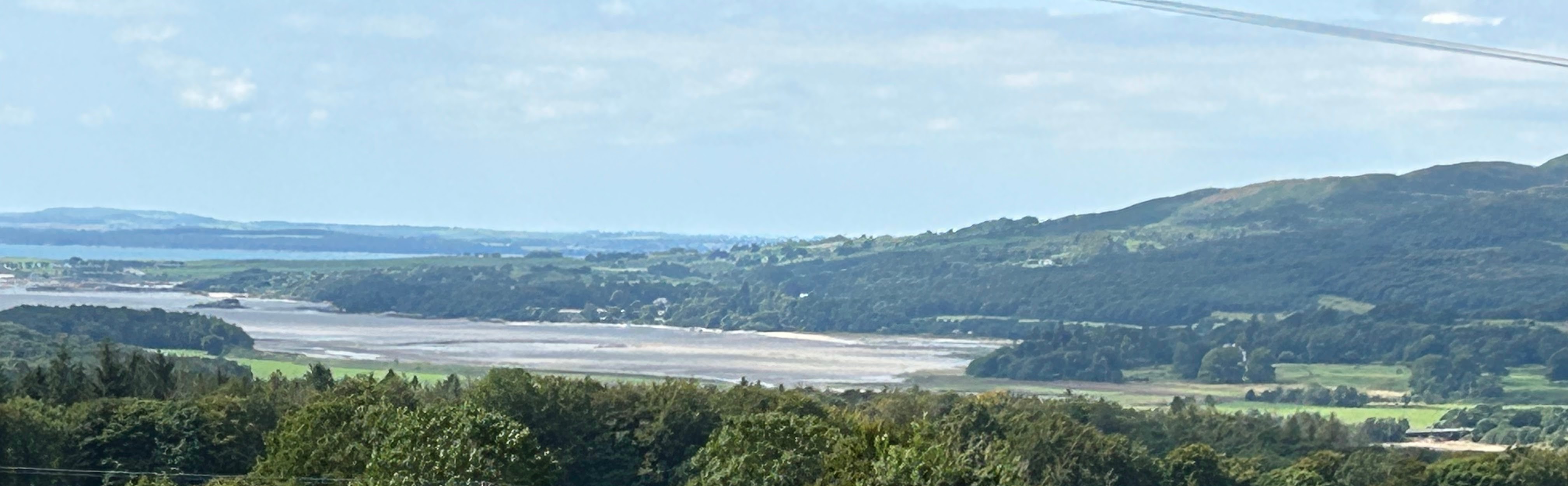
I’ve been away on holiday near Gatehouse of Fleet in Dumfries and Galloway, Scotland. We had a brilliant time in a lodge overlooking Fleet Bay, part of the Solway Firth.
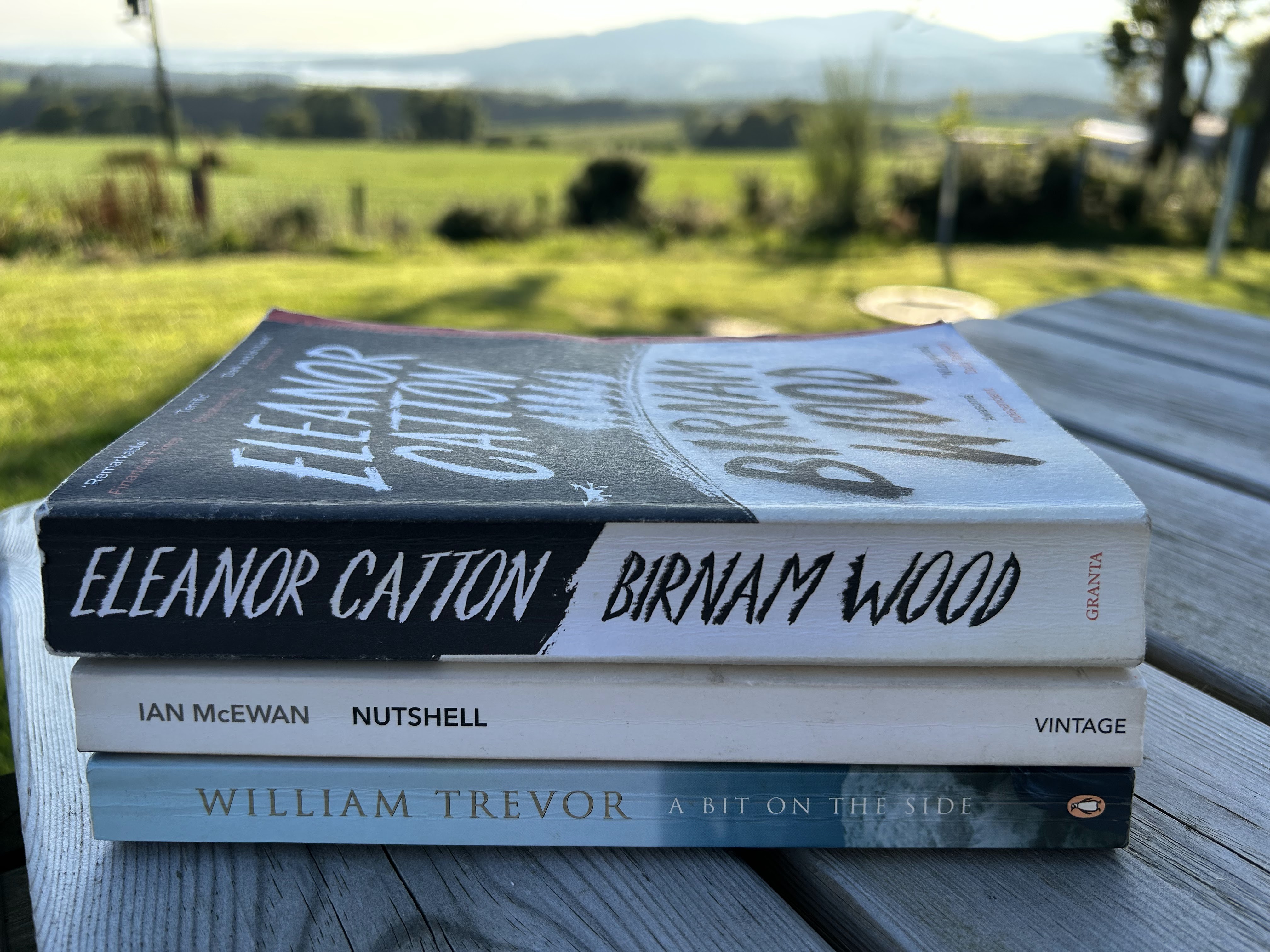
I bought these three paperbacks from a charity shop in Gatehouse of Fleet:

Birnam Wood by Eleanor Catton – Like her previous novel The Luminaries, which I loved, this book is set in a fictionalised New Zealand, primarily in and around a national park in the South Canterbury region. The title is taken from a line in Macbeth. It follows members of a guerilla gardening collective, Birnam Wood as, with the help of a charismatic tech billionaire, they undertake a new project on abandoned farmland.

Nutshell by Ian McEwan, a version of Hamlet. Trudy has betrayed her husband, John. She’s still in the marital home – a dilapidated, priceless London townhouse – but not with John. Instead, she’s with his brother, the profoundly banal Claude, and the two of them have a plan. But there is a witness to their plot: the inquisitive, nine-month-old resident of Trudy’s womb. I’ve enjoyed some of McEwan’s books, but this one looks rather different and, having read a few pages, I’m not sure about it.

A Bit on the Side by William Trevor, a collection of twelve short stories. I don’t think I’ve read any of Trevor’s books, but I thought this one looks interesting, with stories about adultery, secret passions and domestic infidelities. ‘A treat … each meditate[s] on the subject of love – adulterous, unspoken, clandestine, sometimes cruel. Whether set in rural Ireland or London, their pages whisper of relished secrets and dreams foolishly clung to’ Mail on Sunday.

These are e-books I’ve either bought for 99p or acquired for free this month:

The Testaments – Margaret Atwood’s sequel picks up the story more than fifteen years after Offred stepped into the unknown, with the explosive testaments of three female narrators from Gilead. The Republic of Gilead is beginning to rot from within. At this crucial moment, two girls with radically different experiences of the regime come face to face with the legendary, ruthless Aunt Lydia. But how far will each go for what she believes?

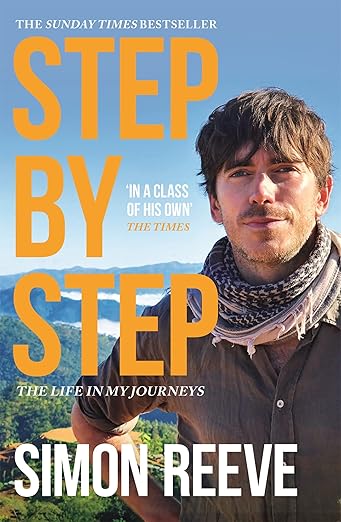
Step by Step: The Life In My Journeys by Simon Reeve. I love his TV travel programmes, so this was a 99p must for me. It’s his autobiography describing how he has journeyed across epic landscapes, dodged bullets on frontlines, walked through minefields and been detained for spying by the KGB. His travels have taken him across jungles, deserts, mountains and oceans, and to some of the most beautiful, dangerous and remote regions of the world. He gives the full story behind some of his favourite expeditions, and traces his own inspiring personal journey back to leaving school without qualifications, teetering on a bridge, and then overcoming his challenges by climbing to a ‘Lost Valley’ and changing his life … step by step.

The First Witch of Boston by Andrea Catalano, her debut novel. This was free from Amazon Prime this month. It is based on the true story of Margaret Jones, the first woman to be found guilty of witchcraft in Massachusetts Bay Colony, 1646. When Thomas and Margaret Jones arrive from England to build a life in the New World Margaret’s skill with healing herbs rouses suspicion of black magic. Personal tragedies, religious hysteria, and wariness of the unknown turn most against her, and even the devotion Margaret and her husband share is at risk.

I enjoy historical fiction and Mist Over Pendle by Robert Neill, (American title, The Elegant Witch) is one of my favourite novels. It tells the tale of witchcraft set in a wild inaccessible corner of Lancashire leading up to the trials of the famous Pendle witches in 1612. So, I thought it would be interesting to compare the two books.

Black Dogs by Ian McEwan

Black Dogs 001Black Dogs is one of Ian McEwan’s earlier books (his fifth), first published in 1992. The narrator is Jeremy who lost his parents in a road accident when he was eight and from then on he is fascinated by other people’s parents, particularly his in-laws, Bernard and June Tremaine. When he first met them they were living apart, barely on speaking terms. Starting from a shared belief in communism, they had separated when June turned to God after an encounter with evil in the form of two black dogs. What actually happened doesn’t become clear until the end of the book.

Jeremy is writing a memoir about their lives. The book shifts in time and perspective as he talks to Bernard and June separately. So it moves from Wiltshire, where he visits June in 1987 where she is living in a nursing home, to Berlin with Bernard, when the Wall came down in 1989. Then it moves back in time to 1981 at Majdanek where Jeremy met Jenny, Bernard and June’s daughter, during a visit to the death camp near Lublin in Poland; then to the present day (1989) at the family house at St Maurice de Navacelles in Languedoc in southern France; and finally to 1946 with Bernard and June, newly married on their honeymoon in St Maurice de Navacelles, where June had her encounter with the black dogs.

In 174 short pages the characters come alive, their ideas and meditations are revealed, and the places they inhabit are easily visualised. Black Dogs is a book that gets inside its characters’ minds. It centres around love, loss and longing. The incidents Jeremy describes are open to interpretation – June and Bernard are the extremities, neither seeming to be on the same wave length; Bernard a rationalist and a scientist, June a mystic and believer, seeing the same events through different perspectives. Jeremy is impatient with the difficulty of communication, seeing

an image of parallel mirrors in place of lovers on a bed, throwing back in infinite regression likenesses paling into untruth. (page 90)

The question of the black dogs hangs over the narrative – were they symbolic of evil, or an expression of Churchill’s term for depression, or real creatures? Their impact was immense however you look at it. Black Dogs is a book I really enjoyed reading and thinking about after I finished it. 

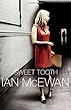
Sweet Tooth by Ian McEwan: my view

I finished reading Sweet Tooth feeling disappointed. To my mind it falls well short of Atonement, but is better than Solar.

It began so well and Ian McEwan’s writing is smooth, eloquent and richly descriptive. I couldn’t fail to visualize the scenes and for the most part the characters were distinct and believable, but I really couldn’t warm to any of them – purely a personal reaction, and one that shouldn’t detract from the novel.

Set mainly in the 1970s, it’s written in the first person as Selena Frome, looks back from forty years later. The first paragraph reveals that she was sent on a secret mission by the British Security Services; the mission failed, she was sacked and her lover was ruined. From then on the novel expands on this plot. But this is not primarily a spy story, nor even a love story, although there is a lot about that and about the politics of the 70s (which dragged a bit), it’s about deception, about writers and writing and readers and reading, with multiple stories within stories. I should have enjoyed that, but it all fell a bit flat and contrived. And I really disliked the ‘unexpected twist in the tale’ at the end.

KevinfromCanada has written a more detailed analysis of Sweet Tooth, which expresses just what I felt about it. And for more positive reviews there are those in The Observer and The Telegraph, and for a slightly more reserved look at the book there is this article in The Independent.

  • Hardcover: 336 pages
  • Publisher: Jonathan Cape (21 Aug 2012)
  • ISBN-10: 0224097377
  • ISBN-13: 978-0224097376
  • Source: my own copy
  • My Rating: 3/5 (because I liked the writing)

Book Beginnings …

I’m currently reading  Ian McEwan’s latest book, Sweet Tooth. At the moment I’m still quite near the beginning of the book.

It didn’t take me long to decide that I wanted to read Sweet Tooth. I like Ian McEwan’s books, although I wasn’t that keen on his previous book, Solar, but this one looked good when I picked it up from one of the display tables in a local bookshop. Set in 1972, it’s about Serena Frome, the daughter of an Anglican bishop, who is a compulsive reader of novels. She works for MI5 in a very junior position, until she is assigned to a ‘special mission’ called ‘Sweet Tooth’, which brings her into the literary world of a promising young writer.

I’m hoping it’s going to be as good as Atonement, one of my favourite books.  Like Atonement, Sweet Tooth is both a love story and a book about writing.

It begins:

My name is Serena Frome (rhymes with plume) and almost forty years ago I was sent on a secret mission for the British security service. I didn’t return safely. Within eighteen months of joining I was sacked, having disgraced myself and ruined my lover, though he certainly had a hand in his own undoing. (page 1)

For more Book Beginnings on Friday see Gilion’s blog Rose City Reader.

Book Notes

These are notes on a couple of books I’ve read recently. They didn’t send me rushing to the computer to write about them, but they were good enough to finish.

I wrote a bit about Solar by Ian McEwan in a Teaser Tuesday post, whilst I was still reading it.

Opinion on Amazon is pretty much spread across the board, almost as many people  giving it five stars as those giving it one star. I thought it was OK, not as good as Atonement or Enduring Love both of which I loved.

It’s a story of greed, self-deception as well as climate science, global warming and photovoltaics.  The book is in three sections, 2000, 2005 and 2009 following the life of Michael Beard, a Nobel Prize winning physicist whose fifth marriage has failed.  His previous marriages had all ended due to his womanising,  but this time it’s his wife who has an affair and he can’t stand it. Beard is an unlikeable character, bemoaning his weight, overeating and drinking to excess, lecturing and lechering, stealing his colleagues research and setting up his wife’s lover for murder:

He was self-sufficient, self-absorbed, his mind a cluster of appetites and dreamy thoughts. Like many clever men who prize objectivity, he was a solipsist at heart , and in his heart was a nugget of ice … (page 169)

There are some interesting and some not so interesting parts to this book, some of it great and some not so great. It seemed as though it was really three episodes rather than one story.

The Turning of the Tide by Reginald Hill was originally published under the pseudonym of Patrick Ruell in 1971 as The Castle of the Demon. It’s described on the book jacket as an ‘intricately plotted thriller’. Emily has left her husband, the enigmatic Sterne Follett and is staying in Skinburness, a coastal town on the Solway Firth. At first the reasons for her doing this are not revealed. A sequence of sinister events unfolds, a body is found and Emily realises that her husband is involved – just how or why she has yet to discover.

Emily is staying in a house facing the long spit of land called the Grune, a sandy raised shingle beach. She suspects someone has been in the house, moving her things, she sees a green face looking in the window at her, an American staying at the local hotel goes missing, there are two archaeologists digging in a patch of furze and gorse. Then she is attacked whilst walking back from the hotel. She doesn’t know who to trust.

I wasn’t totally convinced by the plot, although there is plenty of tension. There was no way I would have guessed the outcome which I thought was a bit far-fetched. The descriptions of the location, however are very good:

They walked along the shore in a silence which became almost companionable after a couple of minutes. The sun was quite low now, shooting a line of varnished brightness up the Solway, laying a golden boundary between England and Scotland. The line of the tide running down to the Irish Sea was obscured by light. Her mind played with the phrase for a moment, then let it be washed away by the gentle lap of the ebbing water which, with their own footsteps, was the only sound. It seemed to merge with the silence rather than break it, just as the buildings that were now in sight seemed to lie flat against the frieze of grass, sea and sky rather than intrude into it. (page 12)

I borrowed both books from the library.

Teaser Tuesday – Solar by Ian McEwan

Teaser Tuesdays is a weekly bookish meme, hosted by MizB of Should Be ReadingShare a couple or more sentences from the book you’re currently reading.

I started to read Solar by Ian McEwan on Saturday. I’ve borrowed it from the library and on Saturday I discovered I couldn’t renew it because someone had reserved it. It’s due back tomorrow and I really wanted to read it.  So I stopped reading Gone to Earth and Agatha Christie’s Autobiography (my current books) to concentrate solely on Solar.

I think it’s a strange juxtaposition of the story of a scientist, Michael Beard, a Nobel Prize winning physicist whose fifth marriage has failed, set against a scientific background. I love it when McEwan writes sentences such as this on page 8:

Then her absence hung in the summer dusk like garden bonfire smoke, an erotic charge of invisible particulates that caused him to remain in position for many pointless minutes. He was not actually mad, he kept telling himself, but he thought he was getting a taste, a bitter sip.

And I also am full of admiration for his detailed description of Beard sitting opposite a stranger in a train, both eating salt and vinegar crisps from the same packet:

Inevitably the second crisp was less piquant, less surprising, less penetrating than the first and it was precisely this shortfall, this sensual disappointment, that prompted the need, familiar to drug addicts, to increase the dose. He would eat two crisps at once. (page 123)

But he loses me somewhat with sentences like this:

Without the ‘entexting’ tools the scientists used – the single-photon luminometer, the flow cytometer, immunofluorescence, and so on – the gene could not be said to exist. (page 131)

As I haven’t finished this book yet it’s too soon to decide what I think of it, but so far I’m liking it, despite those words I have only a vague idea about their meanings. Parts of it actually made me laugh out loud, at the morbid humour, but I wonder if it could have done without the science and stood just as well as a story about an ageing, womanising, narcissistic, overweight and food-obsessed man.