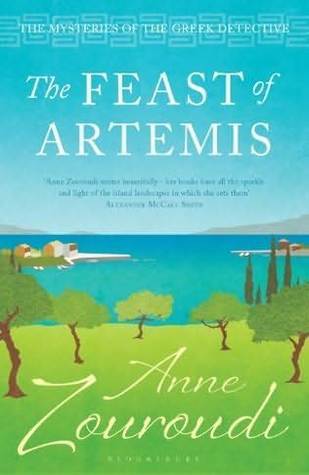
Bloomsbury| 2014| 288 pages| paperback| library book| 4 stars
Description
The olive harvest is drawing to a close in the town of Dendra, and when Hermes Diaktoros arrives for the celebratory festival he expects an indulgent day of food and wine. But as young men leap a blazing bonfire in feats of daring, one of them is badly burned. Did he fall, or was he pushed? Then, as Hermes learns of a deep-running feud between two families, one of their patriarchs dies. Determined to find out why, Hermes follows a bitter trail through the olive groves to reveal a motive for murder, and uncovers a dark deed brought to light by the sin of gluttony.
This is the seventh in Anne Zouroudi’s unique series of award-winning books featuring the enigmatic and courteous investigator Hermes Diaktoros, a man as much a mystery as the cases he solves. Who dispatches him to where he’s needed? And on whose authority does he act?
Hermes’s uncertain origins bring an additional level of bafflement to these much-loved stories. Perfect for fans of well-written crime thrillers and armchair travellers alike, they combine compelling suspense with touching portraits of Greek life far away from the tourist hotspots most visitors to Greece know.
‘Firmly in the delicious subgenre of crime-cum-gastroporn pioneered by Andrea Camilleri . . . Essentially gloriously sunny escapism, the perfect holiday read’ – Daily Telegraph
This book is the 7th in Anne Zouroudi’s series about Hermes Diaktoros of Athens, the Greek Detective. Each of the books in the series features one of the Seven Deadly Sins – in this one it is the sin of gluttony. It is set in the town of Dendra, where two families of olive growers, the Papayiannis and the Kapsis, are continuing a long standing feud. It begins on the day the town is celebrating the annual feast day, a festival that replaced an ancient feast in honour of the goddess Artemis. But the feast ends in disaster, when a young boy, Dmitris Kapsis is badly burned jumping a bonfire, either through being pushed or by slipping. The Kapsis family immediately blame the Papayiannis.
Hermes is a detective with a difference. Just who he is and who he works for is never explained. He’s most definitely not a policeman and when asked he says he works for the ‘highest Authorities, whose interests lie in justice where there’s been none. I act on their behalf, in the capacity of what you might call an investigator’ (page 161) . He’s described as ‘the fat man‘:
His owlish glasses gave him an air of academia; under his raincoat, his bark-brown suit was subtly sheened, and expertly tailored to flatter his generous stomach. His pale green polo shirt had a crocodile on the chest, and on his feet he wore white shoes, old fashioned canvas shoes of the type once used for tennis; in his hand was a sportsman’s hold-all in black leather, painted in gold with the emblem of the rising sun. (page 14)
Hermes stays in Dendra, investigating what had happened, together with the death of the head of the Papayiannis family, and the deaths of several townspeople from poisoning, allegedly after eating ice cream from the local gelateria. There are many characters to keep in mind, but this is made easier, by the Dramatis Personae at the beginning of the book. And with so much to investigate there are many twists and turns, but Hermes manages to get to the bottom of all the mysteries and along the way we meet his half-brother Dino, an unkempt and dissolute character, with wine-stained teeth and the smell of alcohol seeping through his pores and the flaking skin on his dry lips black from the wine – an interesting version of the god Dionysus.
I did enjoy reading The Feast of Artemis, following Hermes both as he investigates, enjoys all the Greek foods, learns about the impact of technology on the traditional methods of olive oil production, and interacts with the local people. I loved the descriptions of the Greek town and the surrounding countryside. All in all, a most enjoyable book.
 BooksPlease