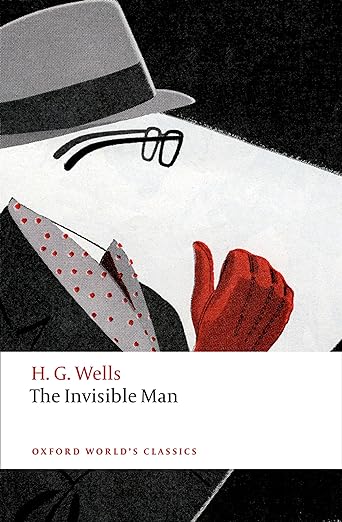
The Invisible Man by H G Wells

The Invisible Man is my Classics Club spin book The rules of the Spin are that this was the book for me to read by 3rd March 2024 and I did. In fact I finished it about two weeks early and only got round to writing about it a few days ago. The Invisible Man was first published in 1897, a science fiction novel, originating in Pearson’s Weekly. But it was not quite what I expected. And I certainly didn’t expect it to turn into slapstick comedy.

Synopsis from Amazon

‘The man’s become inhuman … He has cut himself off from his kind. His blood be upon his own head.’

One night in the depths of winter, a bizarre and sinister stranger wrapped in bandages and eccentric clothing arrives in a remote English village. His peculiar, secretive activities in the room he rents spook the locals. Speculation about his identity becomes horror and disbelief when the villagers discover that, beneath his disguise, he is invisible.

Griffin, as the man is called, is an embittered scientist who is determined to exploit his extraordinary gifts, developed in the course of brutal self-experimentation, in order to conduct a Reign of Terror on the sleepy inhabitants of England. As the police close in on him, he becomes ever more desperate and violent.

In this pioneering novella, subtitled ‘A Grotesque Romance’, Wells combines comedy, both farcical and satirical, and tragedy – to superbly unsettling effect. Since its publication in 1897, The Invisible Man has haunted not only popular culture (in particular cinema) but also the greatest and most experimental novels of the twentieth century.

My thoughts

Griffin, a scientist, is a stranger to the village of Iping in West Sussex, staying at the Coach and Horses Inn. His story is a sad one. Whilst experimenting he has managed to make himself invisible, and dresses from top to toe in clothes, which even in winter makes him stand out from the crowd. Everything he does leads everyone to wonder what is wrong with him and draws attention to himself. What follows grows in intensity, as Griffin causes first confusion, then panic and finally madness. There’s a lot of shouting, pushing and fighting and surprisingly (to me at any rate) quite a lot of comedy – after all the invisible man is as naked as a new born baby.

I enjoyed it. There’s not much to the plot, it’s mainly a character study really, but what an amazing personality. And being invisible is not what he had thought – having to walk around with no shoes or socks on, especially in winter is not funny, neither is the sight of undigested food floating around mid-air. But it is worse than that because Griffin is only at the start of his escapade. By the end he is stark staring bonkers. Wells demonstrates the dangers of using science beyond control. Griffin has succeeded in lowering the refractive index of his body to make it invisible – ‘Either a body absorbs light or reflects it, or refracts it, or does all these things. If it neither refracts nor absorbs light, it cannot of itself be visible.’

Sadly, the end is all violence and drama!
The Classics Club Spin Result

The spin number in The Classics Club Spin is number …

20

which for me is The Invisible Man by H G Wells. The rules of the Spin are that this is the book for me to read by 3rd March 2024

Synopsis from Amazon

‘The man’s become inhuman … He has cut himself off from his kind. His blood be upon his own head.’

One night in the depths of winter, a bizarre and sinister stranger wrapped in bandages and eccentric clothing arrives in a remote English village. His peculiar, secretive activities in the room he rents spook the locals. Speculation about his identity becomes horror and disbelief when the villagers discover that, beneath his disguise, he is invisible.

Griffin, as the man is called, is an embittered scientist who is determined to exploit his extraordinary gifts, developed in the course of brutal self-experimentation, in order to conduct a Reign of Terror on the sleepy inhabitants of England. As the police close in on him, he becomes ever more desperate and violent.

In this pioneering novella, subtitled ‘A Grotesque Romance’, Wells combines comedy, both farcical and satirical, and tragedy – to superbly unsettling effect. Since its publication in 1897, The Invisible Man has haunted not only popular culture (in particular cinema) but also the greatest and most experimental novels of the twentieth century.

I was hoping I’d get one of the shorter books on my list – this one is just that at 192 pages. I’m looking forward to reading it.

Did you take part in the Classics Spin? What will you be reading?

The Time Machine by H G Wells

This morning the clocks went forward – does that mean we lost an hour? Quite by coincidence yesterday I read The Time Machine – it seems apt!

The Time Traveller has gathered together a group of his friends, who have names such as the Psychologist, the Editor, the Provincial Mayor and so on. First of all he treats them to an explanation of time – of how it is the fourth dimension, ‘with Time as only a kind of Space.’ He then tells them that he intends to explore time in a machine he has invented that transports him back and forth in time.

And to prove it he travels to the future – specifically to the year 802,701 where humanity has evolved into the Eloi, who are pretty little childlike people, strict vegetarians who live above ground and the Morlocks, bleached, obscene nocturnal beings who live underground. Their society is divided between these two – industry being carried out underground by the Morlocks and the Eloi above pursing pleasure and comfort.

On his return he describes his adventures. He was:

 … in an amazing plight. His coat was dusty and dirty and smeared with green down the sleeves; his hair disordered, and as it seemed to me greyer – either with dust or dirt of because its colour had actually faded. His face was ghastly pale; his chin had a brown cut on it – a cut half-healed; his expression was haggard and drawn, as if by intense suffering. … He walked with just such a limp as I have seen in footsore tramps. (page 15)

Whilst describing what happened to him the Time Traveller comments on the society he encountered. At first he thought it was a social paradise, but soon he realised the truth, that the perfection of comfort and security had actually resulted in the weakening of society with no need to struggle for survival or for work. And the truth about the relationship between the Eloi and Morlocks was devastating!

In addition he had soon realised that he had gone into the future particularly ill-equipped – without anything to protect himself, without medicine and without anything to smoke, or even without enough matches! And no camera:

If only I had thought of a Kodak! I could have flashed that glimpse of the Under-world in a second, and examined it at leisure. But, as it was, I stood there with only the weapons and the powers that Nature had endowed me with – hand, feet, and teeth; these, and the four safety matches that still remained to me. (page 69)

I was struck by Wells’s descriptions of the divisions in society between the Haves and the Have-nots and the conditions of the working class as a result of industrialisation in his own time, citing the new electric railways, the Metropolitan Railway in London, the subways and underground workrooms and restaurants:

Even now, does not an East-end worker live in such artificial conditions as practically to be cut off from the natural surface of the earth?

Again, the exclusive tendency of richer people – due, no doubt, to the increasing refinement of their education, and the widening gulf between them and the rude violence of the poor – is leading to the closing, in their interest, of considerable portions of the surface of the land. About London, for instance, perhaps half of the prettier country is shut in against intrusion. (page 62)

So, The Time Machine, which was first published in 1895, is a work of imagination and an early example of science fiction, but it is also a commentary on late 19th century society and a vehicle for H G Well’s views on socialism and industrialisation.

It’s a book I’ve had for a couple of years and so qualifies for the Mount TBR Reading Challenge and after I finished it I realised that it also fits in the ‘Time’ category for the What’s In a Name? Challenge too.

Classics Challenge – September Prompt: Music

Classic Challenge 2012This year I am taking part in a Classics Challenge hosted by Katherine of November’s Autumn. The goal is to read at least seven classics in 2012 and every month Katherine is posting a prompt to help us discuss the books we are reading.

This month’s prompt is to select a piece of…

Music

…that you feel reflects the book. Modern, classical, jazz, anything, it doesn’t have to be from the period of the novel but share what it is about the piece that echoes the novel in someway.

I don’t listen to music when I’m reading because I just don’t hear it when I’m lost in the words and the story. But some books automatically bring music into my head as the book I’m reading this month does. It’s the classic science fiction – The War of the Worlds by H G Wells and the music is Jeff Wayne’s Musical Version of The War of the Worlds, an album that we bought in 1978 – wonderful music and words bringing the book to life. It’s narrated by Richard Burton with songs by David Essex, Julie Covington and Justin Hayward.

The opening words and music are always thrilling, heralding the coming of the Martians to Earth:

No one would have believed, in the last years of the nineteenth century, that human affairs were being watched keenly and closely by intelligences greater than man’s and yet as mortal as his own; that as men busied themselves about their affairs they were scrutinized and studied, perhaps almost as narrowly as a man with a microscope might scrutinize the transient creatures that swarm and multiply in a drop of water. With infinite complacency men went to and fro over this globe about their little affairs, serene in their assurance of their empire over matter.

The clip below is ‘Thunder Child’, the warship that destroys two Martian tripods before being sunk.

http://www.youtube.com/watch?v=QkjKQmjLLxY&feature=share&list=AL94UKMTqg-9CyGC_QpyDc6hiLdoTOuHJ3

Whilst I was looking for the clip to include in my post I discovered that there is a new version of Jeff Wayne’s classic album – Jeff Wayne’s Musical Version of The War of the Worlds, the New Generation, to be released on 12 November, which features Liam Neeson, Gary Barlow, Joss Stone and Ricky Wilson.