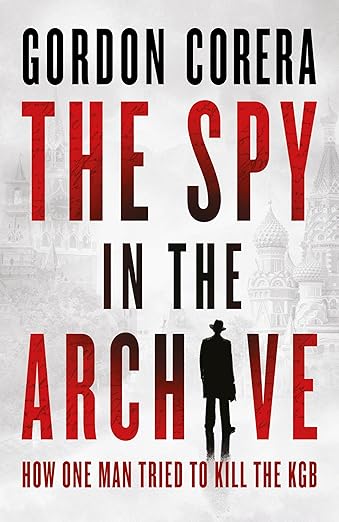
William Collins| 5 Jun 2025| 298 pages| e-book| Review copy| 4*
Description:
The Spy in the Archive tells the remarkable story of how Vasili Mitrokhin – an introverted archivist who loved nothing more than dusty files – ended up changing the world. As the in-house archivist for the KGB, the secrets he was exposed to inside its walls turned him first into a dissident and then a spy, a traitor to his country but a man determined to expose the truth about the dark forces that had subverted Russia, forces still at work in the country today.
Bestselling writer and historian Gordon Corera tells of the operation to extract this prized asset from Russia for the first time. It is an edge-of-the-seat thriller, with vivid flashbacks to Mitrokhin’s earlier time as a KGB idealist prepared to do what it took to serve the Soviet Union and his growing realisation that the communist state was imprisoning its own people. It is the story of what it was like to live in the Soviet Union, to raise a family and then of one man’s journey from the heart of the Soviet state to disillusion, betrayal freand defection. At its heart is Mitrokhin’s determination to take on the most powerful institution in the world by revealing its darkest secrets. This is narrative non-fiction at its absolute best.
I was intrigued by the title of The Spy in the Archive: How One Man Tried to Kill the KGB by Gordon Corera, a former BBC correspondent. It’s about Vasili Mitrokhin, a KGB archivist who defected to Britain in 1992. Mitrokhin, a quiet, introverted and determined man, was a reluctant defector, because whilst he loved Russia he came to hate the KGB and the Soviet system.
Working in the archives gave him access to top-secret documents and he decided to copy the files on slips of paper written in his own personal code, a type of shorthand. He wasn’t searched when he left work, although his bags were, so he hid the slips of paper in his clothing and typed them up in full at home. They included details about the Soviet secret service and the ‘illegals’, deep-cover operatives who penetrated Western society. These ‘illegals’ had been used to recruit and run the Cambridge spies, including Kim Philby in MI6 as well as atomic spies in America who had stolen the secrets of the Manhattan project and the bomb, and spies in other countries. He also noted the names of hundreds of agents in the west who had collaborated with the KGB. He wanted the documents he had copied to be made public, not just to the world but to open the Russians’ eyes to the corruption, torture and terror that was prevalent.
So, in 1992 he decided to take a sample of his notes first to the US embassy in Riga and Vilnius, but he was not taken seriously, He then went to the British embassy in Vilnius, where he was believed and eventually and handed over his secret archive.
It is a remarkable book about a remarkable man. It’s an in-depth account, that took me weeks to read as it’s not a book to read quickly. It’s fascinating and informative, as I know very little about Russian history post the 1917 Revolution (and not much before that either). It includes a glimpse of a young Vladimir Putin, aged sixteen, who already walked with a swagger as he announced to a KGB official that he wanted to get a job, on his way to becoming a Chekist. I think it’s worthy of note that in 2000 he was the first President to attend the Chekist day celebrations personally. Corera wrote that ‘only a few could understand what his [Putin’s] rise really signified. Mitrokhin, in his exile, was one of those. He understood the Chekist roots from which Putin had sprung and he understood what his rise meant.’
I’d never heard of Chekism before so that was particularly interesting for me. The word derives from Lenin’s creation in 1917 of the ‘All Russian Extraordinary Committee to combat Counter-Revolution and Sabotage’, known by its initials as the Cheka. It was more than a secret police force, it was ‘a revolutionary terrorist organisation’. The Lubyanka building in Moscow was its headquarters. It was formally dissolved in 1922 (the year Mitrokhin was born). But it was renamed several times and eventually emerged as the KGB. As Corera explains ‘the Cheka never died. It simply passed from the land of the living to the land of the dead, an otherworldly beast whose outward form would change but whose dark heart kept beating. … those who served the beast would always refer to themselves as the same thing: Chekists.’ Mitrokhin became a Chekist and that was what he came to hate and want to defeat by exposing to the Russian people and the world. He made it a condition of his defection that the documents he had copied should be made public
The final section concerning his exfiltration from Russia via Lithuania and Sweden reads like fiction. It was hard to believe that it is all true, as I began to wonder whether Mitrokhin and his family would make it to London, even though I knew that he did. Sadly, despite his determination that his work would reach the Russian people, that has not proved possible. He died from pneumonia in January 2004.
Many thanks to the publishers for a review copy via NetGalley. I enjoyed this fascinating and enlightening book.
 BooksPlease