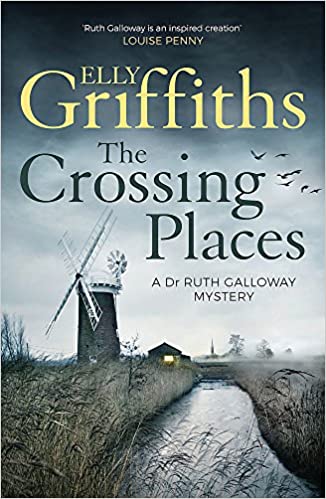
 I loved The Janus Stone by Elly Griffiths, which is just as well as I’d been looking forward to reading it after I’d enjoyed her first book The Crossing Places. Sometimes, a second book does not live up to the promise of the first, but in this case I think her second book is even better than the first. I just wish Elly Griffiths hadn’t written them in the present tense. I always have to overcome my dislike of it, until I become engrossed in the story and forget the tense.
From the Back Cover
Forensics expert Ruth Galloway is called in to investigate when builders, demolishing a large old house in Norwich, uncover the skeleton of a child – minus the skull – beneath a doorway. Is it some ritual sacrifice of just plain straightforward murder?
The house was once a children’s home. DCI Harry Nelson meets the Catholic priest who used to run it. He tells him that two children did go missing forty years before – a boy and a girl. They were never found.
When carbon dating proves that the child’s bones predate the children’s home, Ruth is drawn more deeply into the case. But as spring turns to summer it becomes clear that someone is trying very hard to put her off the scent by frightening her half to death…
My view
Once I’d become engrossed in this book I read it very quickly, eager to find out what happens next. It does follow on from The Crossing Places in that it features the main characters in that book and continues their story. Ruth is now pregnant, but she’s not sure she wants the father to know, although it’s obvious she’s pregnant and Harry has his suspicions about the identity of the father.
Two archaeological digs are in progress, one in Norwich where the body of a child is found under a doorway, which is where the book’s title comes from. Janus is the two-faced god of doors and openings and also of times of transition and change as he could backwards and forwards at the same time. The Celts and sometimes the Romans used to bury bodies under walls and doors as offerings to Janus and the god Terminus. The other is on a hillside outside Swaffham, where bones have also been found under a wall.
I like the mix of archaeology, mystery and crime fiction in Elly Griffiths’s books. This one has a double dose, with mythology and Catholicism running through the narrative as well as the police procedures. Ruth is an interesting character, not your usual detective, she’s overweight, self-reliant but also feisty and tough. She has to be with everything that’s thrown at her and as her investigations lead her into great danger. Another interesting character, also found in The Crossing Places, is Michael Malone, also known as Cathbad, a lab assistant and sometime Druid:
When he is in his full Druid outfit, complete with flowing purple cloak, Cathbad can look impressive. Now, with his greying hair drawn back in a ponytail, white coat, jeans and trainers, he looks like any other ageing hippy who has finally found a nine-to-five job. Ruth is pleased to see him though. Despite everything, she is fond of Cathbad. (page 87)
Cathbad plays an important part in the tense ending to this book as Ruth is abducted, resulting in a dramatic if slow chase through the fog-bound Norfolk rivers:
It is like voyaging into the afterlife. they have left behind the solid world and entered into a dream state, moving silently between billowing white clouds. There is nothing to anchor them to their surroundings: no landmarks, no sounds, no earth or sky. There is only this slow progress through the endless whiteness, the sound of their own breathing and the lap of the water against the sides of the boat. (page 309)
It’s the suffocating, unearthly nature, the grey nothingness and the uncertainty that makes this so frightening and tense. I have Elly Griffiths’s next book, The House at Seas End, lined up to read very soon.
 Diane at Bibliophile By the Sea hosts this weekly meme. The idea is that you post the opening paragraph (sometimes maybe a few ) of a book you decided to read based on the opening paragraph (s).
 Elly Griffiths’s website has more information.
 The House at Sea’s End
 BooksPlease